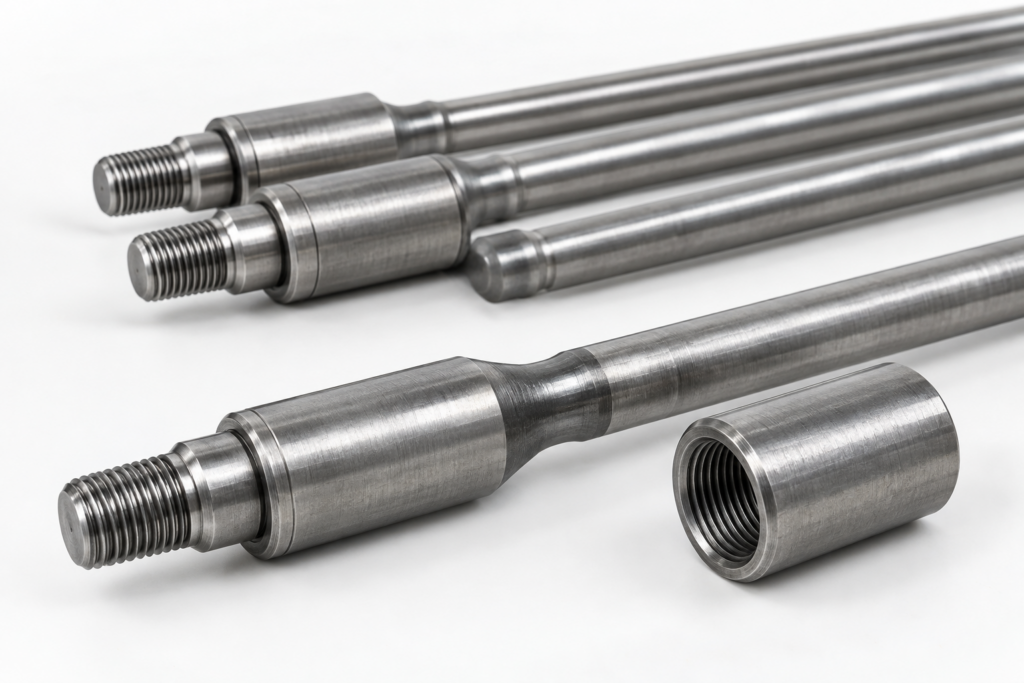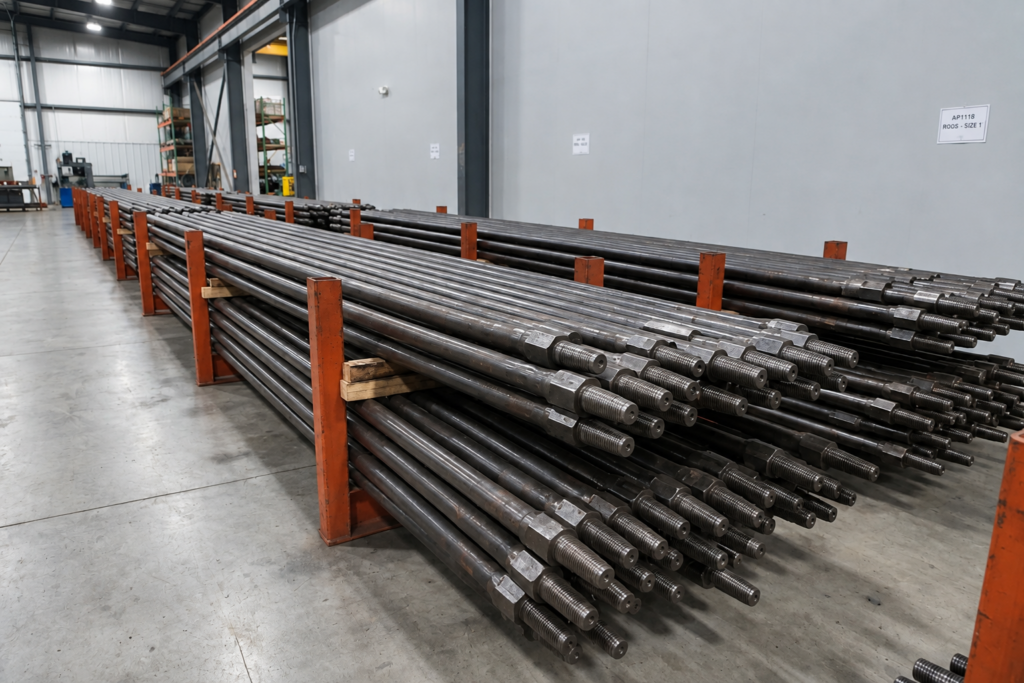
A sucker rod pumping system uses a connected series of rod components to transfer reciprocating motion from the surface pumping unit to the downhole pump. Within this system, rod selection is determined not only by diameter and material, but also by the position of each component in the load path, the type of mechanical duty it carries, and the way it interfaces with the wellhead and the rest of the rod string.
The sucker rod makes up most of the rod string and carries repeated axial load through the well, so grade, diameter, connection condition, fatigue resistance and service environment are the main selection factors. The polished rod works at the surface end of the string, where it transfers load while moving through the stuffing box. Its straightness, working-surface condition and sealing compatibility therefore require more attention than those of a conventional sucker rod. A pony rod is a shorter rod-string member used when full-length rods alone cannot provide the required assembled length; it normally needs to match the surrounding rod string in grade, body diameter and connection.
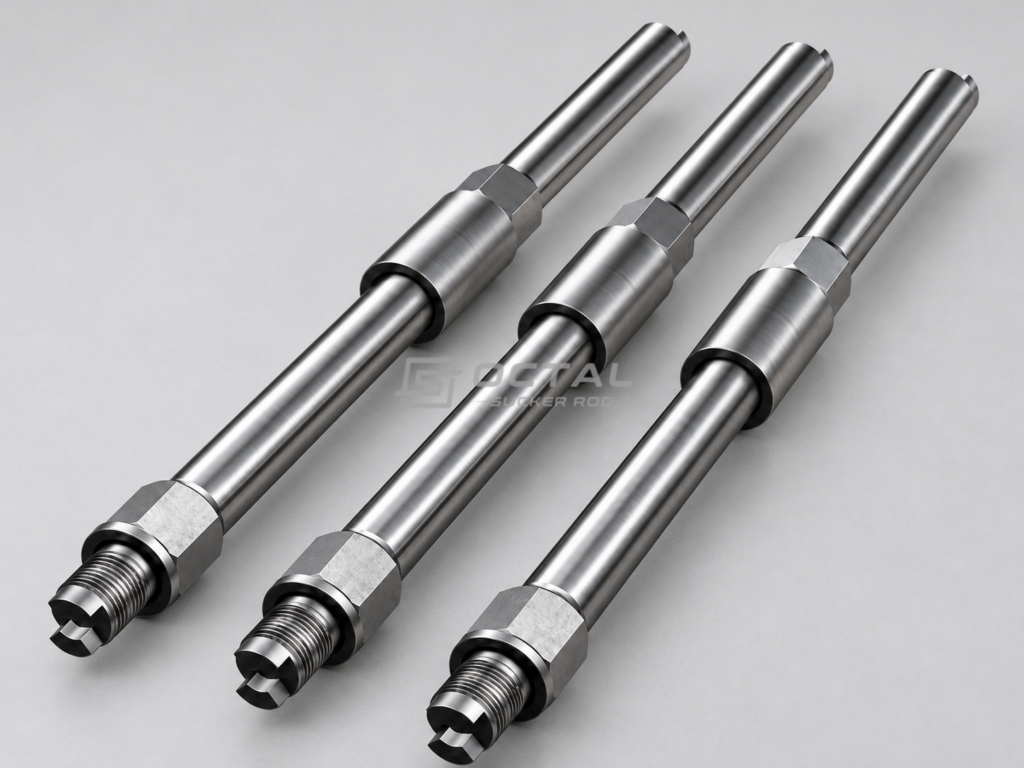
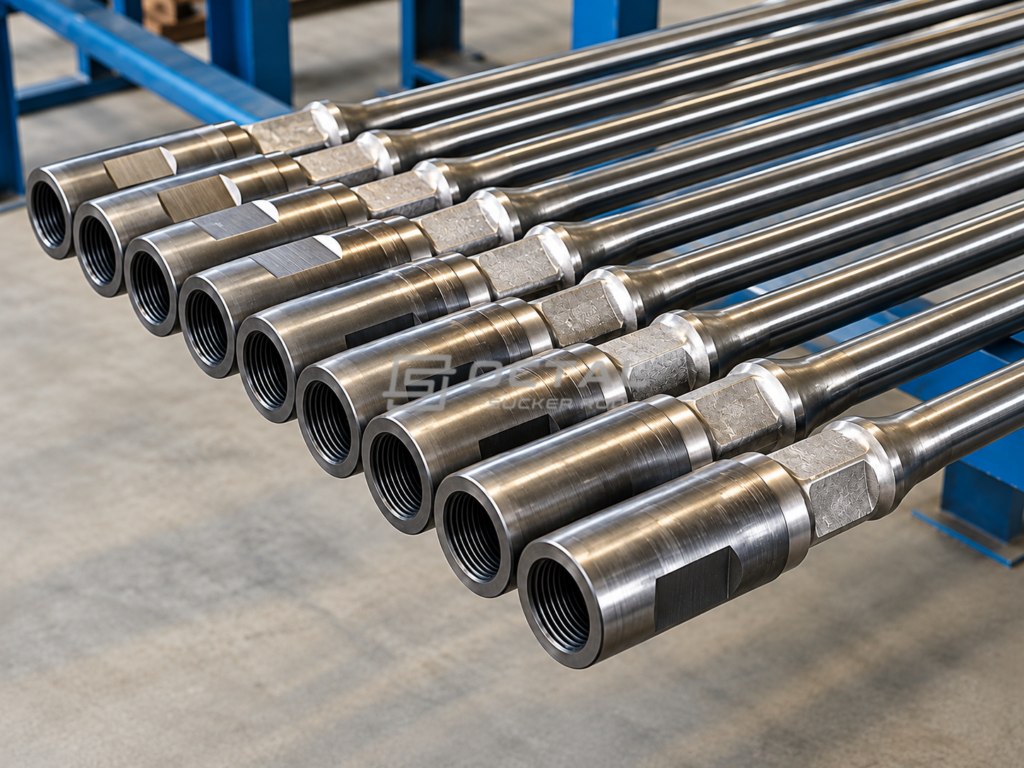
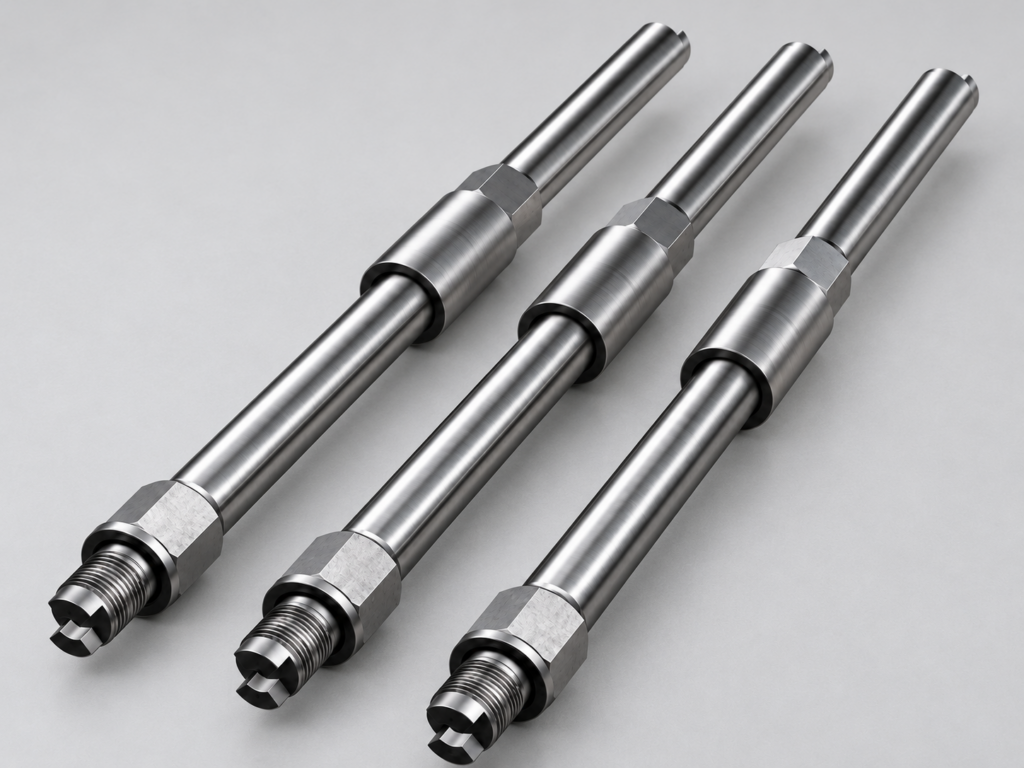
These differences mean the three rods are not selected simply as long, smooth and short versions of the same product. Sucker rods are used for the main load-transmitting string, polished rods are used where surface load transfer and wellhead sealing occur, and pony rods are used to fine-adjust rod-string length without changing the basic rod-string design. Their operating position also changes what engineers should check during selection, inspection and replacement.
How Sucker Rod, Polished Rod and Pony Rod Differ in a Rod-Lift System
Although all three components belong to the same rod-lift system, their design is controlled by different operating conditions. The sucker rod carries cyclic load through most of the well, the polished rod works at the surface where load transfer and wellhead sealing occur together, and the pony rod provides a shorter structural section when the required rod-string length cannot be achieved with standard rods alone.
The differences become clearer when the rods are compared by system position, load path, working interface, dimensions, connection requirements and failure concerns rather than by appearance alone.
| Comparison Item | Sucker Rod | Polished Rod | Pony Rod |
| Position in the system | Forms most of the rod string between the surface unit and downhole pump | Located at the upper end of the rod string and works through the stuffing box | Installed as a short section within the sucker-rod string |
| Main function | Transfers reciprocating motion and cyclic load through the well | Transfers surface-end rod-string load while providing the moving sealing surface at the wellhead | Adjusts the final rod-string length while continuing to transmit load |
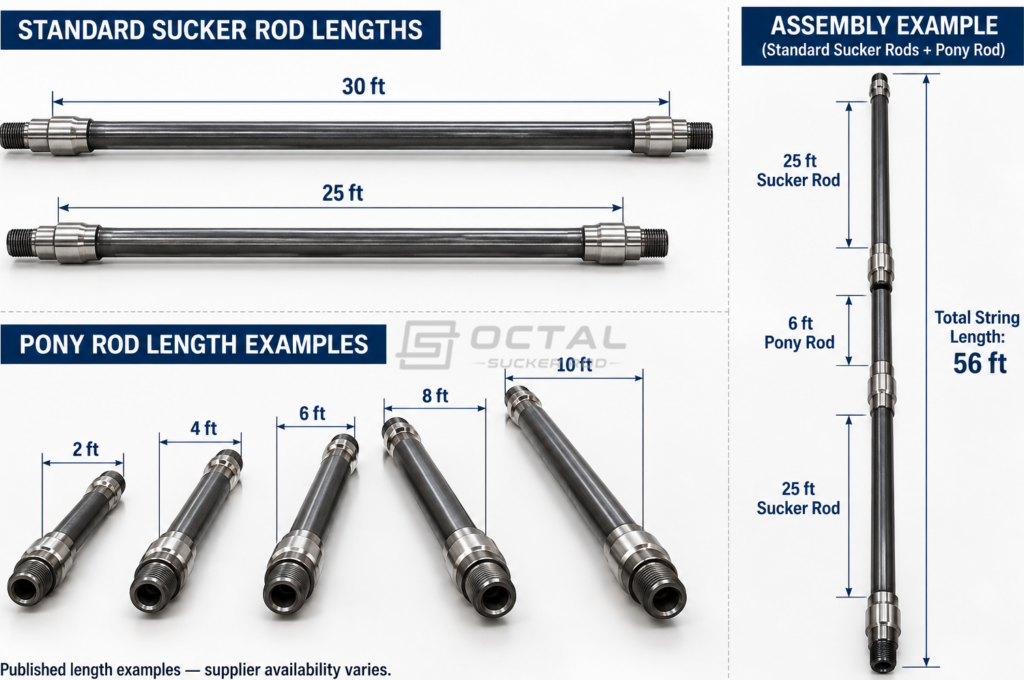
| Typical length | Commonly 25 ft or 30 ft | Depends on pumping-unit stroke, wellhead geometry and working travel | Common published lengths include 2, 4, 6, 8 and 10 ft |
| Common diameter | Steel sucker rods commonly include 5/8, 3/4, 7/8, 1, 1-1/8 and 1-1/4 in | Common oilfield polished-rod diameters include about 1-1/8, 1-1/4, 1-1/2 and 1-3/4 in, depending on system design | Usually follows the same body-diameter range as the corresponding sucker-rod family |
| Mechanical strength | Depends on grade; published steel rod ranges include minimum yield strengths from about 60 ksi (414 MPa) to 115 ksi (793 MPa) | No single universal value; strength depends on material, heat treatment and polished-rod construction | Generally follows the mechanical-property requirements of the corresponding sucker-rod grade |
| Key selection requirement | Grade, diameter, well depth, cyclic load, corrosion condition and coupling compatibility | Working OD, length, straightness, surface condition, material/coating, end connection and stuffing-box compatibility | Required make-up length, grade, body diameter and pin/coupling compatibility with surrounding rods |
| Surface / connection focus | Rod body, upset, pin threads and coupling integrity are important for fatigue and load transfer | Smooth sealing surface, straightness and correct surface connection are critical because the rod moves through stuffing-box packing | Surface requirements are similar to sucker rods; pin/thread and coupling must match the rod string |
| Typical field problem | Fatigue fracture, corrosion pitting, rod/tubing wear, pin or coupling damage | Packing leakage, surface scoring, pitting, coating damage or misalignment | Wrong make-up length, mismatched grade or incompatible thread/coupling |
| Comparison Item | Sucker Rod | Polished Rod | Pony Rod |
| Position in the system | Forms most of the rod string between the surface unit and downhole pump | Located at the upper end of the rod string and works through the stuffing box | Installed as a short section within the sucker-rod string |
| Main function | Transfers reciprocating motion and cyclic load through the well | Transfers surface-end rod-string load while providing the moving sealing surface at the wellhead | Adjusts the final rod-string length while continuing to transmit load |
| Typical length | Commonly 25 ft or 30 ft | Depends on pumping-unit stroke, wellhead geometry and working travel | Common published lengths include 2, 4, 6, 8 and 10 ft |
The Most Important Difference Is the Operating Interface
The sucker rod and pony rod are mechanically closer to each other than either is to the polished rod. Both work as structural members of the rod string and transmit reciprocating load. In many product systems, a pony rod can use the same grade family, rod-body diameter and connection design as the corresponding sucker rod. Its shorter length is what allows engineers to adjust the final string configuration.
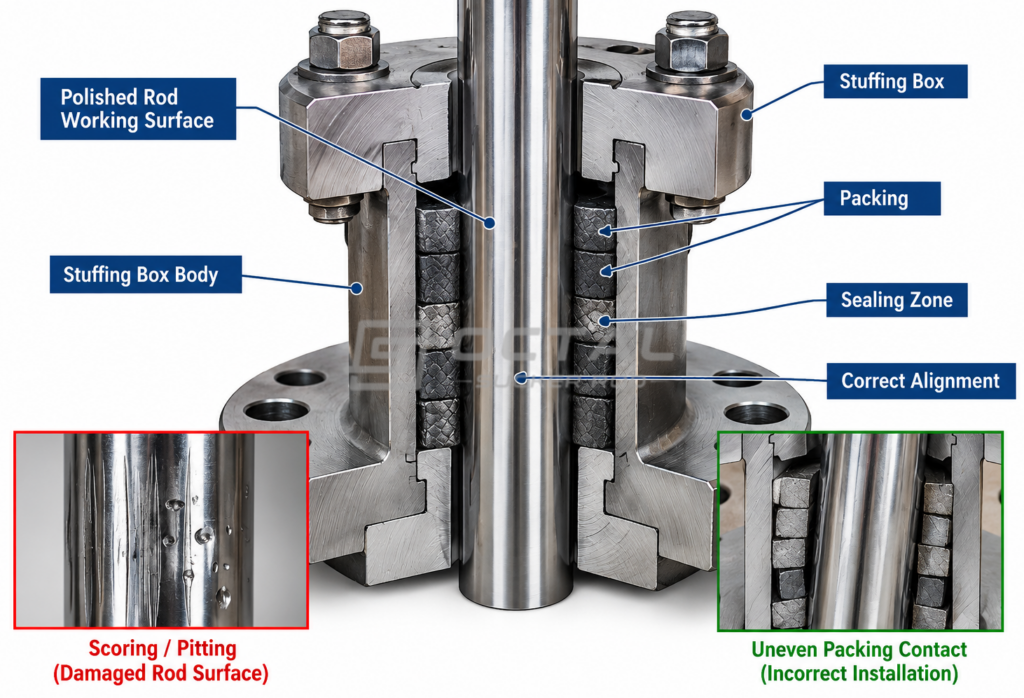
The polished rod has an additional operating interface. While carrying the rod-string load, its working section repeatedly travels through the stuffing-box packing. The rod surface therefore becomes part of the wellhead sealing system. A rod can remain mechanically strong enough to carry load but still become unsuitable as a polished rod if the sealing area develops scoring, pitting, coating damage or poor alignment.
Where Each Rod Sits in a Rod-Lift System
The difference between a sucker rod, polished rod and pony rod becomes much clearer when they are viewed as parts of one continuous load path. In a conventional rod-lift system, the surface pumping unit creates the reciprocating motion, and that motion is transmitted through the polished rod and rod string to the downhole pump.
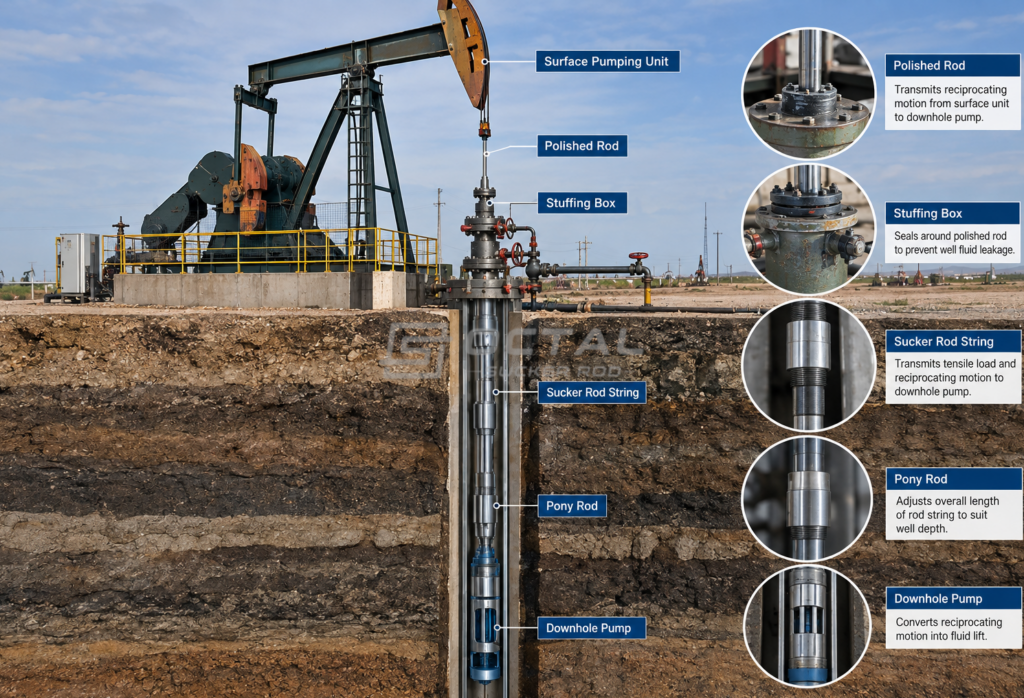
A simplified arrangement is:
Surface Pumping Unit
↓
Polished Rod Clamp / Surface Connection
↓
Polished Rod
↓
Stuffing Box
↓
Sucker Rod String
↓
Pony Rod, where required for length adjustment
↓
Downhole Rod Pump
The polished rod is the transition between the surface pumping equipment and the downhole rod string. It is connected to the pumping unit at the surface and moves vertically through the stuffing box during every stroke. This position gives it two functions at the same time: it must transfer the rod-string load, and its outside surface must also work with the stuffing-box packing to maintain the wellhead seal.
Below the polished rod, the sucker rod string carries the reciprocating motion deeper into the well. Individual sucker rods are connected together to create the required string length, and the entire string moves as one mechanical system during each pumping cycle. Rods near the upper part of the string carry the suspended weight of the rods below them together with the dynamic pumping load, while the loading condition changes progressively along the string.
A pony rod becomes part of this same load path when a shorter section is needed. It is not installed as an unloaded spacer. Once connected into the string, it moves with the surrounding sucker rods and transmits the same reciprocating motion. Its purpose is mainly to provide a shorter length increment so that the completed rod string can reach the required installed length or pump position without modifying a standard full-length rod.
This arrangement also explains why the three components are inspected differently. For the polished rod, the working surface, straightness and stuffing-box interface are especially important. For sucker rods and pony rods, more attention is placed on rod-body condition, grade, connection integrity, corrosion, fatigue exposure and compatibility with the surrounding string.
The location of each rod therefore determines more than where it is installed. It determines the type of load it carries, the interfaces it works against, the failure modes that are most likely to develop, and the information that must be checked when selecting or replacing the component.
How Sucker Rod, Polished Rod and Pony Rod Differ in a Rod-Lift System
Once their positions in the rod-lift system are clear, the main differences come from how each component carries load, what it contacts during operation, and what must be controlled during selection and replacement. The sucker rod forms the main mechanical string, the polished rod adds a moving sealing interface at the wellhead, and the pony rod provides a shorter load-carrying section where the rod string needs length adjustment.
| Comparison Item | Sucker Rod | Polished Rod | Pony Rod |
| Role in the rod string | Forms most of the continuous load-transmitting string | Connects the rod string with the surface pumping system | Provides a shorter section within the rod string |
| Load condition | Repeated axial loading throughout the pumping cycle, with stress affected by string position, rod weight and well condition | Carries the surface-end rod-string load while reciprocating through the wellhead | Carries the same basic cyclic load path as adjacent sucker rods |
| Length function | Standard lengths are used to build most of the required string depth | Length is determined by the surface equipment, stroke and wellhead arrangement | Selected specifically to make up the remaining rod-string length |
| Working interface | Operates mainly within the tubing and connected rod string | Works directly against stuffing-box packing during every stroke | Operates like a short sucker-rod section inside the string |
| Surface requirement | Rod-body condition is mainly related to fatigue, corrosion, handling damage and rod/tubing contact | Surface quality is directly related to sealing performance; scoring, pitting and misalignment require particular attention | Normally follows the rod-body requirements of the corresponding sucker-rod system |
| Connection requirement | Pin and coupling must match the rod-string design | Must connect correctly to the rod string below and the surface assembly above | Must match the surrounding sucker rods in thread, coupling and body size |
| Main selection factors | Grade, diameter, load, well depth, deviation, corrosion and connection | Working OD, length, straightness, surface condition, material or coating, connection and stuffing-box compatibility | Required make-up length, grade, diameter and connection compatibility |
| Typical service concern | Fatigue cracking, corrosion pitting, connection damage and rod/tubing wear | Stuffing-box leakage, surface scoring, packing wear, corrosion and alignment problems | Incorrect string length, mismatched grade or connection, and unnecessary additional joints |
| Replacement logic | Replacement must match the mechanical requirements of the string position | Replacement must match both mechanical load and wellhead sealing requirements | Replacement must match the surrounding string while providing the required short length |
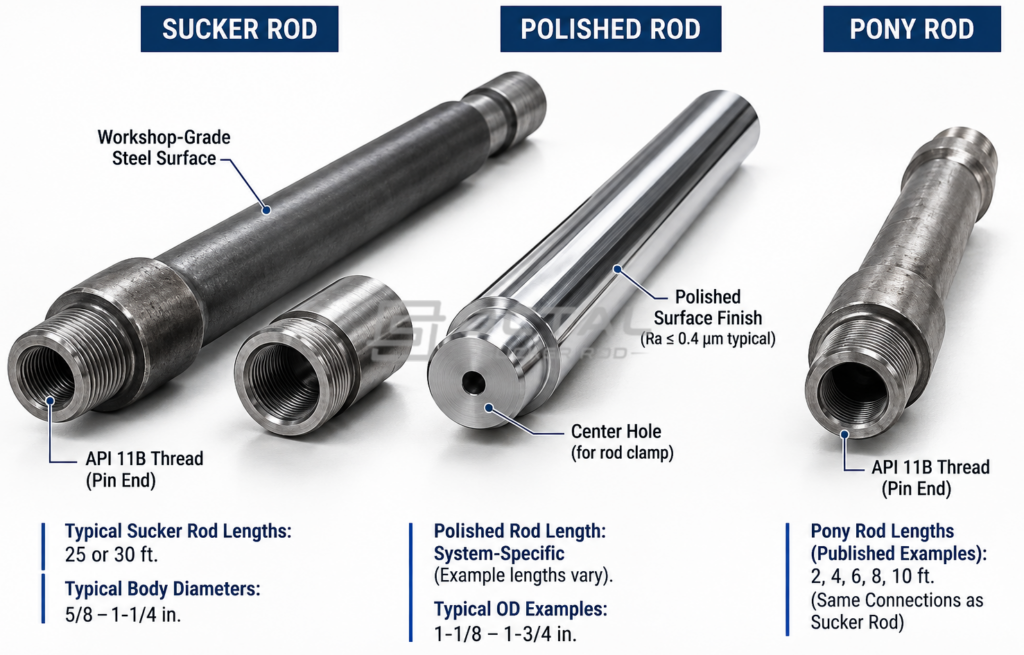
The Main Difference Is the Operating Duty
The sucker rod and pony rod are mechanically closer to each other because both work as structural members of the rod string and transmit reciprocating load. The pony rod differs mainly in length and in the way it is used to complete the final rod-string assembly.
The polished rod has an additional duty. It must carry the rod-string load while its working surface repeatedly moves through the stuffing box. This means that a polished rod can become unsuitable because of surface scoring, pitting, straightness problems or sealing-zone damage even when its basic load-carrying capacity has not been exceeded.
For selection, this leads to a simple engineering distinction: sucker rods are selected primarily around rod-string load and fatigue conditions, pony rods add a required short make-up length to those same compatibility requirements, and polished rods add surface and wellhead-sealing requirements to the mechanical load requirement.
Sucker Rod vs Polished Rod: Technical and Field Differences
A sucker rod and polished rod both carry cyclic load, but they operate under different service conditions. The sucker rod forms the main downhole load-transmitting string, while the polished rod works at the wellhead where mechanical load, surface condition and stuffing-box sealing must be controlled at the same time.
| Comparison | Sucker Rod | Polished Rod |
| Position in the system | Forms most of the rod string between the surface pumping unit and downhole pump | Installed at the upper end of the rod string and reciprocates through the stuffing box |
| Main function | Transfers reciprocating motion and cyclic load through the well | Transfers rod-string load while providing the moving surface required for wellhead sealing |
| Common body diameters | Published steel sucker-rod ranges commonly include 5/8, 3/4, 7/8, 1, 1-1/8 and 1-1/4 in | Common oilfield polished-rod diameters include approximately 1-1/8, 1-1/4, 1-1/2 and 1-3/4 in, depending on manufacturer and surface equipment |
| Typical lengths | Common full-length steel sucker rods are 25 ft and 30 ft | Length is selected according to pumping-unit stroke, wellhead geometry and surface arrangement rather than one universal standard length |
| Yield strength | Depends on rod grade. Published steel sucker-rod data ranges from about 60 ksi (414 MPa) minimum yield for lower-strength grades to about 115 ksi (793 MPa) for higher-strength products | No single universal value applies. Yield strength depends on the polished-rod material, heat treatment and surface construction |
| Tensile strength | Changes with rod grade and material route; published steel rod ranges extend from roughly 90 ksi for lower-strength products to around 140–150 ksi for higher-strength grades | Depends on the selected carbon steel, alloy steel, stainless steel or coated construction; strength should be verified from the actual product specification |
| Main mechanical load | Repeated axial tension from rod-string weight and pumping load; additional bending or contact loads may develop in deviated wells | Surface-end rod-string load combined with repeated sliding movement through the stuffing box |
| Surface requirement | Rod-body surface condition mainly affects fatigue resistance, corrosion behavior and rod/tubing wear | Working surface directly affects sealing performance; scoring, pitting, coating damage and poor straightness can accelerate packing wear or leakage |
| Connection requirement | Pin and coupling configuration must remain compatible with the surrounding sucker-rod string | Lower-end connection must match the rod string, while the upper section must also suit the polished-rod clamp and surface equipment |
| Conventional vertical well | Standard rod grades may be suitable where cyclic load, corrosion and rod/tubing contact remain within design limits | Conventional polished-rod construction may be suitable where stuffing-box alignment and fluid conditions are controlled |
| Deep or high-load well | Higher-strength rod grades or optimized tapered rod strings may be required as suspended rod weight and upper-string load increase | Higher load capacity, straightness and connection performance become more important because the polished rod carries the surface-end rod-string load |
| Deviated well | Rod/tubing contact and bending can increase wear and local fatigue damage | Correct wellhead and stuffing-box alignment remains important to prevent uneven packing contact and side loading |
| Corrosive production | Corrosion pits can become fatigue-initiation sites under cyclic stress | Corrosion in the stuffing-box travel area can damage the sealing surface and increase packing wear; corrosion-resistant materials or surface treatments may be considered |
| Abrasive or scale-bearing production | Abrasive contact can accelerate rod-body and rod/tubing wear | Sand, scale or other solids reaching the stuffing box can increase surface scoring, packing damage and leakage |
| Long-stroke pumping | Longer stroke increases rod movement and can affect dynamic loading and fatigue exposure | Longer stroke increases the sliding distance of the polished rod through the stuffing-box packing during every cycle |
| Typical field failure | Fatigue break, corrosion-pit failure, pin or coupling damage, rod/tubing wear and bending-related damage | Packing leakage, polished-surface scoring, pitting, coating failure, uneven wear and misalignment |
For polished rods, the situation is different. Diameter, length and strength are tied more closely to the surface pumping unit, stuffing-box geometry, rod-string load and material construction. Current industry ranges include common diameters such as 1-1/8, 1-1/4, 1-1/2 and 1-3/4 in, while length is selected according to stroke and wellhead arrangement rather than one fixed standard length.
What This Difference Looks Like in the Field
The difference becomes more obvious when actual operating problems are considered. A sucker rod may fail while the surface still looks acceptable because a corrosion pit, rod/tubing contact point or stressed connection has become a fatigue initiation site.
A polished rod can fail the acceptance test for a completely different reason. It may still have enough tensile capacity to carry the rod-string load, but a longitudinal scratch, corrosion pit or local misalignment in the stuffing-box travel area can damage the packing and produce surface leakage. In that case, increasing steel strength does not solve the problem; the sealing surface, alignment and packing condition need to be checked together.
The practical selection rule is therefore different for the two products: sucker rods are selected mainly around rod-string load, fatigue, grade, diameter, corrosion and connection, while polished rods must satisfy those mechanical requirements together with surface condition, straightness, working length and stuffing-box compatibility.
Sucker Rod vs Pony Rod: The Main Difference Is Length
A sucker rod and a pony rod perform the same basic job in the rod string: both transmit reciprocating load between the surface pumping unit and the downhole pump. The main difference is their length and how they are used during rod-string assembly.
| Item | Sucker Rod | Pony Rod |
| Main use | Builds most of the rod string | Adjusts the final rod-string length |
| Typical length | Commonly 25 ft or 30 ft | Commonly supplied in shorter lengths such as 2, 4, 6, 8 or 10 ft |
| Load function | Carries cyclic rod-string load | Carries the same type of cyclic load at its installed position |
| Grade and diameter | Selected according to well load and service condition | Normally matched to the surrounding sucker rods |
| Connection | Uses the required rod pin and coupling system | Must match the same connection system used in the rod string |
For example, if a rod string assembled with standard 25 ft sucker rods still needs another 6 ft to reach the required final length, adding another full-length sucker rod would make the string too long. A 6 ft pony rod can be used instead.
The pony rod should still match the surrounding rod string in body diameter, grade and connection. If the string uses 7/8 in Grade D sucker rods, selecting a 6 ft pony rod only by length is not enough; its mechanical and connection requirements must also be compatible.
So the practical difference is straightforward: a sucker rod builds the main rod string, while a pony rod fills the shorter remaining length.
Polished Rod vs Pony Rod: Different Functions in the Same Rod-Lift System
A polished rod and pony rod serve very different purposes even though both belong to the same rod-lift system. The polished rod works at the surface end of the rod string and reciprocates through the stuffing box, so both mechanical load and sealing-surface condition matter. The pony rod works within the sucker-rod string and is mainly used when a shorter rod section is needed to reach the required assembled length.
| Comparison | Polished Rod | Pony Rod |
| Main function | Transfers surface-end rod-string load while providing the moving surface through the stuffing box | Provides a shorter rod section to adjust the final rod-string length |
| Position | Upper end of the rod string at the wellhead | Within the sucker-rod string |
| Length selection | Determined by pumping-unit stroke, working travel and wellhead arrangement | Selected according to the remaining make-up length; commonly supplied in short increments |
| Key requirement | Working-surface condition, straightness, material, connection and stuffing-box compatibility | Correct grade, body diameter, length and connection compatibility with surrounding sucker rods |
| Main field concern | Surface scoring, pitting, misalignment and packing leakage | Incorrect length, mismatched grade or incompatible pin/coupling |
| Can they replace each other? | No. A polished rod is designed for the wellhead sealing interface, not simply as a short rod section | No. A pony rod does not provide the controlled working surface and wellhead compatibility required of a polished rod |
A practical example makes the difference clearer. If the rod string needs another 6 ft to reach the designed installed length, a correctly specified 6 ft pony rod may be used, provided its diameter, grade and connection match the surrounding rods.
If the problem is leakage at the stuffing box, however, the relevant component is the polished rod. Scoring, pitting or poor alignment in its working area can damage the packing even when the rod still has enough mechanical strength to carry the load.
So the distinction is simple: the polished rod solves a surface load-transfer and sealing requirement; the pony rod solves a rod-string length-adjustment requirement.
How the Three Rods Work Together During a Pumping Stroke
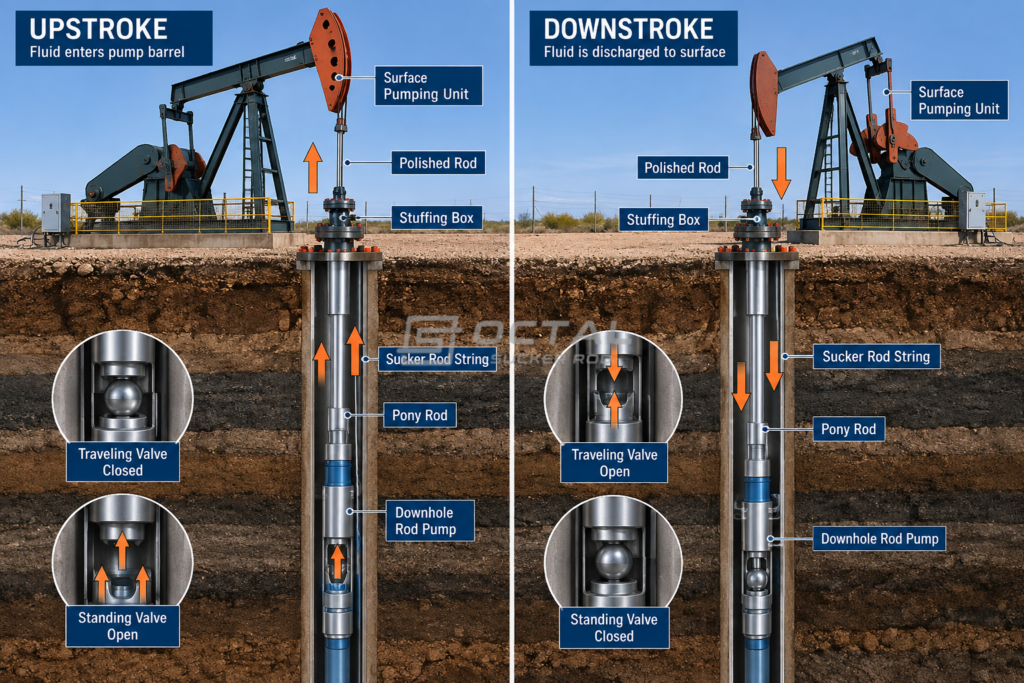
During a pumping cycle, the polished rod, sucker rods and pony rods move as one connected rod string. The surface pumping unit provides the motion, and that motion is transferred down the well to operate the downhole pump.
During the Upstroke
When the pumping unit lifts the polished rod, the polished rod moves upward through the stuffing box and pulls the sucker-rod string below it.
The sucker rods then transfer this upward movement down the well to the subsurface pump. If pony rods are installed in the string, they move with the sucker rods and carry the same type of cyclic load at their installed position.
The load path can be viewed simply as:
Pumping Unit → Polished Rod → Sucker Rod String → Pony Rod, if used → Downhole Pump.
At the same time, the stuffing-box packing remains in contact with the polished rod surface to control leakage while the rod is moving.
During the Downstroke
When the pumping unit reverses direction, the polished rod moves downward and the entire connected rod string follows.
The sucker rods and pony rods continue to transmit motion to the downhole pump, while the polished rod again slides through the stuffing box.
This up-and-down movement is repeated continuously during production.
How Rod Position Affects Service Performance
Although the polished rod, sucker rods and pony rods move together, their service risks are different because they work in different positions. The polished rod operates through the stuffing box, so surface damage, straightness and alignment directly affect sealing and packing wear. Sucker rods carry repeated cyclic load through the well, making fatigue, corrosion, connection condition and rod/tubing contact more important. A pony rod is shorter, but once installed it carries the same basic rod-string load as the surrounding sucker rods, so its grade, diameter and connection still need to match the string.
How the Three Rod Types Lead to Different Field Problems
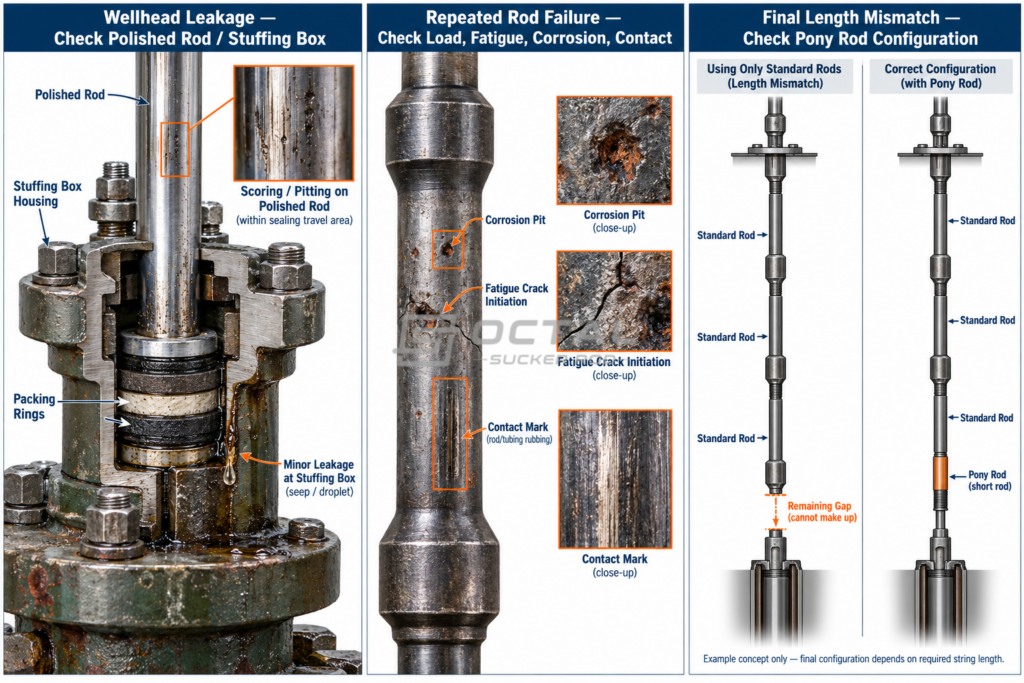
Problems in a rod-lift system often point to different components depending on where the symptom appears. A wellhead leak, repeated rod break and incorrect rod-string length should not be investigated in the same way.
| Field Problem | Component to Check First | Main Checks | Why It Matters |
| Leakage at the wellhead | Polished rod and stuffing box | Surface scoring or pitting, straightness, alignment, packing condition and sealing-zone wear | The polished rod moves continuously through the stuffing box. Even if the rod still has enough strength, surface damage or misalignment can increase packing wear and cause leakage. |
| Repeated sucker-rod breakage | Sucker rod string | Rod load, fatigue location, corrosion pits, rod/tubing contact, connection damage and well deviation | Replacing only the broken rod may not solve the problem if the failure is caused by cyclic overload, corrosion fatigue, repeated contact or an incorrect rod-string design. |
| Rod string cannot reach the required final length | Pony rod / rod-string configuration | Remaining make-up length, pony-rod size, grade and connection compatibility | This is usually a string-assembly issue. A correctly selected pony rod can provide the short additional length without adding another full-length sucker rod. |
A useful rule in the field is to start with where the problem occurs. Wellhead leakage usually leads back to the polished rod and stuffing-box interface; repeated downhole rod failures require investigation of the sucker-rod load and operating environment; and a final length mismatch is normally solved through the correct pony-rod configuration.
This avoids a common maintenance mistake: replacing a component because it looks similar without checking whether it actually performs the required function at that position in the rod-lift system.
Can Sucker Rods, Polished Rods and Pony Rods Be Interchanged?
Sucker rods, polished rods and pony rods may share similar diameters or connection sizes, but they should not be treated as interchangeable parts. The deciding factor is not whether two rods can physically connect, but whether the replacement can perform the required job at that position in the rod-lift system.
| Replacement | Interchangeable? | Why |
| Sucker Rod → Polished Rod | No | A standard sucker rod does not provide the controlled working surface, straightness and wellhead sealing characteristics required for repeated movement through the stuffing box. |
| Pony Rod → Polished Rod | No | A pony rod is a short rod-string member. Similar length does not make it suitable for the polished-rod sealing zone or surface equipment. |
| Sucker Rod → Pony Rod | Only when the required length and specification match | The two can belong to the same rod family, but a pony rod is specifically used as a short make-up section. Grade, diameter, pin/thread and coupling still need to match the string. |
| Pony Rod → Full-Length Sucker Rod | Not as a direct substitute | Several short pony rods could add unnecessary connections and change the intended rod-string configuration. A standard sucker rod is normally used where a full-length section is required. |
Even when two components have the same nominal diameter or compatible threads, that alone does not make them interchangeable. Working position, load requirement, surface condition, length and connection compatibility must all be checked before substitution.
API 11B Requirements for Sucker Rods and Related Products
API Spec 11B is the main industry specification covering sucker rods and related rod products used in rod-lift systems. It provides requirements for product dimensions, mechanical properties, materials, manufacturing and inspection, depending on the specific rod type.
For buyers, however, specifying only “API 11B” is not enough to define the product. A purchase order should also state whether the requirement is for a sucker rod, polished rod or pony rod, because each component has a different function and selection basis.
The order should normally identify the key product details, including rod type, diameter, grade or material, length, connection and any required inspection or documentation. For polished rods, the working surface and wellhead compatibility may also need to be specified; for pony rods, the short make-up length must match the surrounding sucker-rod string.
In practical terms, API 11B defines the technical framework, while the purchase specification defines the actual rod required for the well.
Common Selection Mistakes for Sucker Rods, Polished Rods and Pony Rods
Even when the three rod types have similar diameters or compatible connections, their operating roles are different. Several selection mistakes occur repeatedly in rod-lift systems.
Selecting a Pony Rod Only by Length
A pony rod is chosen because a shorter make-up length is required, but length alone is not enough. Its body diameter, grade, pin/thread and coupling must still match the surrounding sucker-rod string. A 6 ft pony rod with the wrong grade or connection can solve the length problem while creating a mechanical or compatibility problem.
Treating a Polished Rod as a Normal Sucker Rod
A polished rod does more than transmit load. Its working section repeatedly passes through the stuffing box, so surface condition, straightness and alignment directly affect sealing performance. A rod that is strong enough mechanically may still be unsuitable if the sealing surface is scored, pitted or poorly aligned.
Assuming Matching Threads Mean the Rods Are Interchangeable
Compatible threads only confirm that two components can be connected. They do not confirm that the rods have the same length, grade, body diameter, surface requirement or operating function. Replacement should always be checked against the position of the rod in the system, not only the connection.
Increasing Rod Strength Without Checking the Failure Cause
A higher-strength rod does not automatically solve repeated failures. Breaks can result from corrosion pits, fatigue, rod/tubing contact, poor alignment, damaged connections or an unsuitable rod-string design. Changing grade without identifying the failure mechanism can leave the same problem in place.
The practical rule is to match function first, then dimensions, grade and connection. This avoids selecting a rod that fits physically but is wrong for the actual operating condition.
How to Choose the Right Rod
The correct rod type depends first on where it will be installed and what problem it needs to solve.
- Choose a sucker rod when you need a standard load-carrying member for the main rod string. Selection should focus on rod diameter, grade, well depth, load, corrosion condition and connection compatibility.
- Choose a pony rod when the rod string needs a shorter section to reach the required final length. The pony rod should still match the surrounding sucker rods in grade, body diameter and connection.
- Choose a polished rod when the rod is installed at the wellhead and must move through the stuffing box. In addition to mechanical strength, check the working diameter, surface condition, straightness, length and compatibility with the stuffing box and surface equipment.
In practice, the three products solve different problems. Sucker rods build the main rod string, pony rods adjust its final length, and polished rods connect the rod string to the surface pumping system while providing the moving sealing surface at the wellhead. Choosing the correct rod therefore starts with its operating position, then moves to size, grade, length and connection.
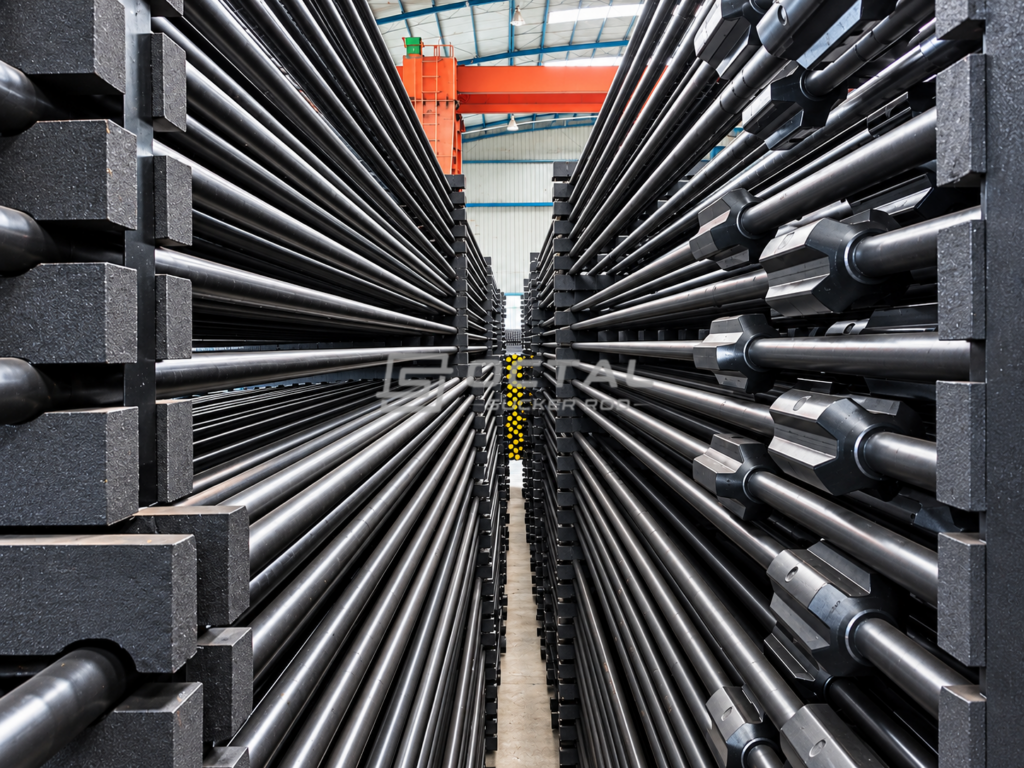
What Octal Can Supply for Rod-Lift Systems
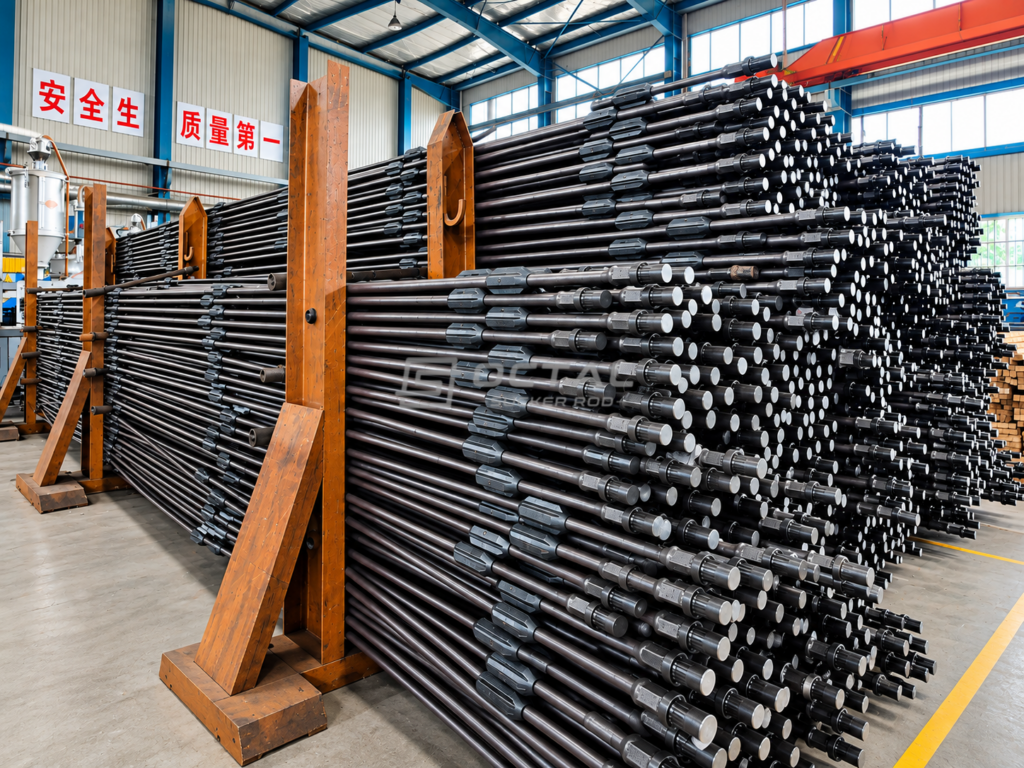
Octal can supply sucker rods, polished rods and pony rods for rod-lift applications, with product configuration matched to the required rod-string design and surface equipment.
For sucker rods, supply can be arranged by rod-body diameter, grade or material route, standard length, connection and coupling requirement. For pony rods, the same rod-string compatibility needs to be maintained while providing the shorter make-up length required for final string assembly. For polished rods, selection can include working diameter, length, material or surface treatment, end connection and compatibility with the stuffing box and surface pumping equipment.
For project or replacement orders, Octal can work from the existing rod-string specification to confirm the required rod type, installation position, body diameter, length, grade or material, pin/thread and coupling compatibility, polished-rod surface and connection requirements, inspection and traceability needs, and packing or shipment identification before production. Where several rod sizes or lengths are included in one order, these details should be clearly separated in the purchase specification so that each component can be matched to the correct position in the rod string during installation.
FAQ
What is the main difference between a sucker rod and a polished rod?
A sucker rod forms most of the downhole rod string and transmits reciprocating load. A polished rod is the surface-end member that also moves through the stuffing box, so working-surface condition, straightness and sealing compatibility become additional requirements.
Is a pony rod a type of sucker rod?
A pony rod is a short rod-string member closely related to the sucker rod. In established product lines, it may use the same rod-body size, material/grade family and mechanical requirements as corresponding sucker rods, but in much shorter lengths.
How long are sucker rods and pony rods?
Steel sucker rods are commonly supplied in 25 ft and 30 ft lengths. One published Norris range lists pony rods in 2, 4, 6, 8 and 10 ft lengths, with availability depending on size and grade and other lengths available by special order
Why does a polished rod need a smooth surface?
The polished rod reciprocates through the stuffing-box packing. Its working surface therefore forms part of a moving sealing interface. Scoring, pitting, roughness or misalignment can increase packing wear or contribute to leakage.
Can a pony rod be installed directly below a polished rod?
It can be used within the rod string where its length and mechanical specification fit the rod-string design, but “directly below the polished rod” is not the defining requirement of a pony rod. Its defining purpose is to provide a shorter make-up length while remaining compatible with the surrounding rod string.