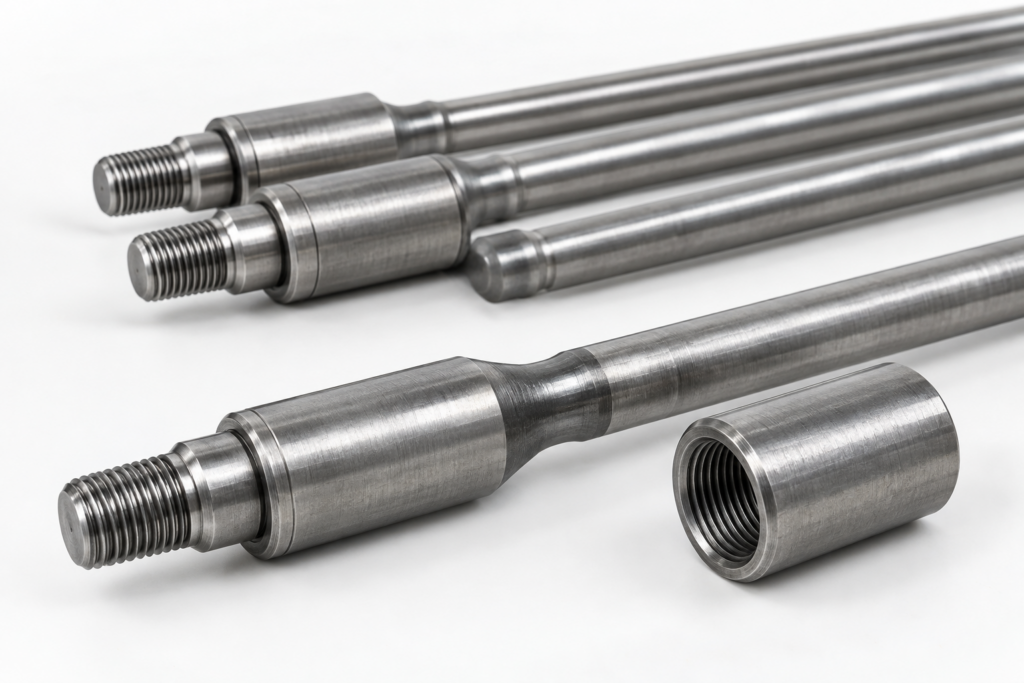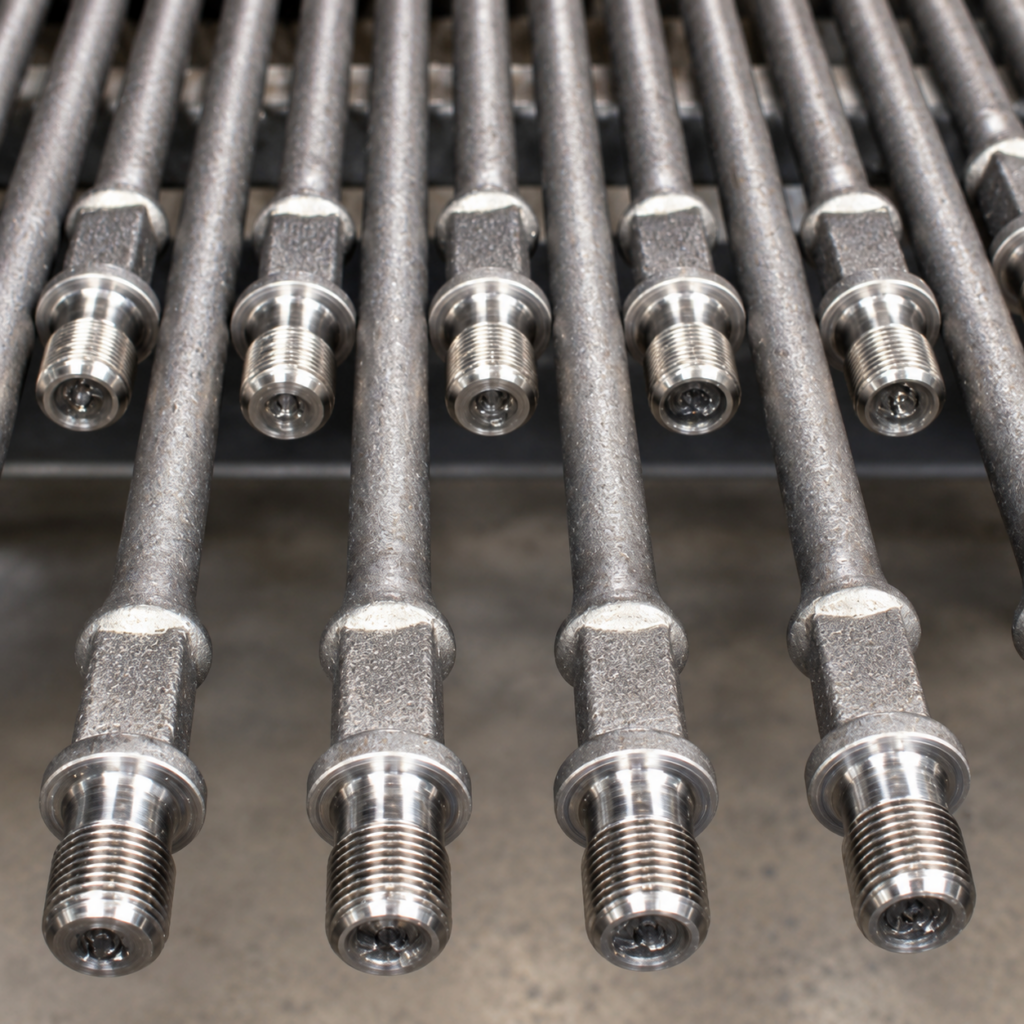
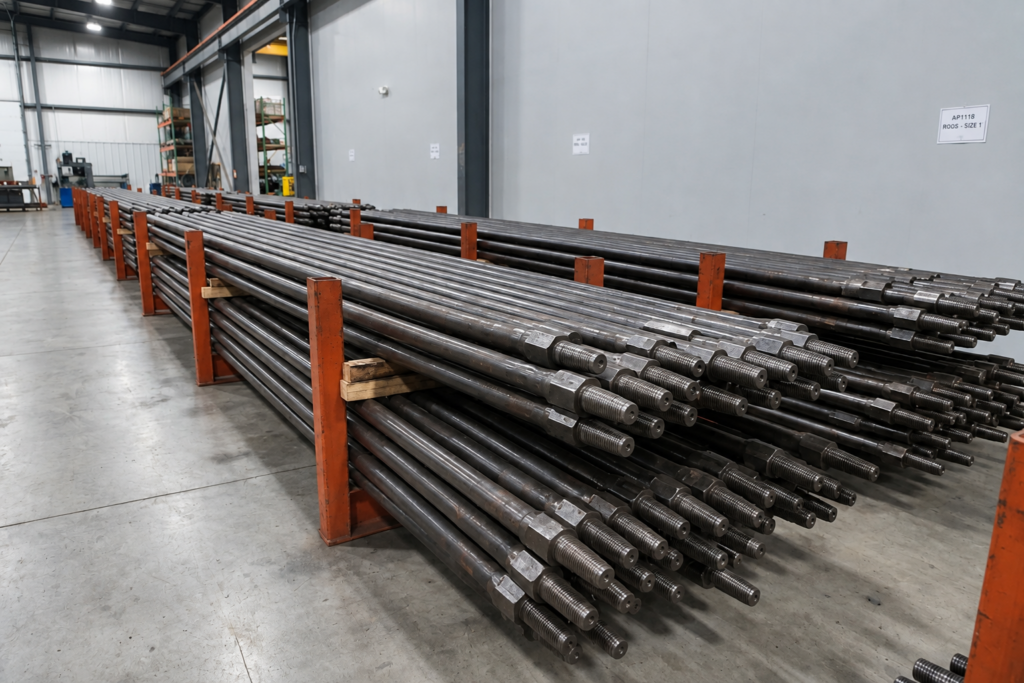
Sucker rod is used to transmit reciprocating mechanical loads from a surface pumping unit to a downhole pump in an artificial lift system, allowing continuous fluid production from oil wells where reservoir pressure is insufficient to lift hydrocarbons to the surface. Multiple sucker rods are connected together to form a sucker rod string, which provides the mechanical connection between the polished rod at the surface and the downhole pump inside the production tubing.
The primary function of a sucker rod is to transfer tensile and compressive loads during each pumping cycle while maintaining sufficient strength and fatigue resistance under repeated operation. In rod pumping systems, performance depends on engineering factors including rod diameter, steel grade, connection design, well depth, corrosion environment, and fatigue loading conditions.
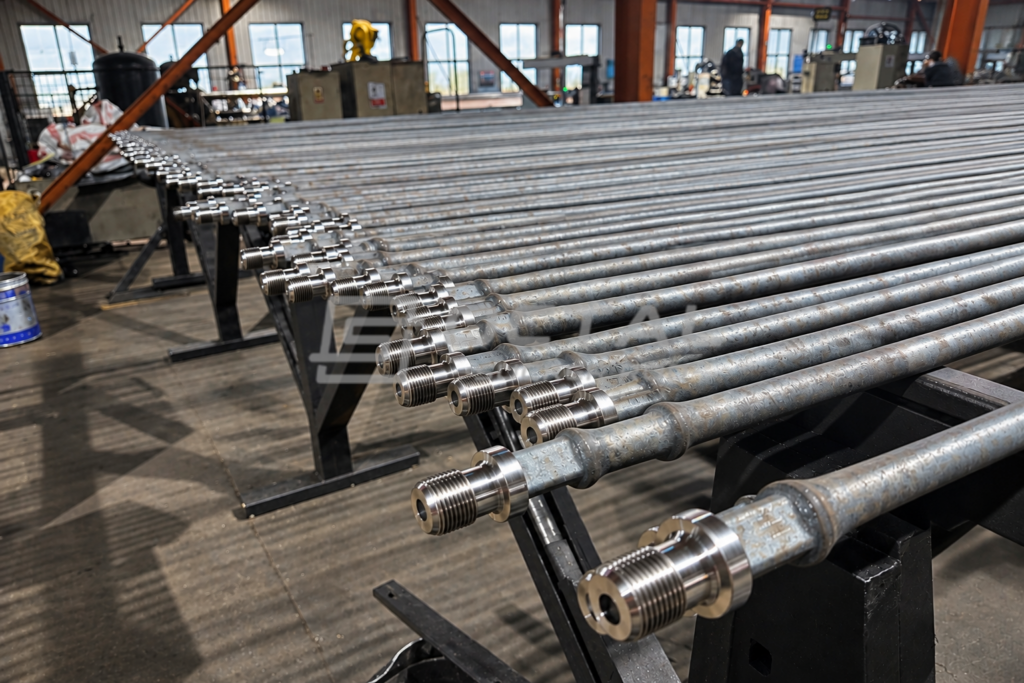
API 11B defines requirements for sucker rods, pony rods, couplings, and related rod lift equipment used in petroleum and natural gas production. Because a sucker rod string may experience millions of cyclic loading operations during its service life, material selection, heat treatment, dimensional control, and traceability are critical factors affecting field reliability.
How Does a Sucker Rod Work in a Pumping System?
Sucker Rod Function and Load Transmission
The primary function of a sucker rod is to transfer reciprocating mechanical loads from the surface pumping unit to the downhole pump through the complete rod string. In a rod pumping system, multiple sucker rods are connected together to form a continuous load-transmission assembly, allowing the surface unit to operate the subsurface pump during repeated production cycles.
During operation, the surface pumping unit drives the polished rod in an upward and downward movement. This motion is transferred through the sucker rod string to the downhole pump plunger, creating the pressure changes required to lift formation fluids through the tubing string.
The working process of a sucker rod pumping system includes:
- The surface pumping unit generates reciprocating movement through the polished rod.
- The sucker rod string transfers mechanical movement and axial loads along the wellbore.
- The downhole pump converts rod movement into fluid lifting action.
- Produced fluids move through the tubing string to the surface production system.
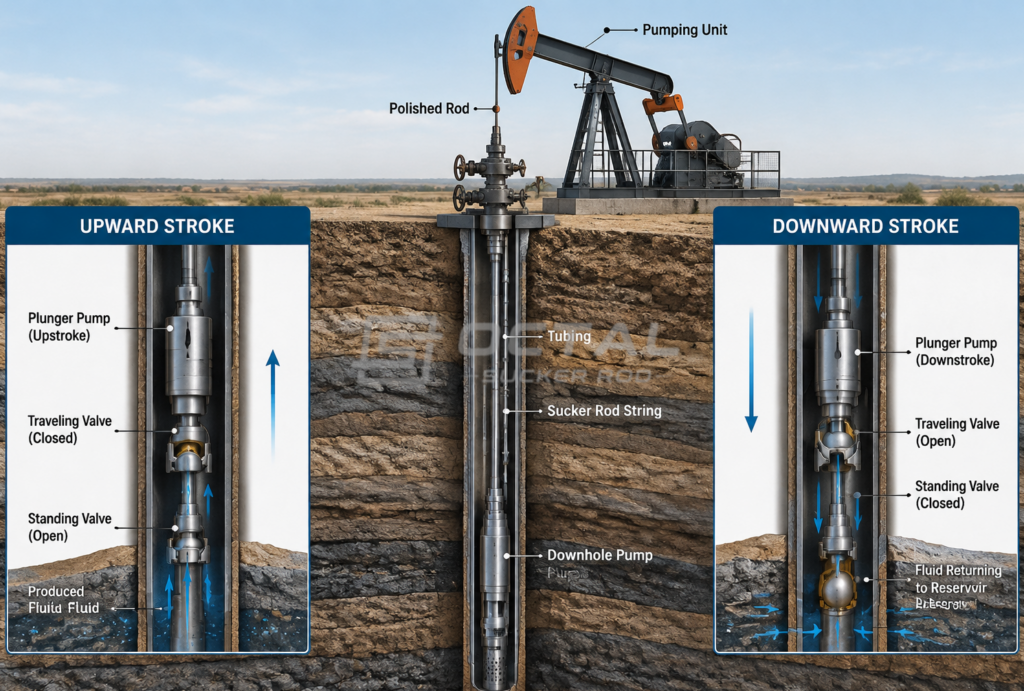
During service, the sucker rod string is exposed to complex loading conditions rather than simple tension. The main mechanical stresses include:
| Loading Condition | Engineering Impact |
| Tensile load during upward stroke | Supports rod weight and fluid load from the pump |
| Compressive load during downward stroke | Requires sufficient stability to reduce buckling risk |
| Cyclic loading | Creates fatigue stress after repeated pumping operations |
| Side loading in deviated wells | Increases contact wear between rod and tubing |
Because sucker rods operate continuously under cyclic loading, fatigue resistance, connection integrity, and material consistency directly affect service reliability. Rod diameter, steel grade, connection design, and manufacturing quality must be selected according to well depth, production conditions, and operating environment.
Sucker Rod Application in Artificial Lift Systems
Role of Sucker Rod in Oil Well Production
Sucker rods are primarily applied in artificial lift systems to maintain oil production when reservoir pressure is insufficient to move fluids naturally to the surface. Among different artificial lift methods, rod pumping systems using sucker rod strings remain widely applied for onshore oil production because they provide a reliable mechanical solution for long-term well operation.
The suitability of a sucker rod system depends on the actual well conditions rather than the lifting method alone. Engineers evaluate production requirements, mechanical loading, and environmental factors before selecting the appropriate rod size, grade, and connection configuration.
Key application factors include:
| Operating Factor | Influence on Sucker Rod Selection |
| Well depth | Determines total rod string weight and tensile loading requirements |
| Production rate | Affects pump capacity and operating loads |
| Fluid properties | Influences corrosion and wear resistance requirements |
| Well deviation | Increases bending stress and tubing contact risk |
| Pumping frequency | Determines fatigue exposure during service life |
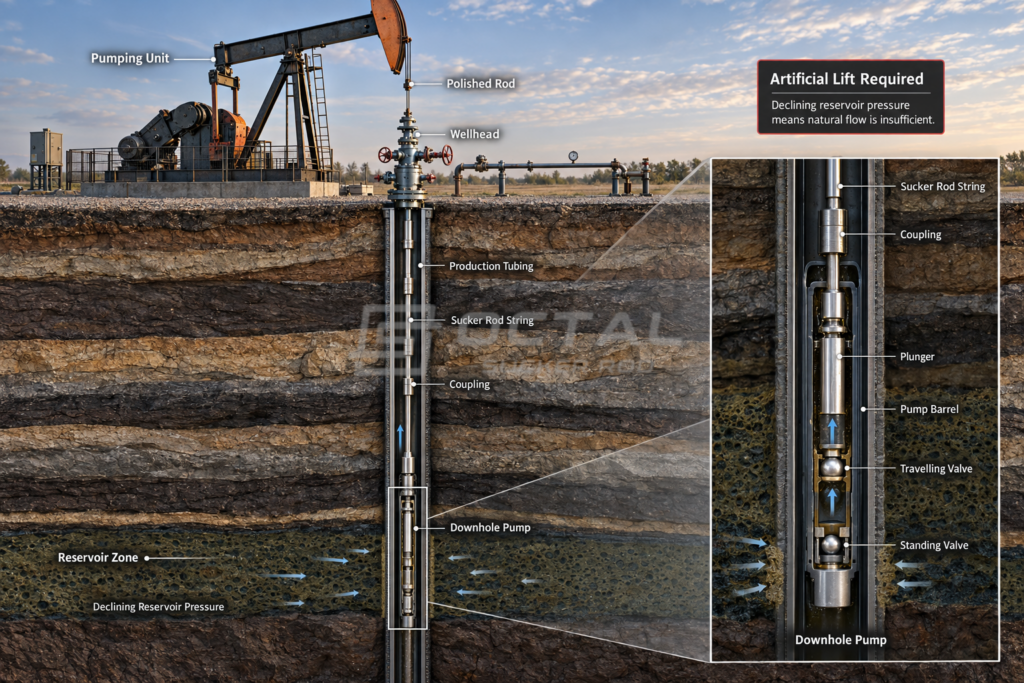
For deeper wells or high-cycle pumping operations, sucker rod performance depends on maintaining stable mechanical properties, accurate dimensions, and reliable connections throughout the operating period. Proper grade selection, such as API 11B Grade C, D, K, or KD sucker rods, helps match the rod string to specific load and corrosion conditions.
Sucker Rod Applications Under Different Oil Well Conditions
Matching Rod String Design with Production Requirements
The application of a sucker rod system is mainly determined by well operating conditions, production objectives, and mechanical loading requirements. In oil production, the same sucker rod design cannot be applied to every well because variations in depth, fluid properties, deviation, and operating cycles directly affect rod string performance.
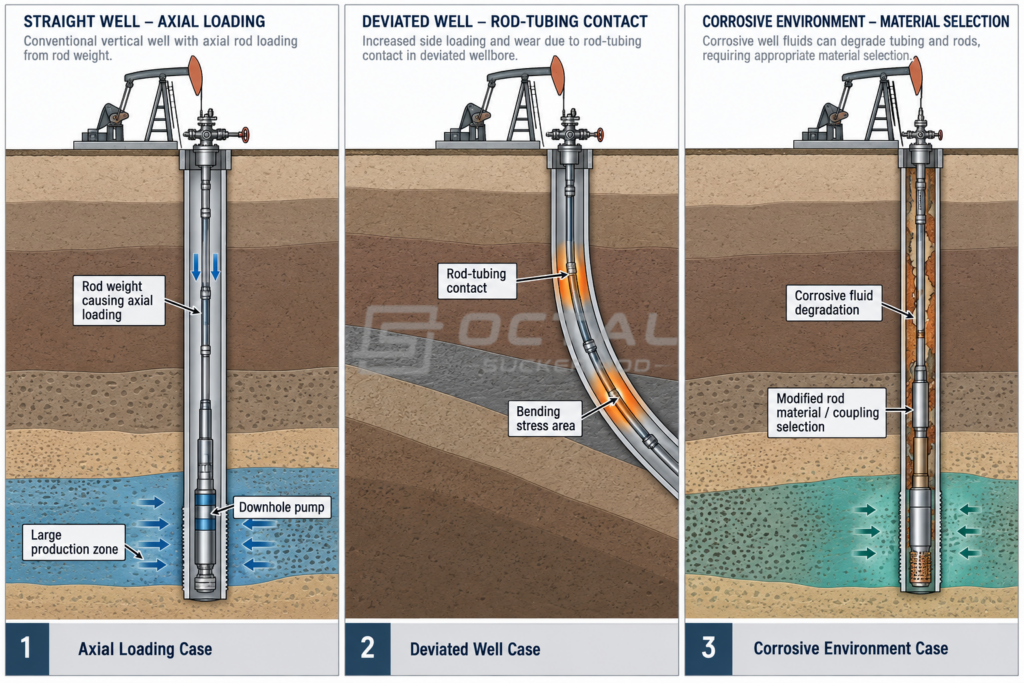
For example, a shallow vertical well and a deep deviated well may use the same artificial lift principle, but the sucker rod string experiences completely different mechanical conditions. Deeper wells increase axial loading from rod weight and fluid load, while deviated wells introduce additional bending stress and contact wear between the rod and tubing.
The main factors considered during sucker rod system design include:
| Well Condition | Engineering Concern | Sucker Rod Design Consideration |
| Deep production wells | Higher axial tensile load | Higher strength grade and proper rod sizing |
| Deviated wells | Increased bending and tubing contact | Wear resistance and suitable string design |
| High-cycle pumping operations | Fatigue accumulation | Material consistency and connection reliability |
| Corrosive production fluids | Metal degradation | Corrosion-resistant grade selection and chemical control |
| Heavy fluid production | Increased pump load | Rod strength and load capacity evaluation |
Sucker Rod Performance in Mature Oil Fields
Many oil wells require artificial lift systems after reservoir pressure declines during later production stages. In these conditions, the reliability of the sucker rod string becomes a key factor affecting production continuity.
Unlike static structural components, sucker rods operate under millions of repeated loading cycles. Field performance depends not only on tensile strength but also on:
- fatigue resistance under cyclic loading
- connection integrity during repeated make-up and operation
- dimensional accuracy along the rod string
- material traceability from manufacturing to installation
Therefore, sucker rod selection requires a balance between mechanical strength, operating environment, and expected service life rather than selecting the highest strength grade alone.
API 11B Sucker Rod Requirements
Manufacturing, Material Control and Specification Verification
API Specification 11B establishes requirements for sucker rods, pony rods, couplings, and related rod lift equipment used in petroleum and natural gas production operations. The standard focuses on controlling product consistency, mechanical performance, dimensional accuracy, and connection reliability to ensure that sucker rods can withstand repeated loading conditions during field operation.
For procurement and field application, API 11B compliance is not only related to product marking but also involves the complete manufacturing and inspection process. A qualified sucker rod supply chain should provide traceable records covering material verification, heat treatment, mechanical testing, dimensional inspection, and final acceptance documentation.
Key control areas include:
| Control Item | Engineering Requirement | Purpose in Field Operation |
| Steel chemistry | Controlled chemical composition according to specified grade requirements | Ensures consistent mechanical properties and service performance |
| Heat treatment | Controlled heating and cooling process to achieve required strength and toughness | Improves fatigue resistance under repeated pumping cycles |
| Mechanical properties | Verification of yield strength, tensile strength, elongation and hardness where applicable | Confirms load-carrying capability under operating conditions |
| Dimensions | Control of rod diameter, length, straightness and critical geometry | Ensures proper fit within the rod string and tubing system |
| Thread connection | Inspection of thread profile, engagement and surface condition | Maintains reliable load transfer between connected rods |
| Surface quality | Examination for defects affecting service performance | Reduces risk of premature failure initiation |
| Traceability | Heat number, batch identification and inspection records | Allows production history verification and quality tracking |
API 11B Sucker Rod Grade Selection
Sucker rod grades are selected according to actual well conditions rather than strength level alone. Different grades are designed to address variations in mechanical loading, corrosion exposure, and production requirements.
Common API 11B sucker rod grades include:
| Grade | Minimum Yield Strength | Tensile Strength Range | Typical Selection Consideration |
| Grade C | 60,000 psi (414 MPa) | 90,000–115,000 psi (621–793 MPa) | General production wells with moderate loading conditions |
| Grade D | 85,000 psi (586 MPa) | 115,000–140,000 psi (793–965 MPa) | Higher load applications requiring increased mechanical strength |
| Grade K | 60,000 psi (414 MPa) | 90,000–115,000 psi (621–793 MPa) | Applications where corrosion resistance considerations are important |
| Grade KD | Grade-dependent | Grade-dependent | Conditions requiring both strength capability and corrosion-related performance |
Key Factors for Sucker Rod Selection
Selecting a sucker rod only according to tensile strength may not provide the best field performance. Engineers normally evaluate multiple operating factors together:
| Selection Factor | Why It Matters |
| Well depth | Determines total rod string weight and axial loading |
| Pumping frequency | Influences fatigue exposure during service life |
| Well deviation | Increases bending stress and tubing contact wear |
| Produced fluid composition | Affects corrosion risk and material selection |
| Expected production period | Determines long-term reliability requirements |
A properly selected API 11B sucker rod should provide a balance between mechanical strength, fatigue resistance, corrosion performance, and connection reliability. For this reason, purchasing decisions should consider not only the grade designation but also manufacturing records, inspection reports, and complete traceability documentation.
Sucker Rod Grade Selection: C vs D vs K vs KD
Mechanical Performance and Application Considerations
Selecting the correct sucker rod grade requires more than comparing tensile strength values. In a rod pumping system, the selected grade must withstand repeated axial loading, fatigue cycles, and environmental exposure throughout the service life of the well.
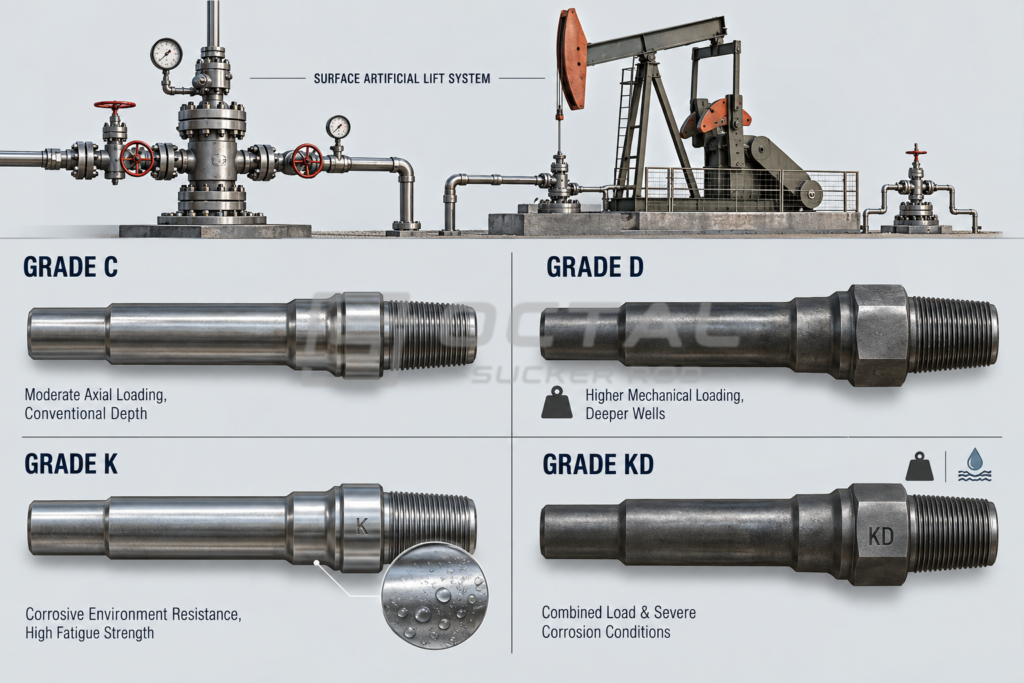
API 11B sucker rods are commonly supplied in different grades, including Grade C, Grade D, Grade K, and Grade KD, allowing engineers to match mechanical performance with specific production conditions.
The main differences between these grades involve:
- Yield strength capability
- Tensile strength range
- Corrosion service requirements
- Fatigue performance under cyclic loading
- Expected well operating conditions
Sucker Rod Grade Comparison
| Grade | Minimum Yield Strength | Tensile Strength Range | Main Characteristics | Typical Selection Condition |
| Grade C | 60,000 psi (414 MPa) | 90,000–115,000 psi (621–793 MPa) | Balanced mechanical performance for general applications | Conventional oil wells with moderate loading requirements |
| Grade D | 85,000 psi (586 MPa) | 115,000–140,000 psi (793–965 MPa) | Higher strength capability for increased mechanical loads | Deeper wells or applications requiring higher load capacity |
| Grade K | 60,000 psi (414 MPa) | 90,000–115,000 psi (621–793 MPa) | Designed for applications where corrosion conditions influence material selection | Wells with corrosive production environments |
| Grade KD | Based on grade requirements | Based on grade requirements | Combines higher mechanical requirements with corrosion-related considerations | Wells requiring both strength capability and improved corrosion performance |
How to Select Between C, D, K and KD Sucker Rods?
The selection of sucker rod grade should be based on the actual well conditions rather than strength value alone. Engineers normally evaluate the combined influence of rod loading, well depth, corrosion environment, pumping cycles, and expected service life before selecting between Grade C, D, K, and KD sucker rods.
For wells with standard production conditions and moderate mechanical loading, Grade C sucker rods are commonly used due to their balanced strength and general service performance. When the rod string is exposed to higher tensile loads, deeper wells, or increased pump loading, Grade D may be considered because of its higher yield and tensile strength capability.
In corrosive production environments, material selection becomes a key factor. Grade K and KD sucker rods are considered when corrosion-related performance is an important requirement, with KD selection focusing on applications where both mechanical loading and environmental conditions require additional performance consideration.
A suitable sucker rod grade should provide a balance between mechanical strength, fatigue resistance, corrosion performance, and operating reliability. Selecting the highest strength grade does not always provide the best solution, as the final choice must match the complete operating conditions of the well.
Sucker Rod Manufacturing and Quality Control
Reliable sucker rods require control from steel production to final shipment.
Typical quality documentation includes:
| Document | Purpose |
| Mill Test Certificate (MTC) | Material traceability |
| Heat number record | Batch identification |
| Mechanical test report | Strength verification |
| Dimensional inspection report | Size accuracy |
| Thread inspection record | Connection quality |
Manufacturing controls include steel chemistry verification, heat treatment monitoring, straightness inspection, surface examination, and mechanical testing to ensure consistent product performance. Each delivered sucker rod string maintains full traceability from individual rods back to the original production batch, supporting quality verification and field reliability throughout the service life.
Sucker Rod vs Other Artificial Lift Components
Understanding the Role of Sucker Rod in a Rod Pumping System
A sucker rod does not operate as an independent lifting component. It works as part of a complete rod pumping system, where each component performs a specific function to transfer mechanical movement, withstand operating loads, and lift produced fluids from the well.
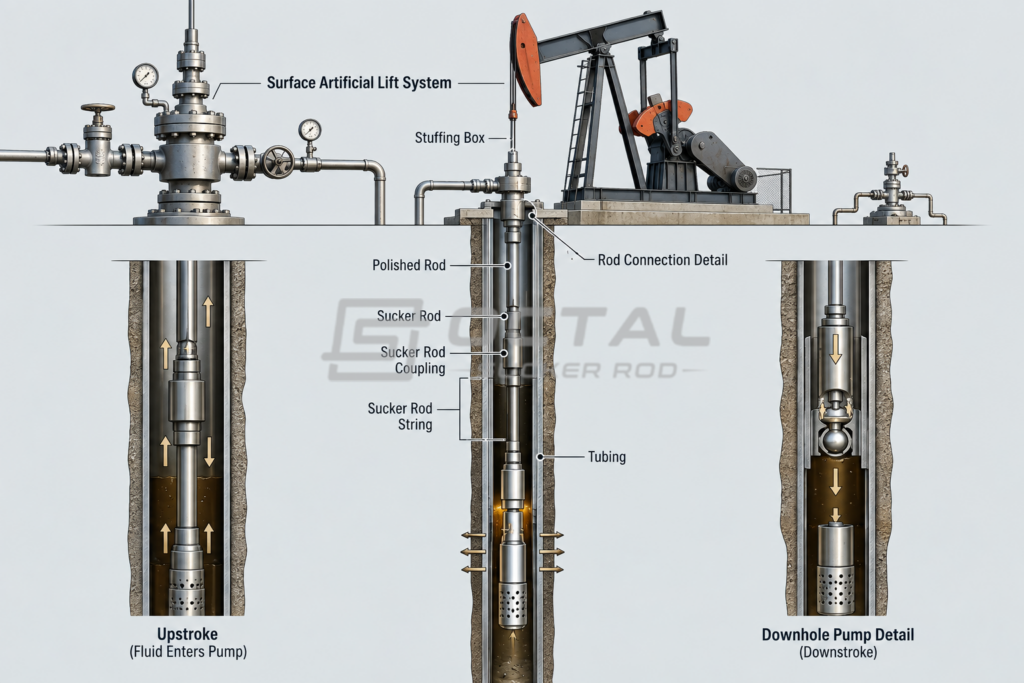
The reliability of the system depends on the compatibility between the sucker rod string, polished rod, coupling, tubing, and downhole pump. Failure or mismatch of any individual component may affect load transmission, pumping efficiency, and overall production reliability.
| Component | Main Function | Engineering Consideration |
| Sucker Rod | Transmits reciprocating movement and axial loads from the surface unit to the downhole pump | Requires sufficient tensile strength, fatigue resistance, and connection reliability under repeated cycles |
| Polished Rod | Connects the surface pumping unit with the upper section of the sucker rod string | Must withstand surface loading and provide smooth movement through the stuffing box |
| Sucker Rod Coupling | Connects individual sucker rod sections to form a continuous rod string | Requires proper thread engagement, load transfer capability, and wear resistance |
| Tubing String | Provides the flow path for produced fluids from the downhole pump to the surface | Must maintain pressure containment and allow proper rod movement inside the well |
| Downhole Pump | Converts rod movement into fluid lifting action inside the well | Determines pumping capacity and directly affects production performance |
Why Sucker Rod System Matching Is Important
A sucker rod works as part of a complete rod pumping system, and its performance depends on the proper matching of the rod string, coupling, polished rod, tubing, and downhole pump. The selected sucker rod grade, diameter, and connection design should match the well depth, loading conditions, production fluid characteristics, and operating environment. Proper system matching helps maintain efficient load transmission, reduce fatigue and wear risks, and improve the long-term reliability of oil well production.
Why Choose Octal for Sucker Rod Supply?
Octal provides API 11B sucker rod solutions designed for different oil well operating conditions, including conventional production wells, high-load applications, and environments requiring specific material performance considerations.
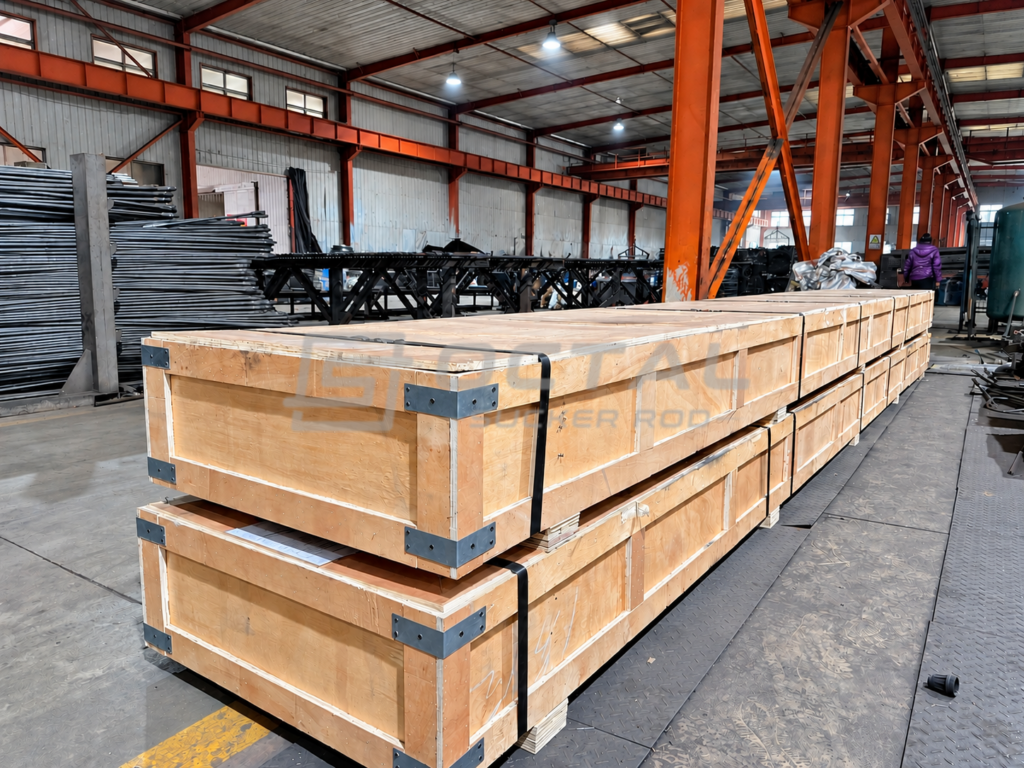
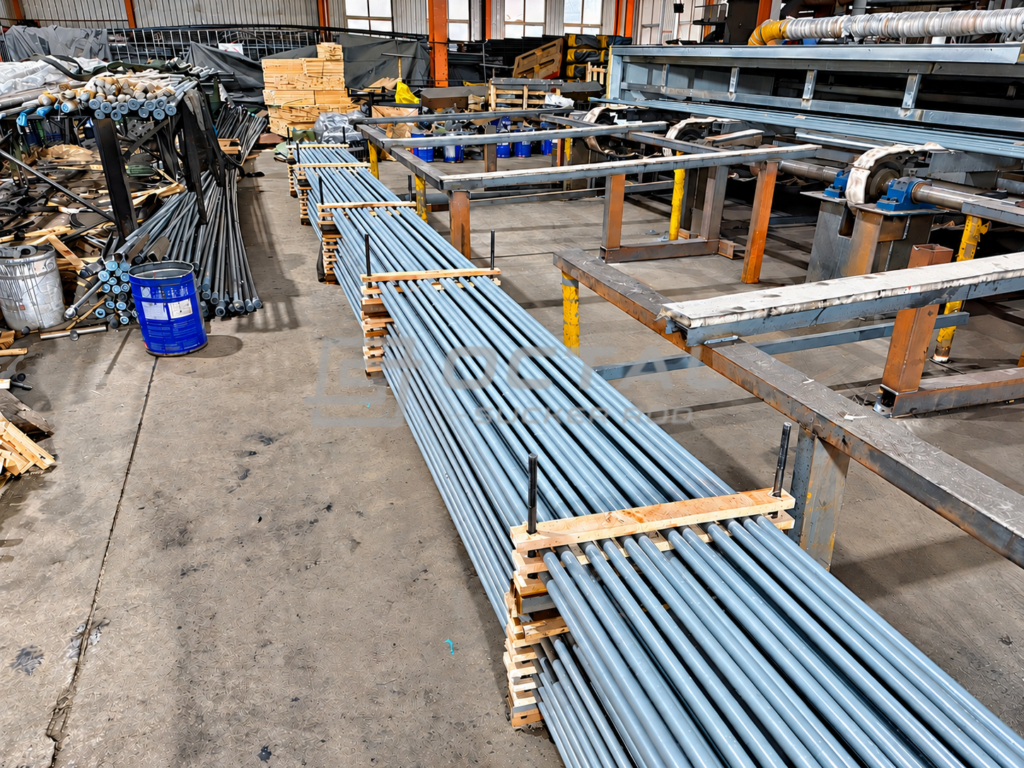
Our sucker rod supply covers different grades, sizes, and connection requirements, with production control focused on mechanical properties, dimensional accuracy, thread quality, and product traceability. Each batch can be supported with relevant inspection records and technical documentation to help customers verify product compliance before field installation.
Octal supports customers with:
- API 11B compliant sucker rods with controlled material and manufacturing processes
- Multiple grades including Grade C, D, K, and KD for different well conditions
- Various rod sizes and coupling configurations according to project requirements
- Mechanical testing and dimensional inspection to verify product performance
- Complete documentation and traceability records for project quality control
By combining standardized manufacturing processes with application-focused technical support, Octal helps customers select suitable sucker rod solutions based on well depth, loading conditions, corrosion environment, and production requirements.
FAQ
What is the main function of a sucker rod?
The main function of a sucker rod is to transmit reciprocating mechanical movement and load from the surface pumping unit to the downhole pump in a rod pumping system.
Are all sucker rods the same grade?
No. Sucker rods are available in different grades, including Grade C, D, K, and KD. Selection depends on load requirements, corrosion conditions, and well operating environment.
What standard covers sucker rods?
API Specification 11B is the primary industry standard covering sucker rods, pony rods, couplings, and related rod lift equipment.
How do I choose the correct sucker rod size?
Selection depends on well depth, pump load, production conditions, and fatigue requirements. Diameter and grade should be evaluated together rather than selected separately.