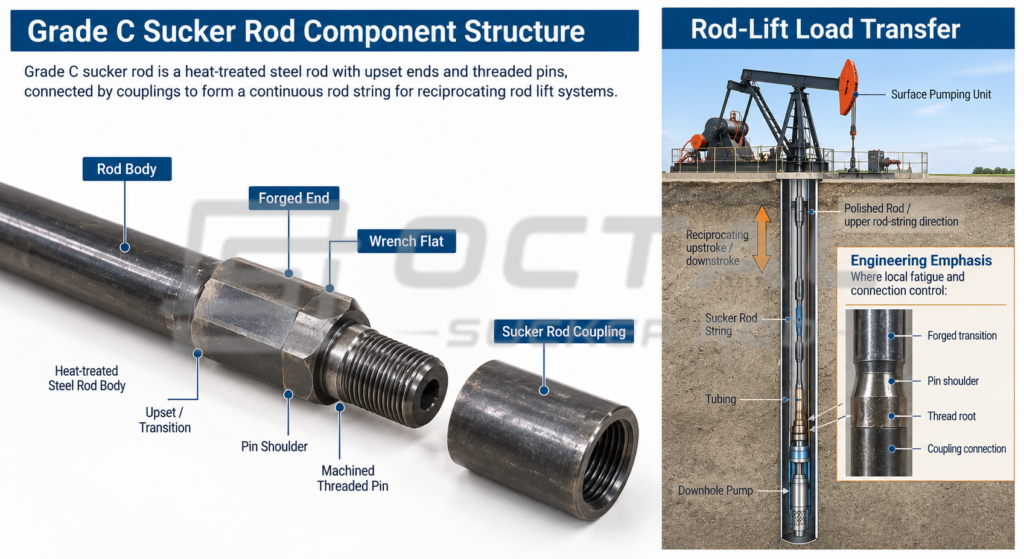
Grade C sucker rod (API 11B Grade C sucker rod) is a standard-strength steel sucker rod used in reciprocating rod-lift systems.Each rod has a heat-treated steel body, forged end sections, wrench flats, and machined threaded pins, while multiple rods are connected through sucker rod couplings to form a continuous rod string between the surface pumping unit and the downhole pump. During operation, the surface unit moves the rod string up and down, transferring reciprocating motion and axial tensile load to the downhole pump so that the plunger can complete repeated pumping strokes. What distinguishes Grade C is its standard-strength mechanical range, with a minimum yield strength of 60,000 psi (414 MPa) and a tensile strength of 90,000–115,000 psi (621–793 MPa). This combination provides a practical balance of strength and ductility for conventional pumping wells with moderate rod loads and non-corrosive or effectively controlled fluid conditions.
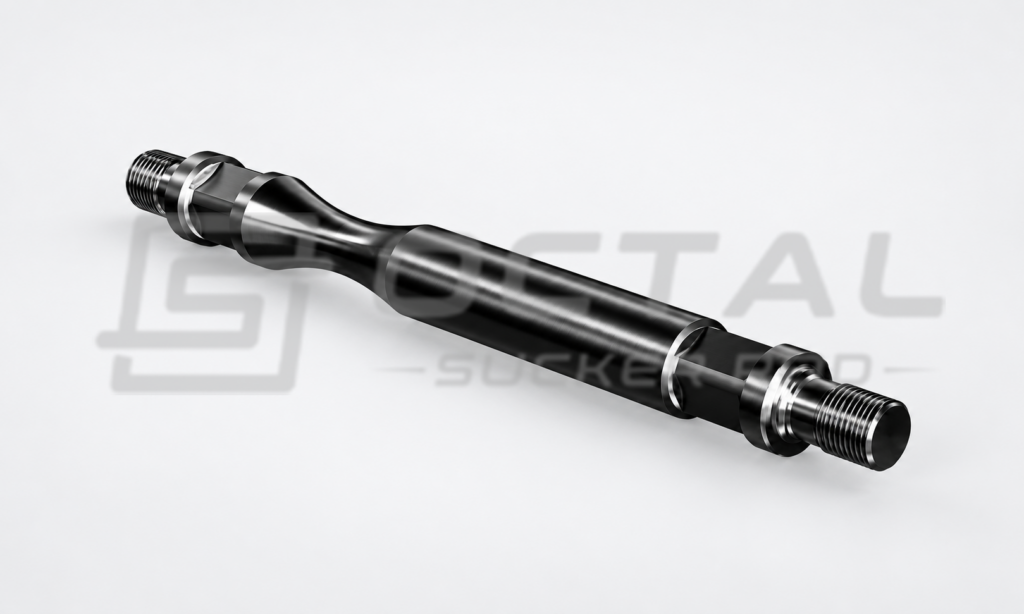
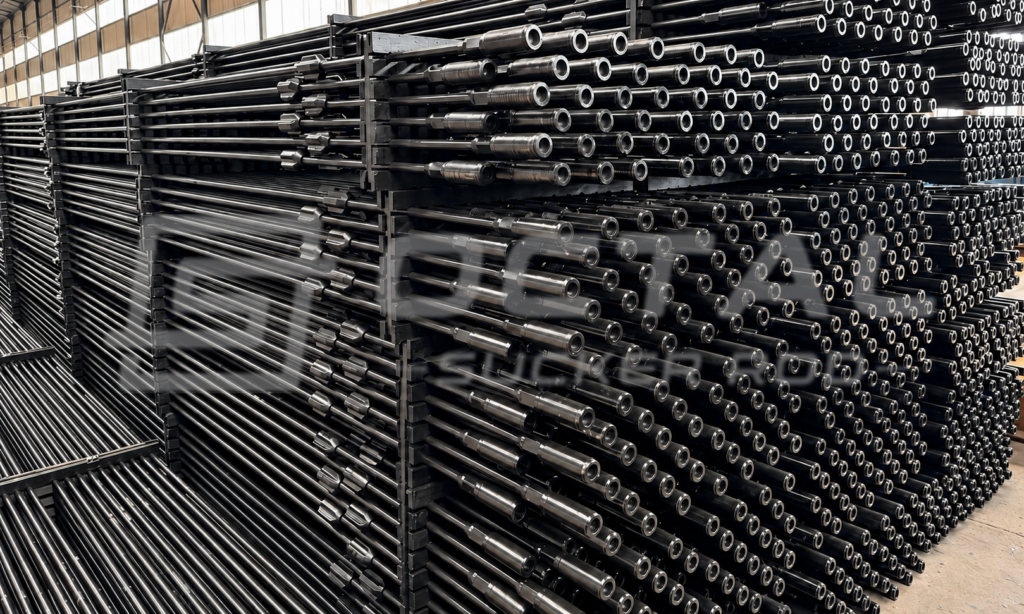
Because sucker rods are subjected to repeated tensile loading during every pumping cycle, their service performance depends on more than nominal diameter and strength grade. Heat-treatment consistency, rod straightness, forged-end quality, thread accuracy, pin and coupling compatibility, and material traceability all influence how evenly the load is transferred through the rod string and how well the connections resist fatigue under cyclic operation. These controls are particularly important for replacement rods, where the new product must match the existing rod string in both mechanical performance and connection geometry.
API 11B Grade C Sucker Rod Specifications
For Grade C rods, the mechanical-property range is more important than a simple material name. The Octal manufacturing reference lists Grade C with a minimum yield strength of 60,000 psi (414 MPa), tensile strength of 90,000–115,000 psi (621–793 MPa), minimum elongation of 13%, and reduction of area of at least 50%.
| Specification Item | Grade C Reference |
| Product | Steel Sucker Rod |
| Standard | API Spec 11B |
| Grade | C |
| Minimum Yield Strength | 60,000 psi / 414 MPa |
| Tensile Strength | 90,000–115,000 psi / 621–793 MPa |
| Elongation | ≥13% |
| Reduction of Area | ≥50% in Octal manufacturing reference |
| Common Rod Sizes | 5/8″, 3/4″, 7/8″, 1″, 1-1/8″ |
| Common Nominal Lengths | 25 ft and 30 ft |
| End Configuration | Forged sucker-rod end with shouldered pin |
| Connection | API sucker-rod pin with matched coupling |
| Typical Service | Conventional reciprocating rod-lift systems |
Grade C acceptance should be based on the complete mechanical and dimensional specification rather than tensile strength alone. Yield strength, tensile strength, elongation, reduction of area, rod-body dimensions, forged-end geometry, thread condition, and coupling compatibility should be checked against the approved order requirements. Where hardness testing is specified, the measured value should be recorded by production lot or heat-treatment batch and evaluated against the qualified manufacturing or project specification rather than treated as a single universal Grade C value..
Grade C Sucker Rod Sizes and Dimensional Control
Grade C sucker rod selection requires the mechanical grade, rod-body dimensions, nominal length, and connection geometry to be confirmed together. The nominal rod size refers to the rod body rather than the larger forged end or coupling envelope. Different rod diameters can use the same Grade C mechanical-property range, so rod size should not be used alone to determine strength or replacement compatibility.
Grade C Mechanical Property Reference
| Property | Grade C Reference | Engineering Note |
|---|---|---|
| Minimum Yield Strength | 60,000 psi / 414 MPa | Minimum Grade C strength reference |
| Tensile Strength | 90,000–115,000 psi / 621–793 MPa | Standard Grade C tensile-strength range |
| Elongation | ≥13% | Used to verify ductility after the qualified heat-treatment route |
| Reduction of Area | ≥50% | Octal manufacturing reference |
| Hardness | Manufacturer / heat-treatment specific | Verify against the approved manufacturing and inspection specification |
| Common Nominal Lengths | 25 ft / 7.62 m; 30 ft / 9.14 m | Confirm together with connection and rod-string position |
Hardness is mainly used to verify heat-treatment consistency rather than to identify Grade C by a single fixed value. Where hardness testing is required, the acceptance range should follow the approved material specification, heat-treatment procedure, and project inspection requirements.
Grade C Sucker Rod Body Sizes and Tolerances
| Nominal Size | Rod Body OD | Rod Body Tolerance | Grade C Strength Reference |
|---|---|---|---|
| 5/8″ | 15.88 mm | +0.18 / -0.36 mm | 60,000 psi min. yield / 90,000–115,000 psi tensile |
| 3/4″ | 19.05 mm | +0.20 / -0.41 mm | 60,000 psi min. yield / 90,000–115,000 psi tensile |
| 7/8″ | 22.23 mm | +0.20 / -0.41 mm | 60,000 psi min. yield / 90,000–115,000 psi tensile |
| 1″ | 25.40 mm | +0.23 / -0.46 mm | 60,000 psi min. yield / 90,000–115,000 psi tensile |
| 1-1/8″ | 28.58 mm | +0.25 / -0.51 mm | 60,000 psi min. yield / 90,000–115,000 psi tensile |
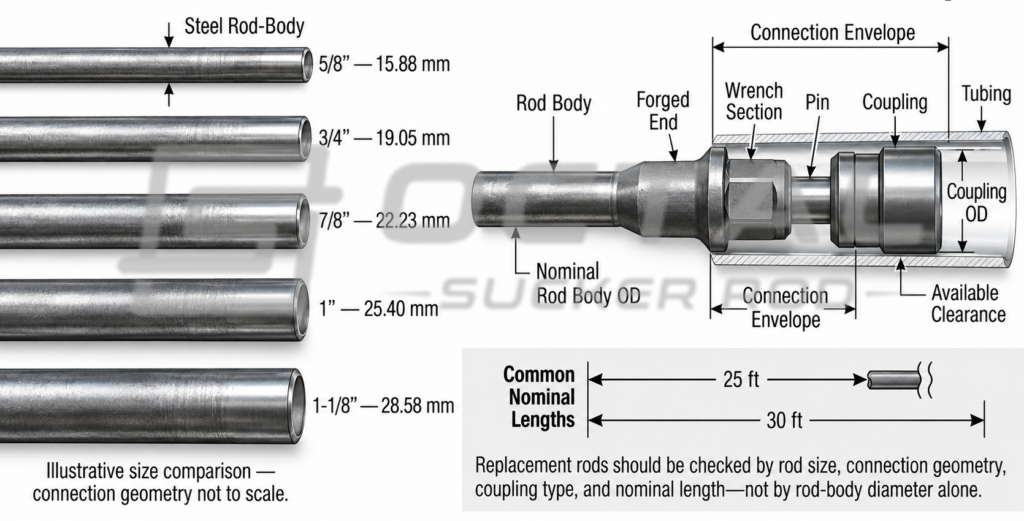
The same Grade C mechanical-property range applies across these common rod-body sizes; increasing rod diameter changes the rod cross-section and load-carrying area, not the Grade C strength definition itself.
The forged end, wrench section, threaded pin, and coupling create a larger connection envelope than the nominal rod-body diameter. For replacement work, the buyer should therefore verify rod size, grade, nominal length, pin and thread configuration, coupling type, and tubing clearance rather than matching body OD alone.
Grade C Sucker Rod Load and Service Conditions
A sucker rod is subjected to repeated tensile loading during every pumping cycle rather than a single static load. The rod string carries the combined effects of rod weight, fluid load, pump load, acceleration, and dynamic stress generated by the surface pumping unit. These cyclic loads make fatigue resistance and local stress control particularly important at the upset transition, forged end, pin shoulder, and threaded connection.
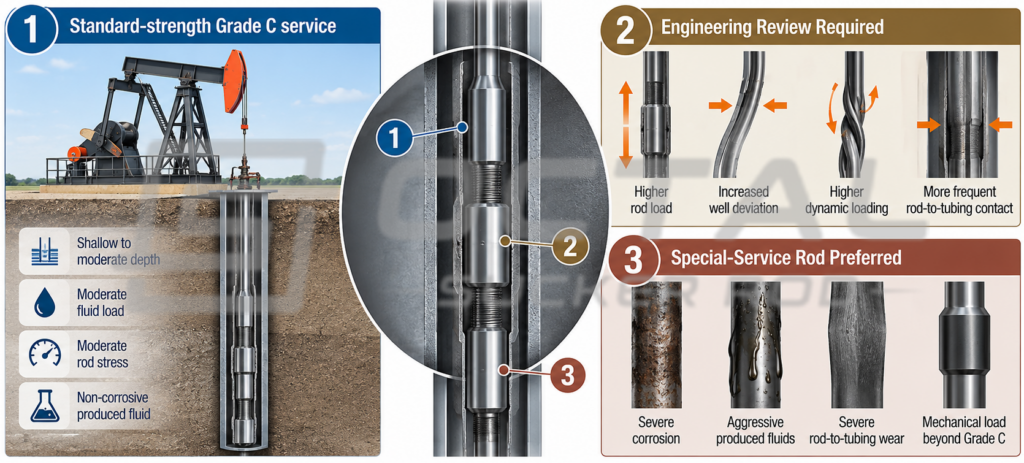
Grade C provides a standard strength level for conventional rod-lift service. Compared with higher-strength Grade D rods, it is better suited to wells where the calculated rod stress remains within the Grade C operating range and where the service environment does not require additional high-strength or corrosion-resistant performance. In these conditions, Grade C offers an effective balance of strength, ductility, fatigue performance, and cost.
For shallow to moderate-depth wells with manageable rod loads, Grade C can be used reliably when rod-string design, connection quality, and corrosion control are properly maintained. Where rod loading becomes substantially higher, corrosion is severe, or rod-to-tubing contact becomes a dominant failure mechanism, a higher-strength or special-service sucker rod grade should be considered instead.
Grade C vs Grade D and Grade K Sucker Rod
Grade selection is controlled primarily by mechanical loading, material route, and produced-fluid condition. Nominal rod diameter and length are separate configuration parameters and may be shared across different sucker-rod grades.
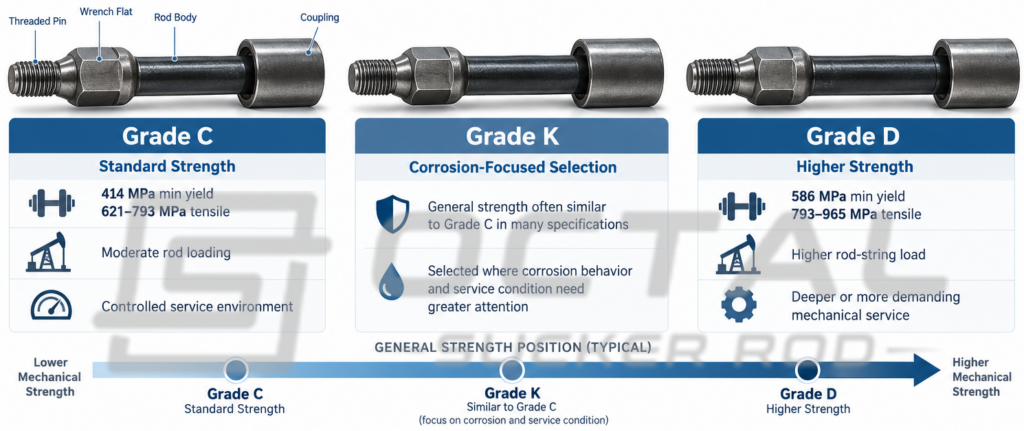
Grade C, Grade K and Grade D Sucker Rod Comparison
| Property | Grade C | Grade K | Grade D |
|---|---|---|---|
| General Strength Position | Standard strength | Similar general tensile-strength range to Grade C | Higher mechanical strength |
| Minimum Yield Strength | 60,000 psi / 414 MPa | Confirm approved manufacturer specification; published Grade K data may use 60,000 psi minimum | Approx. 85,000 psi / 586 MPa |
| Tensile Strength | 90,000–115,000 psi / 621–793 MPa | 90,000–115,000 psi / approx. 620–790 MPa | 115,000–140,000 psi / 793–965 MPa |
| Hardness | Manufacturer / heat-treatment specific | Manufacturer / heat-treatment specific | Manufacturer / heat-treatment specific |
| Material / Service Emphasis | Standard-strength carbon-steel route | Greater emphasis on corrosion behavior and service environment | Higher-load carbon or alloy-steel route |
| Typical Rod Loading | Moderate | Moderate, with corrosion condition influencing selection | Higher rod-string mechanical load |
| Corrosion Consideration | Non-corrosive or effectively controlled service | Greater corrosion resistance than Grade C in typical API grade positioning | Strength increase does not by itself solve corrosion |
| Primary Selection Focus | Balanced strength and ductility | Fluid environment and material route | Higher calculated rod stress and mechanical load |
The mechanical-property difference becomes important as rod-string stress approaches the allowable range. Grade D provides a higher load margin than Grade C, while Grade K is selected more for its material route and service environment; none of these grades alone resolves corrosion, connection mismatch, misalignment, deviation, or rod-to-tubing wear.
Hardness is mainly a heat-treatment and manufacturing verification parameter. Its acceptance range should follow the approved material and inspection specification and remain traceable to the relevant heat and production lot.
Common Dimensional Range
Grade C, Grade K, and Grade D may use the same nominal sucker-rod size system. Rod diameter and length therefore need to be selected separately from mechanical grade.
| Dimensional Item | Common Reference | Selection Note |
|---|---|---|
| Rod Body Size | 5/8″, 3/4″, 7/8″, 1″, 1-1/8″ | Nominal size refers to rod-body OD |
| Rod Body OD | 15.88, 19.05, 22.23, 25.40, 28.58 mm | Grade does not change the definition of nominal rod diameter |
| Nominal Length | 25 ft / 7.62 m; 30 ft / 9.14 m | Confirm length together with connection and rod-string position |
| Connection | API sucker-rod pin with matched coupling | Pin and coupling configuration must match the existing rod string |
A 7/8-inch Grade C rod and a 7/8-inch Grade D rod share the same nominal body size, but their mechanical properties and load ranges differ. Replacement selection should therefore also confirm grade, length, connection, coupling type, service condition, and inspection requirements.
Grade C suits moderate loads and controlled corrosion, Grade D provides higher mechanical strength, and Grade K places greater emphasis on corrosion-related service conditions.
Grade C Sucker Rod Material and Heat Treatment
Grade C sucker rods are produced from qualified carbon-steel materials selected to achieve the required API 11B mechanical properties and fatigue performance. The exact steel chemistry may vary with the approved manufacturing specification, but the finished rod must consistently meet the specified strength, ductility, and dimensional requirements after heat treatment.
Heat treatment controls the final mechanical-property distribution of the rod body and directly affects strength consistency, ductility, straightness, and fatigue resistance. The Octal partner manufacturing base uses controlled heat-treatment lines with independently regulated heating zones and thermocouples to maintain more uniform rod-body temperature during processing. The production system also includes forging, upsetting, straightening, machining, and inspection equipment for complete sucker-rod manufacturing control.
Each production lot can be linked to its material heat number, chemical composition, heat-treatment record, mechanical test results, dimensional inspection, and final product identification. This traceability allows Grade C rods to be verified against the approved order specification before shipment.
Connection and Coupling Selection
The sucker-rod coupling carries load from one rod to the next through two threaded pin connections. Connection quality therefore affects the performance of the entire string.
API rod systems commonly use full-size or slim-hole couplings. A full-size coupling provides the standard connection envelope, while a slim-hole coupling reduces outside diameter where tubing clearance is limited. Octal’s sucker-rod product range also includes coupling configurations such as Class T and spray-metal options, depending on the service requirement.
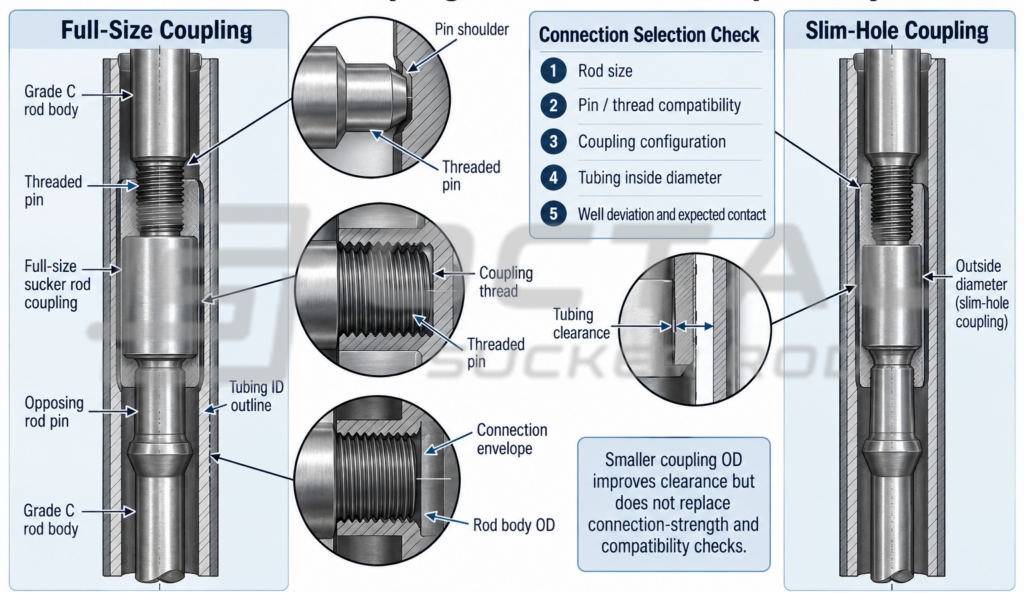
A smaller coupling OD should not be selected only because it provides more clearance. The buyer still needs to check connection strength, tubing ID, rod size, thread compatibility, well deviation, and expected contact between the coupling and tubing.
When replacing rods in an existing string, pin and coupling compatibility deserves the same attention as rod grade. A new Grade C rod with the wrong connection geometry creates a more immediate field problem than a small difference in nominal rod-body diameter.
Grade C Sucker Rod Application Range
Grade C sucker rods are designed for conventional rod-lift wells where the rod string operates within a moderate mechanical load range and the produced-fluid environment does not impose severe corrosion or wear. Their suitability should be evaluated together with well depth, rod load, deviation, corrosion condition, and rod-to-tubing contact.
| Operating Condition | Grade C Suitability | Engineering Consideration |
| Shallow to moderate well depth | Suitable | Rod loading normally remains within the standard Grade C strength range when the string is properly designed. |
| Moderate pump and fluid load | Suitable | Provides sufficient tensile capacity without requiring a higher-strength rod grade. |
| Non-corrosive produced fluid | Suitable | Standard carbon-steel Grade C service is appropriate where corrosion is not the controlling failure mechanism. |
| Effectively inhibited corrosion | Conditionally suitable | Corrosion-control treatment should be stable and monitored throughout operation. |
| High rod-string load | Review required | Higher-strength grades may provide a larger operating margin when calculated stress approaches the Grade C limit. |
| Highly deviated well | Review required | Increased bending and rod-to-tubing contact can make wear control more important than basic tensile strength. |
| Severe corrosion or aggressive fluids | Not preferred | Corrosion-resistant or specially engineered sucker rods should be evaluated instead. |
| Severe rod-tubing wear | Not preferred | Centralizers, wear-resistant designs, or alternative rod configurations may be required. |
In practice, Grade C is most effective when mechanical loading remains moderate and corrosion is controlled. If the primary design challenge shifts to high tensile load, severe corrosion, or continuous rod-to-tubing contact, the rod-string design should move to a more suitable grade or special-service configuration rather than simply increasing Grade C rod diameter.
Manufacturing Control and Inspection
Sucker-rod quality depends on consistent forging, heat treatment, straightening, machining, and thread control. For Grade C rods, inspection should focus on the mechanical properties and dimensional features that directly affect cyclic loading, including yield strength, tensile strength, hardness, rod-body OD, straightness, forged-end geometry, and thread accuracy.
Octal’s manufacturing and inspection capability supports tensile, hardness, impact, and metallographic testing where required. Material heat numbers, production lots, heat-treatment records, dimensional inspection, mechanical test results, product marking, and packing documents can be linked to maintain traceability through final shipment.ork, because mixing grades or connection configurations inside an existing string can create uneven load distribution and maintenance problems.
Octal Steel Grade C Sucker Rod Supply Capability
Octal Steel can supply Grade C sucker rods in common API sizes and nominal lengths, together with compatible sucker rod couplings, pony rods, sinker bars, and other rod-string components. Supply can be matched to the required rod diameter, connection, coupling type, and project inspection requirements. The manufacturing base also supports forging, heat treatment, straightening, machining, and inspection, with tensile, impact, hardness, and metallographic testing available for product verification. Material and production records can be retained through the manufacturing lot to support traceability and final delivery documentation.
FAQ
Is Grade C sucker rod suitable for deep wells?
Grade C can be used only when the calculated rod-string stress remains within its allowable operating range. Well depth alone does not determine the grade. Pump load, rod taper design, dynamic loading, fluid load, and corrosion condition must also be considered. Where calculated stress is high, a higher-strength grade such as Grade D may be more appropriate.
What is the tensile strength of Grade C sucker rod?
A commonly used Grade C range is 90,000–115,000 psi, or approximately 621–793 MPa, with a minimum yield strength of about 60,000 psi / 414 MPa. The final acceptance values should follow the agreed API edition and qualified manufacturer’s specification.
Can a Grade C sucker rod replace a Grade D rod?
Not automatically. Grade D has a higher mechanical-strength range. Replacing it with Grade C requires a rod-string load check to confirm that the lower strength still provides an acceptable operating margin. Connection size, rod length, and coupling compatibility must also be verified.
What information is needed when replacing an existing sucker rod?
The buyer should confirm the existing rod’s nominal diameter, grade, length, pin dimensions, coupling type, and rod-string position. Matching only the nominal diameter is not sufficient because rods of the same body size may use different connection or service configurations.