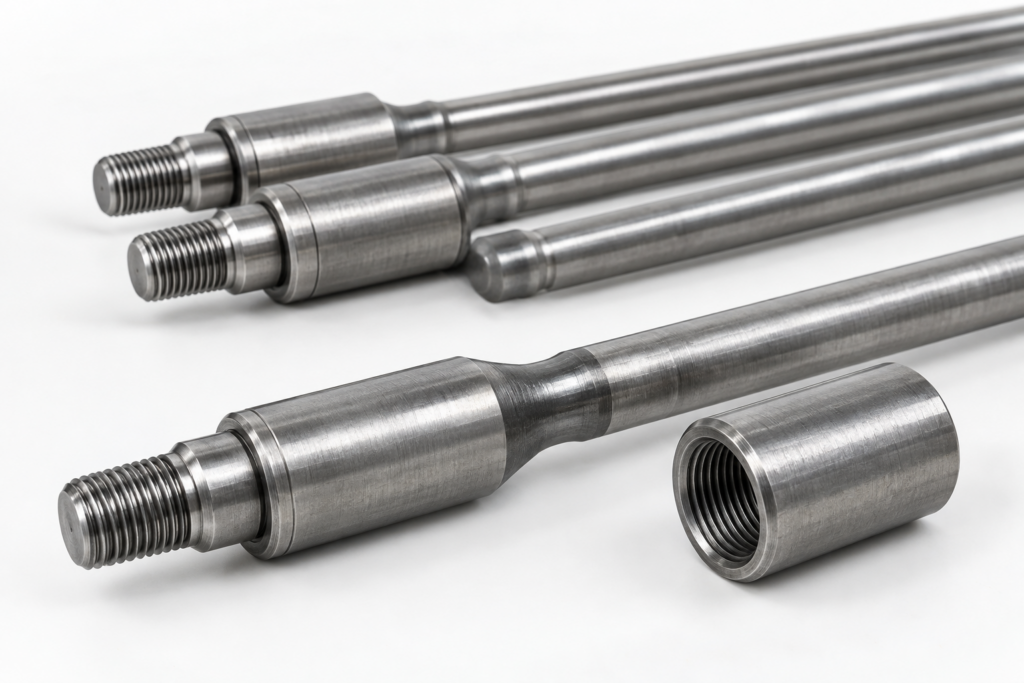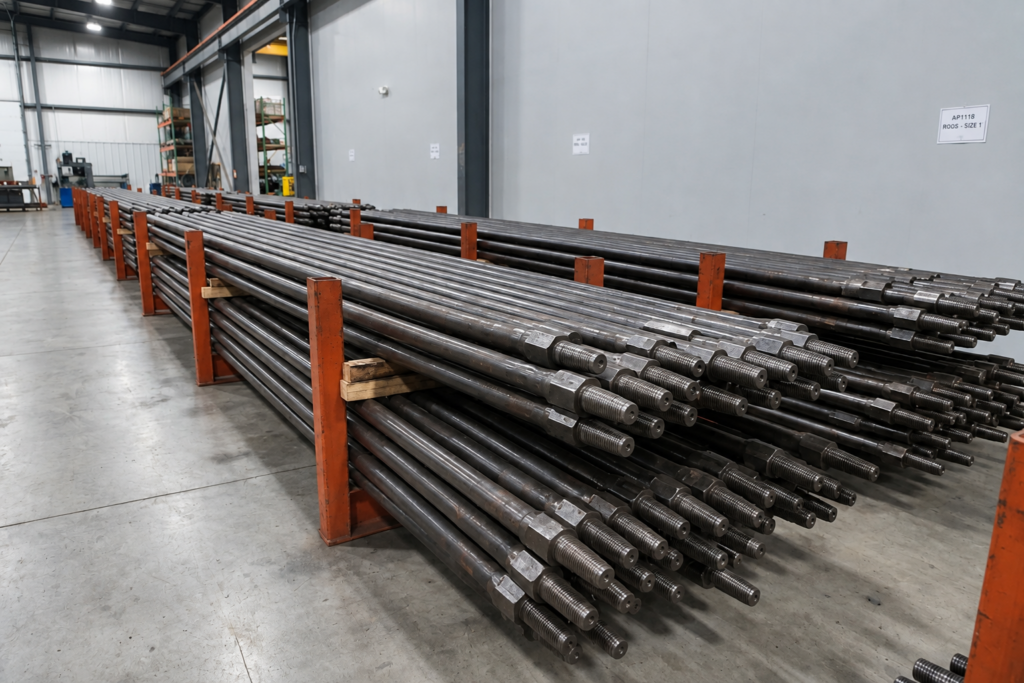
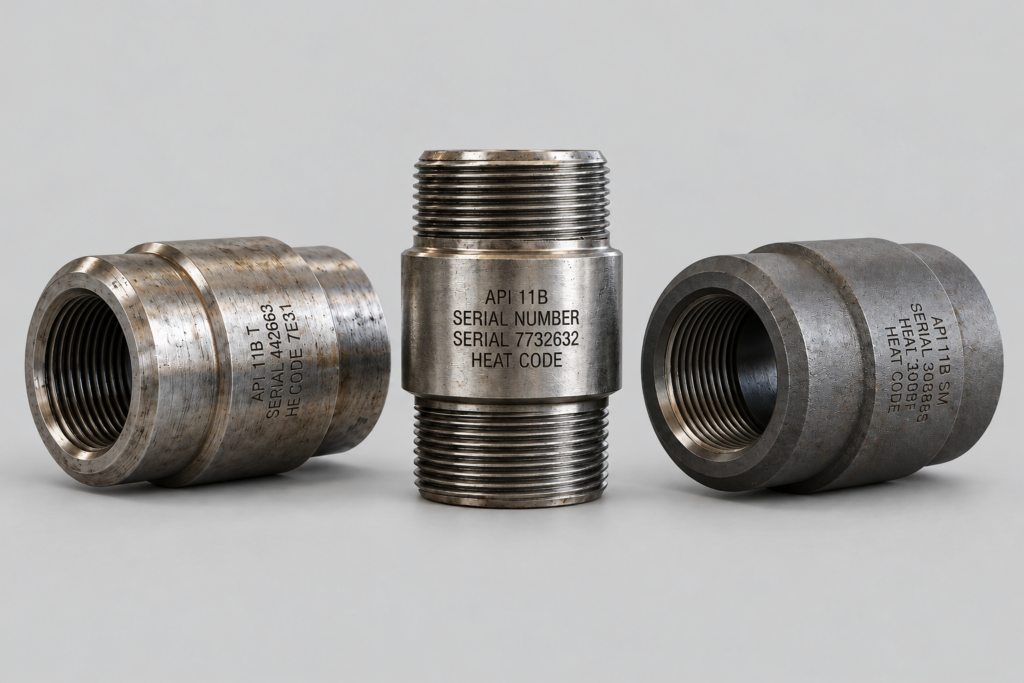
Sucker rod couplings are threaded connection components used to join individual sucker rods into a complete rod string in beam pumping systems. Installed between two sucker rod sections, the coupling transfers the reciprocating load through the rod string while maintaining thread engagement, alignment and connection stability during continuous pumping cycles. Because the coupling operates under repeated tensile loading, compression, tubing contact and fluid exposure, its design directly affects rod-string reliability and service life.
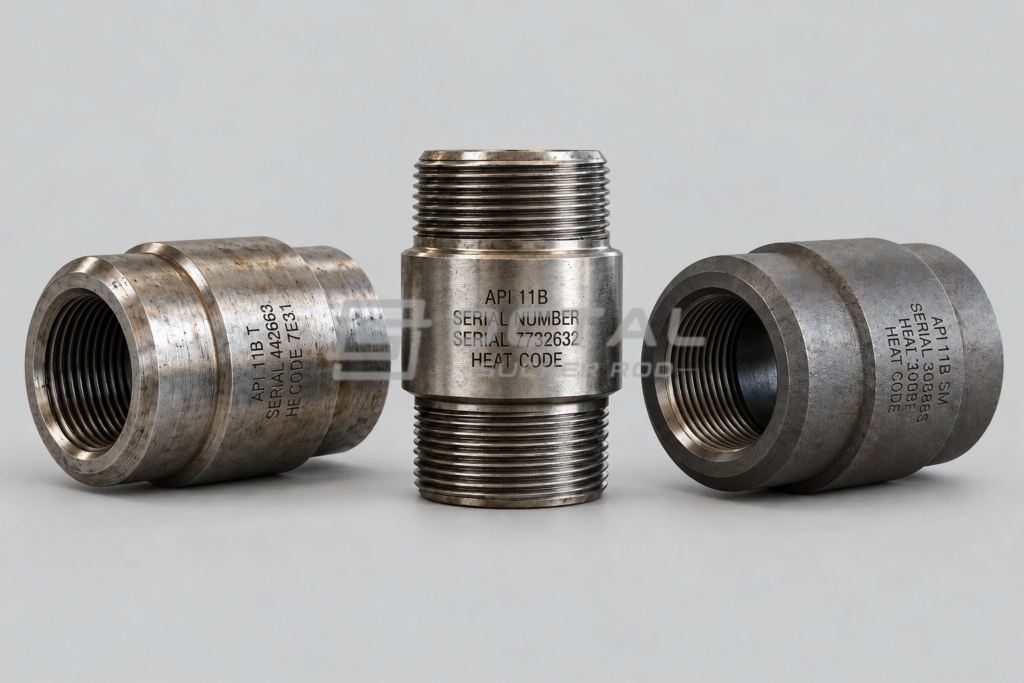
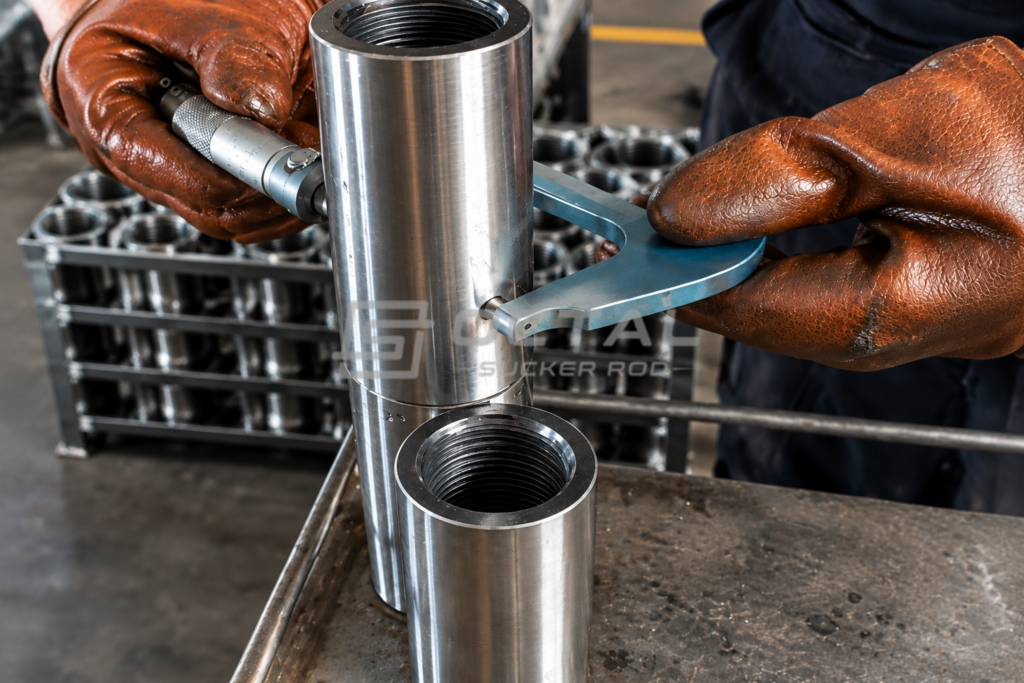
According to API 11B, sucker rod couplings are available in different designs to meet various operating conditions, with Class T and Class SM being two commonly selected coupling types. The main difference between them is the surface treatment and wear protection method. Class T sucker rod couplings are through-hardened couplings, where the entire coupling body is heat treated to achieve uniform hardness and mechanical strength. They are commonly used in standard rod pumping conditions where connection strength and fatigue resistance are the primary requirements.
Class SM sucker rod couplings use a sprayed metal surface layer on the coupling exterior to improve resistance against external wear. This design is mainly considered for applications where coupling-to-tubing contact, well deviation or abrasive operating conditions may accelerate surface damage. Compared with Class T, Class SM provides an additional wear-resistant surface protection layer, making it more suitable for challenging well environments.
Selecting between Class T and Class SM sucker rod couplings requires evaluating not only rod size and thread compatibility, but also tubing clearance, well trajectory, corrosion exposure and potential wear mechanisms. A suitable coupling design helps reduce connection failures, tubing wear risks and unnecessary workover operations.
What Factors Should Be Considered When Selecting a Sucker Rod Coupling?
Although a sucker rod coupling is a relatively small component in the rod string assembly, it directly influences connection reliability, tubing clearance and long-term operating stability. During pumping operation, each coupling experiences repeated tensile and compressive loading, thread stress concentration and possible contact with tubing. In unsuitable conditions, coupling selection may contribute to premature wear, connection damage or increased workover frequency.
For this reason, coupling selection should be based on the complete operating condition rather than only matching the rod diameter. Before choosing between Class T and Class SM sucker rod couplings, buyers should evaluate the following engineering factors.
| Selection Factor | Why It Matters in Field Operation | What Buyers Should Confirm |
| Rod size and connection compatibility | The coupling must correctly match the sucker rod pin size, thread profile and connection specification. Incorrect matching may cause incomplete thread engagement, improper load transfer or connection stress concentration during reciprocating movement. | Rod diameter, API 11B requirement, thread type, coupling size and connection specification |
| Coupling outside diameter (OD) | Coupling OD directly affects the clearance between the rod string and tubing. In restricted clearance conditions, excessive OD may increase tubing contact risk, while insufficient consideration of clearance can accelerate wear during operation. | Coupling OD, tubing ID, available clearance and well completion design |
| Well deviation and rod-string movement | In deviated wells, the rod string tends to move toward the lower side of the tubing due to gravity. Couplings may experience repeated side contact during every pumping cycle, creating external wear on the coupling surface and possible tubing wear. | Well trajectory, deviation angle, dogleg severity and expected tubing contact condition |
| Wear environment | Coupling wear is often related to mechanical contact rather than only material strength. Wells with frequent tubing contact, abrasive particles or long operating cycles may require additional surface protection. | Production conditions, sand content, expected wear rate and required service interval |
| Corrosion exposure | Produced fluids containing CO₂, H₂S, chlorides or water can accelerate corrosion-related damage. Corrosion combined with cyclic loading may increase the risk of fatigue-related failure. | Fluid composition, corrosion environment, material requirements and protection measures |
| Pumping load and operating cycle | Sucker rod strings experience continuous cyclic loading. Over time, stress concentration around threaded connections can contribute to fatigue damage if the coupling design does not match the operating load. | Pump depth, stroke length, pumping frequency, rod load calculation and service conditions |
| Maintenance objective and service life requirement | Different wells have different priorities. Some operators focus on minimizing initial cost, while others prioritize longer run time and fewer pulling operations. | Expected service life, maintenance strategy and total operating cost target |
The selection of sucker rod grade depends on factors such as loading condition and corrosion environment. Different grades may require different rod string considerations during coupling selection.
How These Factors Influence Class T and Class SM Selection
The above factors determine whether the main concern is mechanical strength or external wear resistance.
For relatively stable operating conditions, where tubing contact is limited and the primary requirement is maintaining reliable threaded connections, Class T sucker rod couplings are commonly considered. Their through-hardened structure provides uniform hardness throughout the coupling body and supports repeated loading conditions.
For wells with higher wear risks, especially deviated wells where coupling-to-tubing contact may occur repeatedly, Class SM sucker rod couplings may provide additional protection through their sprayed metal surface layer. The wear-resistant outer surface helps reduce external abrasion on the coupling body.
A coupling that matches only the rod connection but ignores actual well conditions may still experience premature failure. For example, a standard coupling installed in a highly deviated well may maintain thread integrity but suffer accelerated OD wear due to repeated tubing contact.
The selection of coupling should also consider the sucker rod grade and mechanical properties, because different rod grades are designed for different loading conditions and service environments.
Therefore, coupling selection should consider the complete relationship between:
Rod string design → Well trajectory → Tubing clearance → Wear mechanism → Coupling class
rather than selecting a coupling only by nominal size.
Class T vs Class SM Sucker Rod Coupling: What Is the Difference?
Both Class T and Class SM sucker rod couplings are used to connect sucker rods in accordance with API 11B, but they are not intended to solve exactly the same field problem. The most important difference is not simply the coupling name, but the wear-control approach behind each design.
Class T couplings are primarily selected for their through-hardened body structure, which provides uniform hardness and reliable mechanical strength throughout the coupling section.
Class SM couplings, by contrast, are developed to improve external wear resistance, especially in wells where the coupling outside diameter may repeatedly contact the tubing wall.
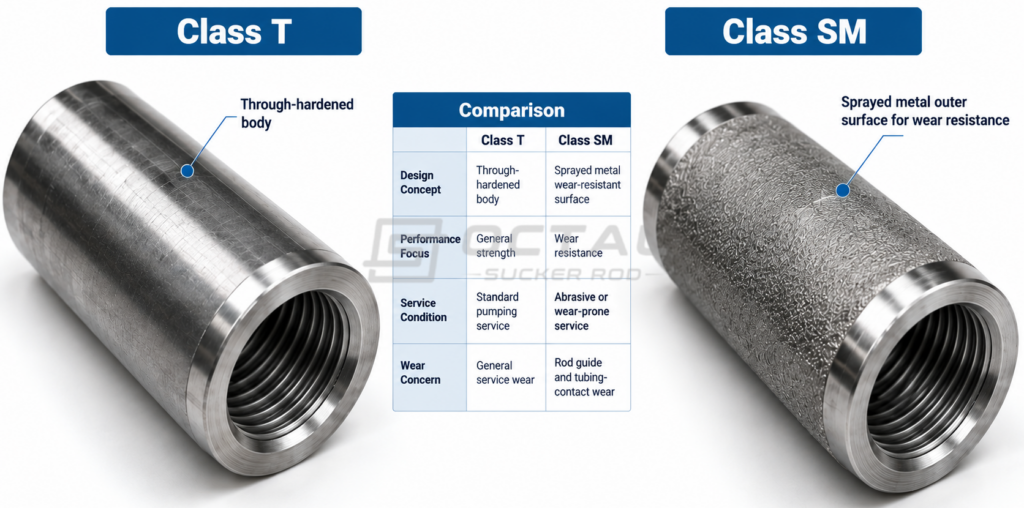
Instead of viewing them as two interchangeable catalog items, buyers should understand them as two coupling designs aimed at different service priorities:
Class T focuses more on connection strength and general mechanical service, while Class SM places more emphasis on external wear protection under harsher running conditions.
Side-by-Side Comparison of Class T and Class SM Sucker Rod Couplings
| Comparison Item | Class T Sucker Rod Coupling | Class SM Sucker Rod Coupling |
| Basic design concept | Through-hardened coupling body | Coupling with sprayed metal outer surface |
| Main design purpose | Provide uniform hardness and reliable mechanical load transfer | Improve resistance to external wear on the coupling OD |
| Key protected area | Entire coupling body and thread-bearing section | Outer surface area exposed to tubing contact |
| Primary performance focus | Strength, thread integrity and fatigue-related service stability | Wear resistance under side contact and abrasive service |
| Typical operating concern | Repeated reciprocating load and connection reliability | Coupling-to-tubing contact, OD wear and frictional damage |
| Recommended well condition | Standard vertical or mildly deviated wells | Deviated wells or wells with increased side loading risk |
| Tubing contact risk | Suitable when tubing contact is limited or moderate | Better suited where repeated tubing contact is expected |
| Wear-control method | Relies mainly on overall hardened body structure | Adds wear-resistant outer layer to resist surface damage |
| Service priority | Mechanical stability in normal rod pumping service | Longer resistance to external abrasion and sliding wear |
| Typical buyer concern | Correct thread match, strength level, load transfer reliability | Wear life, tubing clearance, contact severity and run-time stability |
How Class T and Class SM Sucker Rod Couplings Perform in Different Well Conditions
The difference between Class T and Class SM sucker rod couplings becomes more significant when they are evaluated under actual pumping conditions. Although both coupling types provide the threaded connection between sucker rods, the main operating challenge they address is different. In a rod pumping system, couplings experience repeated tensile loading, compression during movement reversal, thread stress concentration and possible contact with tubing, especially in deviated wells.
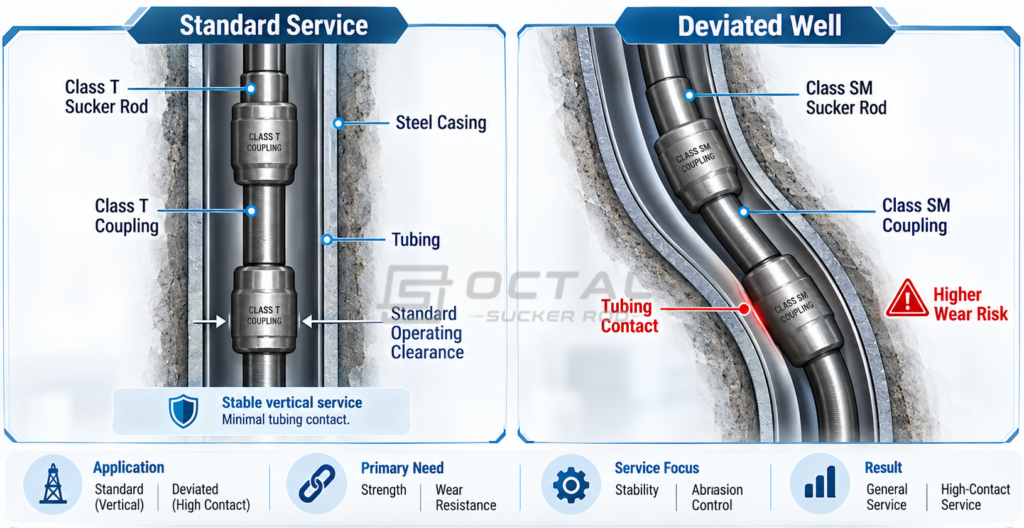
Class T sucker rod couplings are mainly designed for mechanical reliability under standard service conditions. The through-hardened coupling body provides uniform hardness throughout the section, helping maintain connection strength and load transfer capability during repeated pumping cycles. They are commonly considered when the primary requirements are stable thread performance, sufficient mechanical strength and reliable operation without severe external wear exposure.
Class SM sucker rod couplings focus more on controlling external wear risks during operation. The sprayed metal surface layer provides additional protection on the coupling outside diameter, which is beneficial when the coupling may experience repeated contact with tubing, higher side loading or abrasive conditions. In these applications, the limiting factor is often not thread strength, but the gradual loss of coupling material caused by surface wear.
When Should You Choose Class T Sucker Rod Coupling?
Class T sucker rod coupling is generally selected for wells where the main requirement is reliable mechanical connection under standard pumping service, rather than enhanced external wear protection. Its through-hardened body structure makes it suitable for rod strings operating under repeated cyclic loading where thread integrity, load transfer stability and overall connection strength are the main engineering concerns.
In practical terms, Class T is more commonly used when the well is vertical or only slightly deviated, tubing contact is limited, and the coupling outside diameter is not expected to experience severe rubbing against the tubing wall. Under these conditions, the dominant risk is usually not coupling OD wear, but maintaining a dependable connection between rod sections during continuous reciprocating operation.
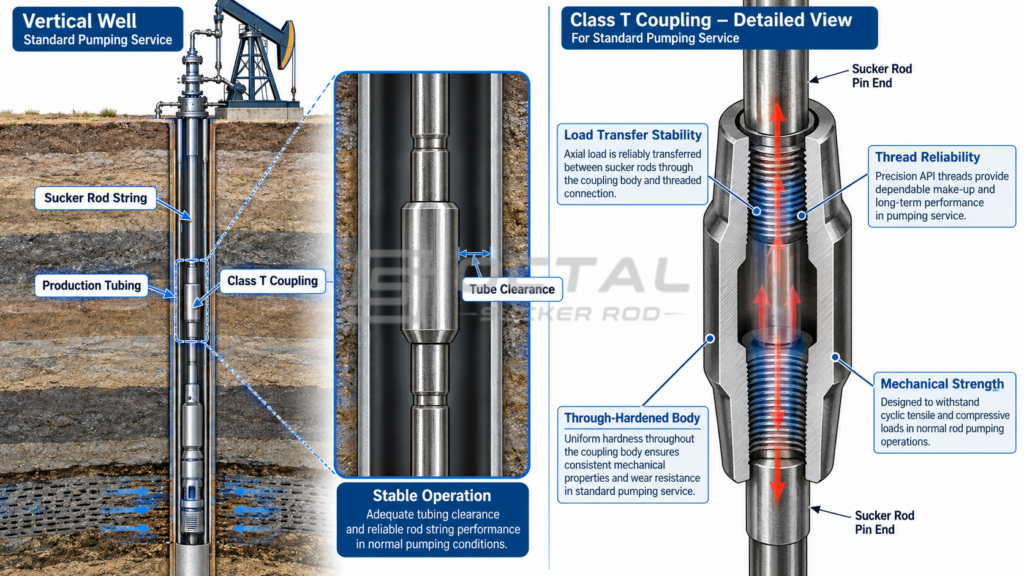
Typical applications include:
- vertical or slightly deviated wells;
- standard sucker rod strings under normal pumping duty;
- wells where tubing clearance is adequate;
- operations where connection reliability is a higher concern than coupling surface wear;
- service conditions where the rod string does not show a history of severe coupling-to-tubing contact.
From a service perspective, the selection focus for Class T is usually:
thread reliability → load transfer stability → fatigue resistance under normal operating conditions.
For these applications, a through-hardened coupling provides a balanced solution between strength and general service performance. However, Class T should not be chosen automatically just because it is a standard option. If the well has noticeable deviation, side loading or a known history of tubing contact, the buyer should also assess whether external wear — rather than connection strength — is the actual limiting factor.
When Is Class SM Sucker Rod Coupling a Better Choice?
Class SM sucker rod coupling becomes a better choice when the coupling exterior is exposed to higher wear risk during operation. Unlike Class T, the main value of Class SM is not simply general mechanical service, but its ability to provide improved protection on the coupling outside diameter through a sprayed metal surface layer. This makes it more suitable for wells where coupling wear is likely to become a practical operating limitation.
Class SM is commonly considered in deviated wells, where gravity causes the rod string to move toward the lower side of the tubing and the coupling outside diameter may repeatedly contact the tubing wall during reciprocating motion. In these conditions, the coupling may suffer progressive OD wear even when the threaded connection itself remains mechanically sound.
Typical risks in such applications include:
- coupling OD wear;
- tubing wear caused by repeated side contact;
- increased friction during pumping;
- shorter service intervals;
- higher pulling frequency caused by wear-related failure.
Class SM may also be more suitable in wells with abrasive production conditions, such as operations involving sand or solid particles, or in rod strings where field history shows abnormal coupling wear. In these cases, the selection concern shifts away from only connection strength and toward long-term resistance to external surface damage.
Class SM is therefore more appropriate when:
- the well has noticeable deviation or side loading;
- tubing contact is frequent or expected;
- the rod string operates in an environment with higher wear exposure;
- service life is being limited by coupling OD wear rather than thread failure;
- reducing wear-related maintenance or pulling frequency is an operating priority.
In short, Class SM should be considered when the dominant field risk is external wear rather than normal mechanical load transfer. For buyers, this is often the most practical dividing line between Class T and Class SM selection.
How Does Coupling Outside Diameter Affect Sucker Rod String Selection?
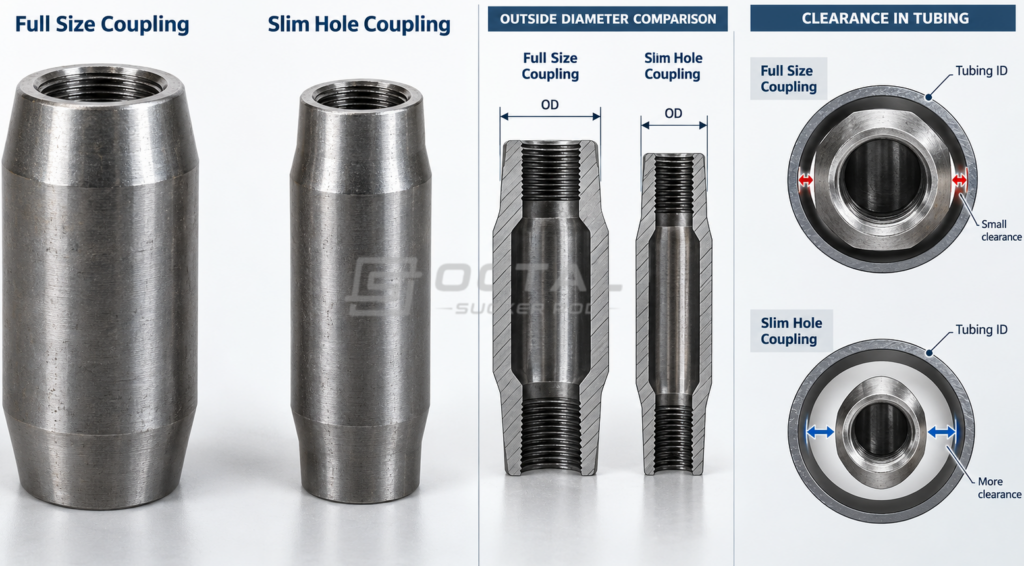
After selecting the appropriate coupling class, another important consideration is the coupling outside diameter (OD). While Class T and Class SM determine the coupling’s performance characteristics, the OD design determines how the coupling fits within the available space between the sucker rod string and tubing.
In rod pumping operations, insufficient clearance between the coupling and tubing may increase the possibility of contact, friction and wear, especially in deviated wells. Therefore, buyers should consider whether a standard full size coupling or a slim hole coupling is more suitable based on the completion design and operating conditions.
Full Size Sucker Rod Coupling
Full size sucker rod couplings maintain the conventional coupling outside diameter specified for standard rod string configurations. They are widely used in beam pumping applications where sufficient clearance exists between the coupling outside diameter and the tubing inside diameter.
In a conventional rod string system, the primary function of the coupling is to provide a reliable threaded connection between sucker rod sections while maintaining stable load transfer during repeated reciprocating movement. When the tubing clearance is adequate and coupling-to-tubing contact is not a dominant concern, a full size coupling provides a standard and proven configuration.
The selection of a full size coupling should consider the following engineering factors:
| Consideration | Engineering Meaning |
| Standard coupling OD | Maintains the conventional outside diameter used with standard sucker rod strings and provides a common configuration for field installation and replacement. |
| Thread engagement and load transfer | Provides the designed connection interface between rod sections, allowing tensile loads and cyclic pumping forces to be transferred through the rod string. |
| Tubing clearance requirement | Requires sufficient space between the coupling outside diameter and tubing inside diameter to allow normal rod-string movement without excessive interference. |
| Operating environment | More suitable when tubing contact, side loading and external coupling wear are not expected to become the main service limitation. |
| Maintenance consideration | Common configuration that simplifies replacement planning when the well operates under conventional conditions. |
In practice, full size couplings are generally selected for wells where the available annular space provides adequate operating clearance. The main selection priority is maintaining a reliable connection system rather than reducing coupling diameter.
However, full size coupling selection should still consider well trajectory and operating history. In wells with significant deviation, even a mechanically reliable coupling may experience accelerated OD wear if repeated contact with tubing becomes the dominant failure mechanism.
Slim Hole Sucker Rod Coupling
Slim hole sucker rod couplings are designed with a reduced outside diameter to provide additional clearance between the coupling and tubing wall. Their main purpose is not to increase connection strength, but to address space limitations and reduce the risk of interference between the rod string and tubing.
During pumping operation, the rod string moves continuously inside the tubing. In deviated wells, gravity and side loading can cause the rod string to move away from the center position, increasing the possibility of coupling-to-tubing contact. When the available clearance is limited, reducing coupling OD can become an important design consideration.
The selection of a slim hole coupling should consider the following engineering factors:
| Consideration | Engineering Meaning |
| Reduced coupling OD | Provides additional annular clearance between the coupling and tubing, allowing more operating space for rod-string movement. |
| Tubing interference risk | Helps reduce the possibility of repeated contact between the coupling exterior and tubing wall in restricted-clearance applications. |
| Deviated well application | Can be considered when well trajectory creates increased side loading and a higher probability of coupling contact. |
| Rod-string movement allowance | Provides additional space for dynamic movement during reciprocating operation, especially where central alignment cannot be maintained. |
| Wear control objective | Helps address situations where coupling wear is caused primarily by external contact rather than thread or material failure. |
Slim hole couplings are often considered in applications where the limiting factor is not the mechanical strength of the connection, but the available space around the rod string.
Typical situations include:
- wells with limited tubing clearance;
- deviated wells with increased side loading;
- applications where coupling-to-tubing contact has been observed;
- rod strings requiring additional running clearance.
It is important to understand that a slim hole coupling is not automatically a better option than a full size coupling. A reduced OD design should be selected only when the well completion design and operating conditions justify the additional clearance requirement.
How to Combine Coupling Class and OD Design for Final Selection?
Selecting the right sucker rod coupling requires evaluating both the coupling class and the outside diameter (OD) design because they address different operating challenges. The choice between Class T and Class SM mainly depends on the required performance characteristics: Class T focuses on reliable mechanical strength, thread integrity and general service performance, while Class SM is considered when external wear resistance becomes a more important requirement due to tubing contact, well deviation or abrasive conditions.
After determining the coupling class, the Full Size or Slim Hole design should be selected based on the available tubing clearance and rod-string movement conditions. Full size couplings are commonly used in conventional applications with sufficient clearance, while slim hole couplings provide additional space where restricted clearance or higher contact risk exists. Therefore, the final coupling selection should consider the complete relationship between rod size, connection requirement, coupling class, coupling OD, tubing clearance and well deviation, rather than selecting a coupling only by nominal size.
API 11B Requirements and Inspection Considerations
For API 11B sucker rod couplings, the coupling specification should be confirmed before ordering to ensure that the supplied product matches the intended rod-string application. Although coupling dimensions may appear similar, differences in coupling class, connection design, outside diameter and inspection requirements can directly affect connection reliability and service performance in the field.
Before procurement, buyers should define the key technical requirements, including coupling type, rod size, connection compatibility, dimensional requirements and required inspection documents. These details help avoid situations where the coupling matches the nominal rod size but does not meet the actual operating requirements.
| Requirement Item | Engineering Consideration |
| Coupling Class (Class T or Class SM) | Defines the coupling performance characteristics. Class T is based on through-hardened mechanical properties, while Class SM provides additional external wear protection through surface treatment. |
| Rod Size and Connection | Must match the sucker rod diameter and thread connection to ensure proper engagement, load transfer and connection reliability during repeated pumping cycles. |
| Coupling Outside Diameter | Determines the available clearance between the coupling and tubing. OD selection should consider tubing ID, well deviation and potential coupling-to-tubing contact. |
| Full Size or Slim Hole Design | Defines the coupling configuration according to space requirements. Slim hole designs may be considered where additional clearance is required. |
| Material and Heat Treatment Requirement | Ensures the coupling achieves the required mechanical properties, hardness level and service performance for the intended application. |
| Inspection and Documentation Requirement | Provides verification of material traceability, dimensional accuracy, manufacturing consistency and shipment acceptance. |
For coupling inspection, the focus is not only on checking final dimensions but also on verifying the manufacturing quality that affects long-term operation. Since sucker rod couplings experience repeated loading and possible wear exposure during pumping cycles, inspection should cover critical characteristics related to material condition, machining accuracy and connection performance.
Typical inspection and quality documents may include:
| Inspection / Document | Purpose |
| Material Test Certificate (MTC) | Confirms material grade, chemical composition and heat traceability. |
| Dimensional Inspection Report | Verifies coupling dimensions, outside diameter and critical machining requirements. |
| Thread Inspection Record | Confirms thread accuracy and proper connection compatibility with sucker rods. |
| Hardness Test Report | Verifies the consistency of heat treatment, especially for through-hardened Class T couplings. |
| Surface Treatment Verification | Confirms the required surface condition for designs such as Class SM couplings. |
| Final Inspection Record | Provides shipment acceptance evidence and production traceability. |
A complete API 11B sucker rod coupling specification should therefore include both product requirements and operating conditions. The coupling class, OD design and inspection requirements should be selected together with consideration of the rod string configuration, tubing clearance and expected well conditions.
Why Choose Octal for Sucker Rod Coupling Supply?
Selecting the correct sucker rod coupling requires more than matching product dimensions. The coupling class, OD design, material condition and inspection requirements must all match the intended rod-string application. Octal supports customers by providing coupling solutions based on technical specifications, operating conditions and project requirements.
Octal supplies API 11B sucker rod couplings, including Class T and Class SM designs, with support for different rod-string configurations and application requirements. Based on customer requirements, Octal can assist with coupling selection, including coupling class, outside diameter design, connection compatibility and related technical documentation.
Our service covers:
| Service Area | Octal Capability |
| Product Selection Support | Assist customers in selecting suitable coupling type based on rod size, well conditions, tubing clearance and service requirements. |
| API 11B Specification Compliance | Supply sucker rod couplings according to applicable API 11B requirements, including required dimensions, grades and connection specifications. |
| Class T and Class SM Supply | Provide both through-hardened Class T couplings and wear-resistant Class SM couplings for different operating conditions. |
| Dimensional and Connection Control | Verify coupling dimensions, OD requirements and thread compatibility to ensure proper connection with sucker rods. |
| Quality Documentation | Provide material traceability, inspection records and related technical documents required for project review and acceptance. |
| Project-Based Support | Support customized requirements according to well conditions, quantity requirements and delivery specifications. |
From coupling selection to final documentation, Octal focuses on providing a complete supply solution that helps customers reduce specification risks before installation and improve confidence in field application.
Conclusion
Selecting the right sucker rod coupling requires more than choosing a standard connection size. Class T and Class SM couplings are designed for different service requirements: Class T focuses on through-hardened mechanical performance, while Class SM provides additional protection where external wear becomes a limiting factor.
For procurement teams, the correct choice should consider the complete rod string system, including rod size, tubing clearance, well deviation, corrosion exposure and inspection requirements. A properly selected coupling can improve connection reliability and help reduce avoidable maintenance during oilfield operation.
FAQ
What is the difference between Class T and Class SM sucker rod couplings?
Class T couplings are through-hardened for mechanical strength, while Class SM couplings use a sprayed metal surface layer for improved external wear resistance.
How do I choose between Class T and Class SM sucker rod couplings?
The choice depends on well conditions. Class T is suitable for standard service, while Class SM is considered for higher wear risks such as tubing contact or deviated wells.
Are Class T and Class SM couplings interchangeable?
No. They have different performance characteristics and should be selected according to rod string design, well conditions and wear requirements.
When should I use a slim hole sucker rod coupling?
Slim hole couplings are used when tubing clearance is limited or additional space is required to reduce coupling-to-tubing contact.
What information is required for ordering API 11B sucker rod couplings?
Buyers should confirm rod size, connection type, coupling class, OD design, quantity and required inspection documents before ordering.