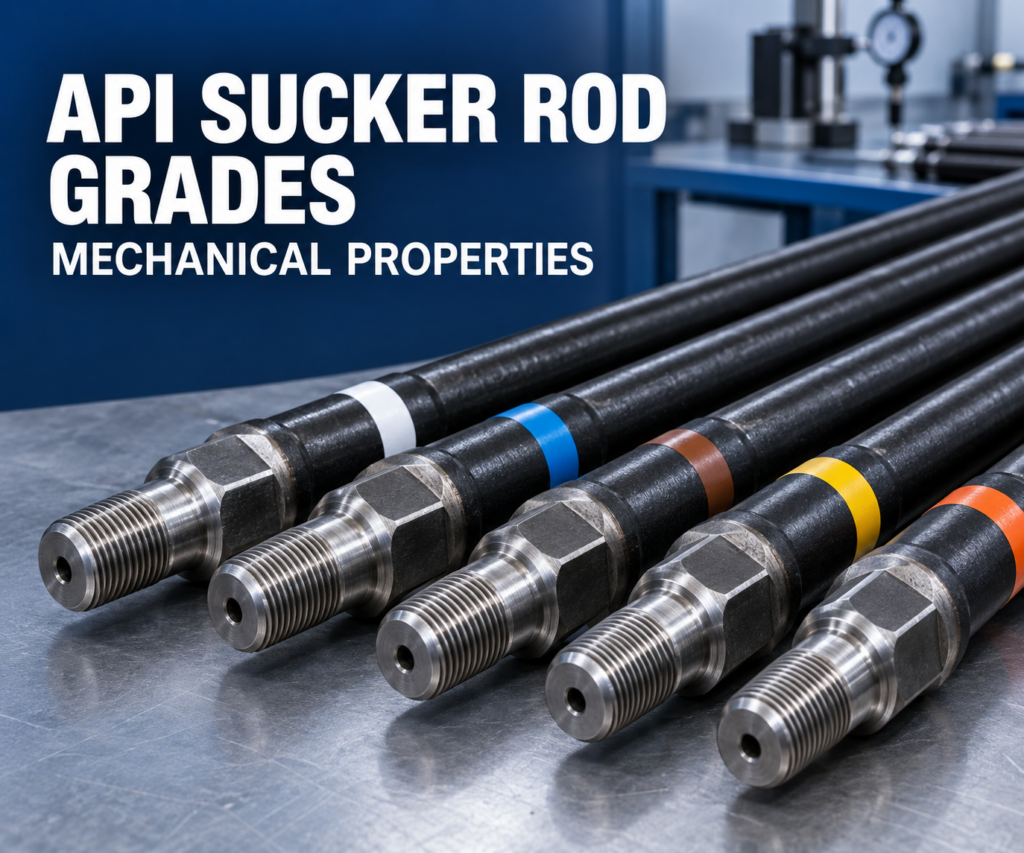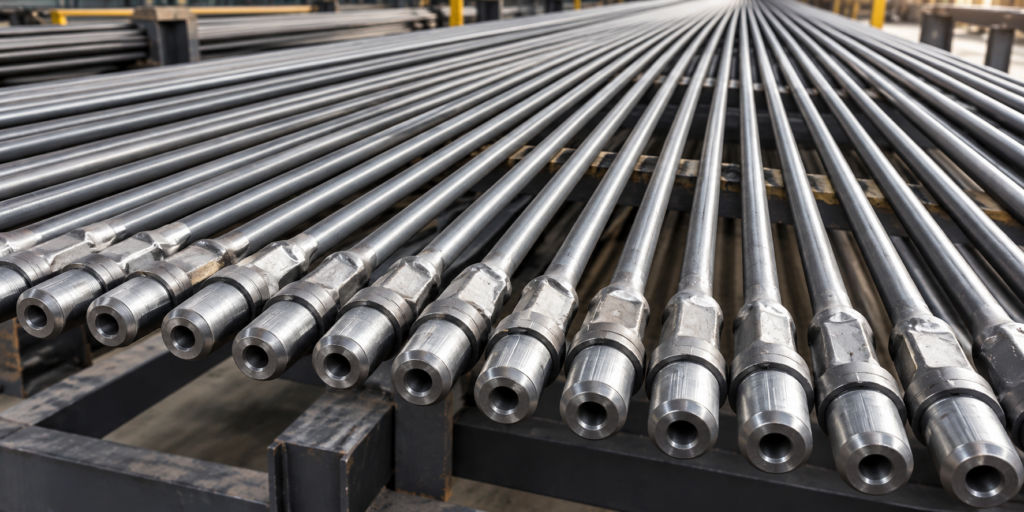
Grade C, Grade D and Grade K sucker rods are steel load-transmitting members used in reciprocating rod-lift systems to connect the surface pumping unit with the downhole pump. Each rod consists of a straight steel body, forged or upset ends, wrench flats and threaded pins, while couplings connect individual rods into a continuous rod string. During operation, the string moves up and down repeatedly while carrying rod weight, fluid load and pump load, so the rod is subjected to cyclic tensile stress rather than one constant static load.
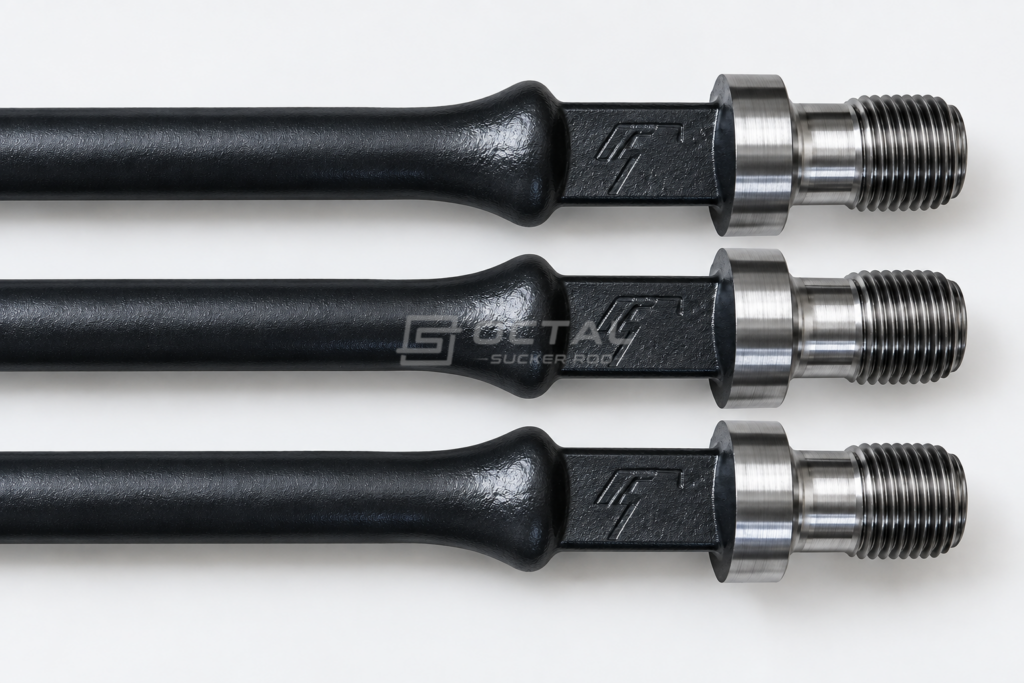
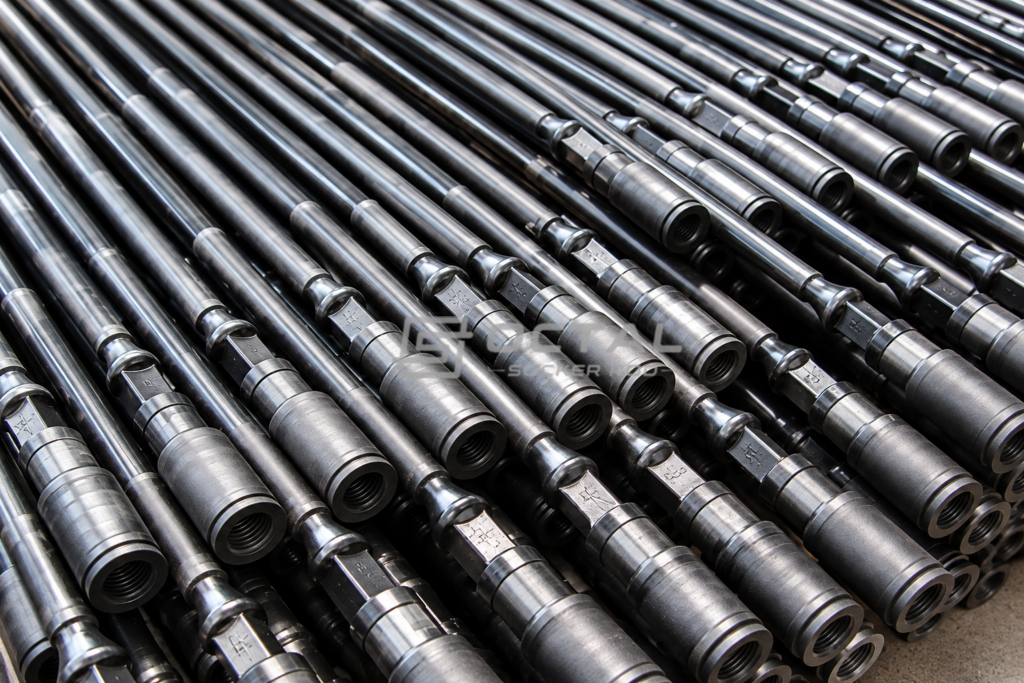
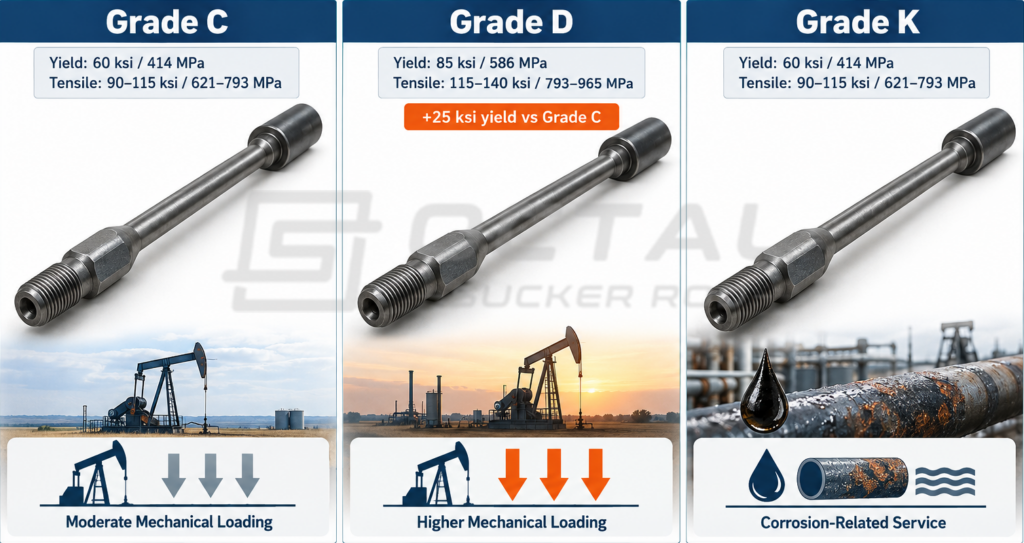
The main difference between Grade C vs Grade D vs Grade K sucker rod is not rod diameter or external shape. It is the combination of mechanical-property range, material route and intended service condition. Grade C provides the standard strength range for moderate mechanical loading; Grade D raises minimum yield strength from 60,000 psi to 85,000 psi and moves the tensile range from 90,000–115,000 psi to 115,000–140,000 psi, making it more suitable where calculated rod-string loading requires additional mechanical strength. Grade K uses a mechanical strength range similar to Grade C but places greater emphasis on material selection for corrosion-related service. Grade selection should therefore follow the dominant operating risk rather than a simple C–D–K ranking.
Grade C, Grade D and Grade K Sucker Rod Selection Overview
The clearest way to distinguish the three grades is to separate strength from service environment.
| Property | Grade C | Grade D | Grade K |
| Minimum Yield Strength | 60,000 psi / 414 MPa | 85,000 psi / 586 MPa | 60,000 psi / 414 MPa |
| Tensile Strength | 90,000–115,000 psi / 621–793 MPa | 115,000–140,000 psi / 793–965 MPa | 90,000–115,000 psi / 621–793 MPa |
| Elongation over 200 mm* | ≥13% | ≥13% | ≥13% |
| Reduction of Area* | ≥50% | ≥50% | ≥50% |
| Main Selection Focus | Moderate calculated loading | Higher calculated mechanical loading | Corrosion-related service selection |
| Typical Material Direction | Carbon-steel route | Carbon, alloy or special-alloy routes depending on specification | Alloy-steel/material route selected with corrosion behavior in mind |
| Hardness | Material and heat-treatment specific | Material and heat-treatment specific | Material and heat-treatment specific |
*Elongation and reduction-of-area values shown here follow the current Octal manufacturing reference used for this comparison; final acceptance should follow the agreed manufacturing specification and purchase requirements.
The most important numerical difference is between Grade C and Grade D. Grade D raises minimum yield strength by 25,000 psi, approximately 42%, while minimum tensile strength increases from 90,000 psi to 115,000 psi. That difference is meaningful when calculated rod stress begins to approach the allowable range of a standard-strength rod. It does not mean that Grade D is automatically the correct choice for every well.
Grade K requires a different interpretation. Its basic yield and tensile range can be similar to Grade C, so choosing Grade K is not primarily a decision to obtain higher tensile capacity. Its purpose is more closely related to the material route and corrosion behavior required by the produced-fluid environment. SLB likewise describes API Grade K as having the same nominal tensile range as Grade C while providing greater corrosion resistance.
Grade C vs Grade D vs Grade K Sucker Rod Comparison
Grade C, Grade D and Grade K sucker rods can use the same nominal rod sizes and similar connection configurations, but their mechanical-property ranges and service priorities are different. The grade therefore does not identify rod diameter; it identifies the performance level and service direction that should be matched to the calculated rod-string load and operating environment.
| Grade | Minimum Yield Strength | Tensile Strength | Main Selection Focus |
| Grade C | 60,000 psi / 414 MPa | 90,000–115,000 psi / 621–793 MPa | Moderate calculated mechanical loading |
| Grade D | 85,000 psi / 586 MPa | 115,000–140,000 psi / 793–965 MPa | Higher calculated rod-string mechanical loading |
| Grade K | 60,000 psi / 414 MPa | 90,000–115,000 psi / 621–793 MPa | Corrosion-related service selection |
Grade C sucker rod provides the standard mechanical-property range for conventional rod-lift applications where calculated tensile and dynamic loads remain moderate. It is generally considered when the rod string does not require the additional strength level of Grade D and the corrosion condition can be adequately controlled. Well depth alone should not determine Grade C selection because pump load, fluid level, stroke condition and rod-string configuration also affect the actual stress carried by the rod.
Grade D sucker rod is distinguished by its higher mechanical strength. Its minimum yield strength increases from 60,000 psi to 85,000 psi, an increase of 25,000 psi or approximately 42% compared with Grade C, while its tensile range shifts from 90,000–115,000 psi to 115,000–140,000 psi. This makes Grade D relevant when rod-string calculations show that additional resistance to higher tensile and cyclic mechanical loading is required.
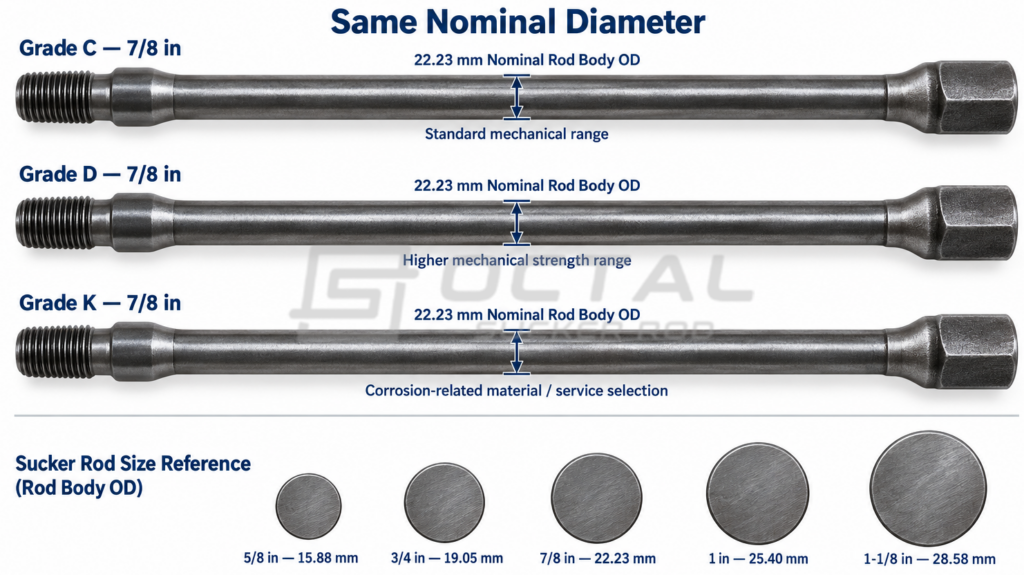
The difference is mechanical rather than dimensional. For example, a 7/8-in. Grade C rod and a 7/8-in. Grade D rod can both use a nominal rod-body diameter of 22.23 mm, while the Grade D rod is manufactured to a higher mechanical-property range. Increasing the grade therefore does not automatically mean increasing rod diameter.
Grade K sucker rod uses a basic strength range similar to Grade C, so its main distinction is not higher tensile capacity. Its selection places greater emphasis on the material route and corrosion-related service environment. Grade K is therefore evaluated where produced-fluid chemistry and corrosion behavior require greater consideration, while the required mechanical loading remains within the applicable strength range.
For purchasing and rod-string design, these grades should not be treated as a simple C → D → K performance ranking. Grade C addresses moderate mechanical loading, Grade D provides additional mechanical strength for higher calculated loads, and Grade K shifts greater attention toward corrosion-related service selection. The final grade should be determined together with rod-string stress, fluid condition, well deviation, tubing clearance, connection compatibility and inspection requirements.
Mechanical Properties and Grade Selection Criteria
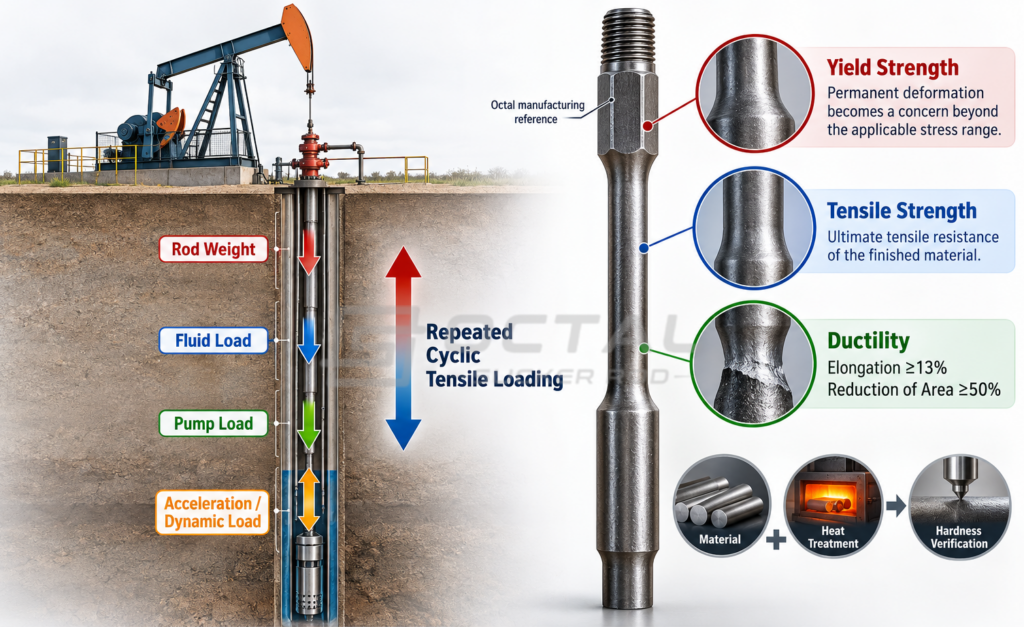
A sucker rod repeatedly changes stress during every pumping cycle. On the upstroke, the rod string supports its own weight while transmitting pump and fluid loads. At stroke reversal, acceleration introduces an additional dynamic component. The mechanical-property table is therefore more than a purchasing formality.
Yield Strength
Yield strength controls resistance to permanent deformation.
For Grade C and Grade K: 60,000 psi / 414 MPa
For Grade D: 85,000 psi / 586 MPa
The 25,000 psi increase gives Grade D greater mechanical margin before permanent deformation becomes a concern.
Tensile Strength
Tensile strength represents the higher material resistance range under tensile loading.
Grade C / Grade K: 90,000–115,000 psi / 621–793 MPa
Grade D: 115,000–140,000 psi / 793–965 MPa
The Grade D range begins where the C/K range ends. This is why Grade D is relevant to a high-load rod string rather than merely being a different material designation.
Elongation and Reduction of Area
These properties show whether the finished rod retains adequate ductility after manufacturing and heat treatment.
The current Octal manufacturing table used in this article lists:
Elongation over 200 mm: ≥13% and Reduction of area: ≥50% for C, D and K.
These values should be evaluated together with strength rather than treated as secondary numbers. A rod is repeatedly cycled in service, so a manufacturing route that reaches high tensile strength at the expense of inadequate ductility would not represent a sound comparison.
Key Differences Between Grade C, Grade D and Grade K Sucker Rod
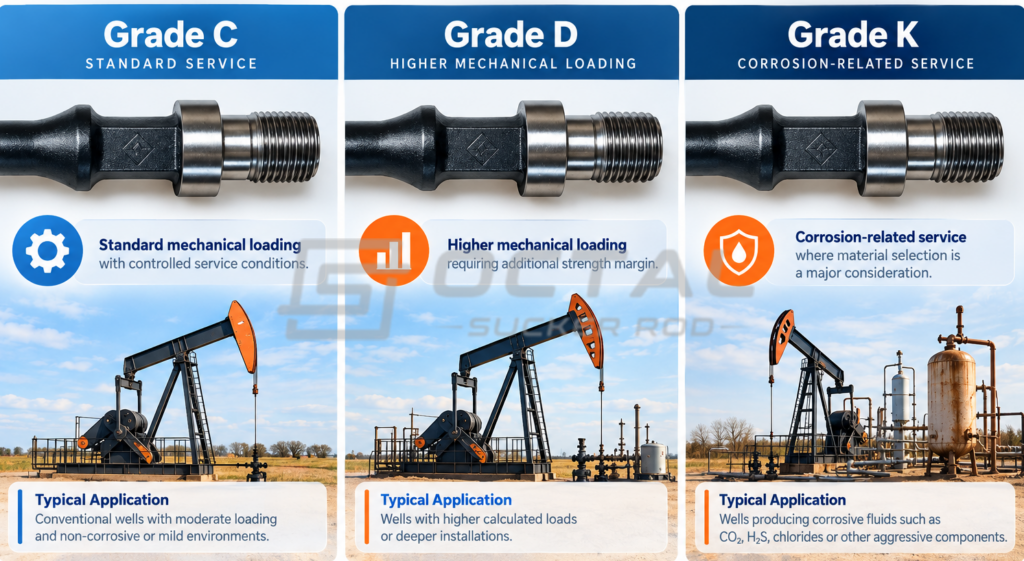
The difference between Grade C, Grade D and Grade K sucker rods is mainly related to their selection purpose, including mechanical loading requirement, material consideration and service environment. These grades are not simply arranged from low to high performance; each grade is intended for different operating conditions.
Mechanical Loading Requirement
The primary difference between Grade C and Grade D is the required mechanical strength level.
Grade C is selected for applications where the calculated rod-string loading remains within a standard operating range.
Grade D is selected when the rod string requires additional strength margin due to higher tensile loading, increased fluid load, larger pump load or higher dynamic stress during pumping cycles.
The decision between Grade C and Grade D should therefore be based on the calculated operating stress of the rod string rather than rod diameter alone.
Material and Service Environment
The main difference between Grade C and Grade K is not tensile strength. Both grades have a similar basic mechanical-property range, but Grade K places greater emphasis on material selection for corrosion-related service conditions.
When produced fluid contains corrosive factors such as CO₂, H₂S, chlorides or other aggressive components, the material route and corrosion control requirements become important considerations.
Hardness Is Not the Grade Classification Basis
Hardness should not be used as the primary method to distinguish Grade C, Grade D and Grade K.
The final hardness value depends on the selected steel route and heat-treatment process. For procurement and quality verification, hardness should be reviewed together with:
- Mechanical test results
- Heat-treatment records
- Material heat number
- Production lot traceability
The practical difference between the three grades can therefore be summarized as:
| Grade | Main Selection Consideration |
| Grade C | Standard mechanical loading with controlled service conditions |
| Grade D | Higher mechanical loading requiring additional strength margin |
| Grade K | Corrosion-related service where material selection is a major consideration |
Grade Selection and Sucker Rod Size Are Two Different Specifications
When selecting a sucker rod, rod grade and rod size should be evaluated separately. The rod diameter determines the physical size of the rod body, while the grade defines its mechanical performance and service selection.
A 7/8 in Grade C sucker rod, 7/8 in Grade D sucker rod and 7/8 in Grade K sucker rod can have the same nominal rod-body diameter of 22.23 mm, but their material characteristics and intended service conditions are different.
The commonly used API 11B sucker rod body sizes include:
| Nominal Rod Size | Rod Body OD |
| 5/8 in | 15.88 mm |
| 3/4 in | 19.05 mm |
| 7/8 in | 22.23 mm |
| 1 in | 25.40 mm |
| 1-1/8 in | 28.58 mm |
For replacement purchasing, the existing rod diameter alone is not enough to define the correct replacement.
For replacement orders, confirm the sucker rod grade, nominal diameter, length, pin/thread configuration, coupling type, service condition, and required inspection documents together.
For example, replacing a 7/8 in Grade C sucker rod with a 7/8 in Grade D sucker rod does not change the rod-body diameter, but it changes the mechanical strength level and load capability of the rod string.
Therefore, sucker rod selection should match both the physical dimensions required by the rod string design and the mechanical or service requirements of the well condition.
Understanding Sucker Rod Body Size and Connection Dimensions
When selecting sucker rods, the nominal rod size refers to the straight rod body diameter, not the maximum outside diameter of the complete connection assembly.
A sucker rod consists of multiple sections with different external dimensions:
Rod Body → Upset Transition → Forged End → Wrench Flats → Pin Shoulder → Threaded Pin → Coupling.
The forged end, pin shoulder and coupling are larger than the straight rod body. Therefore, tubing clearance should be evaluated based on the actual connection dimensions, not only the nominal rod size.
For example, a 7/8 in sucker rod has a nominal rod-body diameter of 22.23 mm, but the coupling outside diameter depends on the selected connection type:
| Rod Size | Full-Size Coupling OD | Slim-Hole Coupling OD |
| 5/8 in | 38.10 mm | 31.80 mm |
| 3/4 in | 41.28 mm | 38.10 mm |
| 7/8 in | 46.00 mm | 41.30 mm |
| 1 in | 55.60 mm | 50.80 mm |
| 1-1/8 in | 60.33 mm | 57.15 mm |
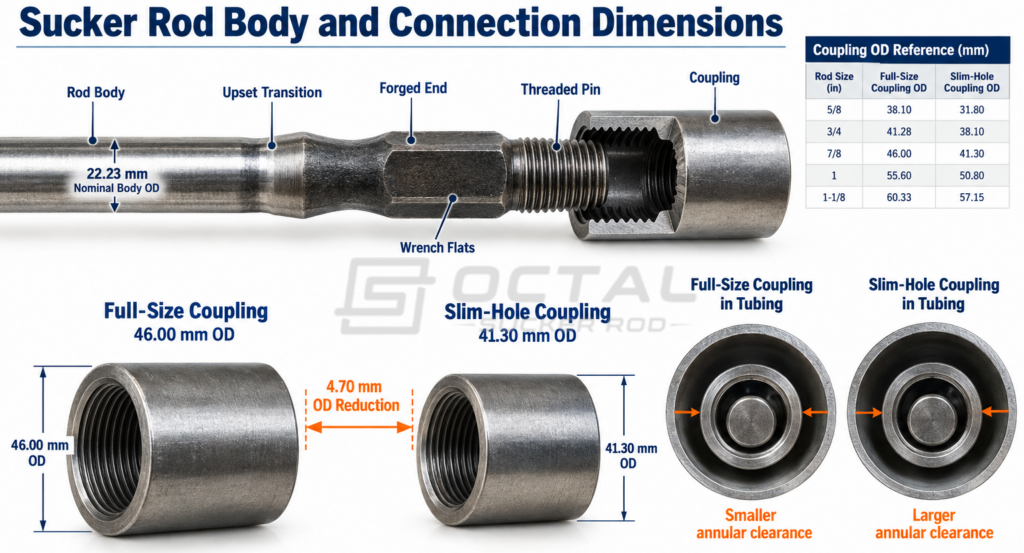
For a 7/8 in sucker rod, switching from a 46.00 mm full-size coupling to a 41.30 mm slim-hole coupling reduces the outside diameter by 4.70 mm, providing additional tubing clearance.
However, coupling selection should still consider thread compatibility, connection strength, tubing ID, deviation and expected rod-to-tubing contact conditions.
Why Well Depth Alone Does Not Determine Sucker Rod Grade Selection
Well depth is an important factor in sucker rod design because a longer rod string increases the total suspended weight and can raise the mechanical load during operation. However, well depth alone does not determine whether Grade C, Grade D or Grade K sucker rod should be selected.
The actual grade selection should consider the complete operating condition, including:
- Pump setting depth
- Fluid load
- Rod-string design
- Rod diameter and taper
- Pumping speed and stroke condition
- Well deviation
- Produced-fluid corrosion environment
For example, a deeper well with moderate pumping conditions and controlled corrosion may still operate within the practical range of Grade C sucker rod. In contrast, a shorter well with higher dynamic loading, larger pump load or severe operating conditions may require a higher-strength grade such as Grade D.
For corrosion-related applications, Grade K selection is mainly related to material behavior and produced-fluid conditions rather than depth itself.
Therefore, sucker rod grade should be selected according to the calculated mechanical loading and service environment, not simply classified by well depth.
Material and Heat Treatment Behind Grade C, D and K
The letter grade should not be confused with one universal steel designation.
Public API-related technical references describe Grade C as using carbon-steel routes, Grade K as an alloy-steel route, and Grade D as allowing carbon, alloy and special-alloy classifications. SLB specifically notes that Grade D includes plain-carbon, alloy and special-alloy steel types.Therefore, statements such as: Grade D always equals AISI 4130 are too narrow.
A supplier may use a qualified steel chemistry that is capable of reaching the required properties after the approved manufacturing and heat-treatment process. The finished mechanical results remain the controlling acceptance point.
Heat treatment is important because strength has to remain consistent along a long, slender rod body while the finished rod also retains ductility and straightness.
Octal’s manufacturing reference describes box-type resistance furnace quenching and tempering lines with independently controlled heating zones and thermocouples, followed by controlled cooling and straightening. The same manufacturing base reports four sucker-rod production lines and five quenching-and-tempering units.
For the buyer, the important outcome is not the furnace description itself. It is whether the process consistently produces the specified:yield strength, tensile strength, ductility, hardness condition, rod straightness and connection geometry.
Manufacturing and Inspection Factors That Matter to Buyers
Mechanical-property tables only describe the finished target. The actual reliability of a sucker rod also depends on how consistently the rod body and connection are manufactured.
Control is required through forging or upsetting, heat treatment, straightening, machining and thread processing. The forged-end transition should be smooth and consistent, the rod should remain straight after heat treatment, and the pin and thread geometry must correspond to the approved connection.
Octal’s cooperative manufacturing information lists an 800-ton horizontal forging machine, an 800-ton hydraulic upsetting unit and a 1,000-ton hydraulic straightening machine, together with dedicated heat-treatment and connection-processing equipment. Its R&D and inspection facilities perform tensile, impact, hardness and metallographic testing on sucker rods and related oilfield products.
For an actual order, the inspection package is more valuable when the documents can be connected through one traceability chain:
material heat number → production lot → heat-treatment record → mechanical test → dimensional inspection → thread inspection → final marking and packing documentation.
That allows a purchaser to verify the delivered rods against the specification rather than relying only on a painted grade identification or nominal diameter.
FAQ
What is the main difference between Grade C and Grade D sucker rod?
The main difference is mechanical strength. Grade C has a minimum yield strength of 60,000 psi / 414 MPa and a tensile range of 90,000–115,000 psi / 621–793 MPa. Grade D increases minimum yield strength to 85,000 psi / 586 MPa and tensile strength to 115,000–140,000 psi / 793–965 MPa. Grade D is therefore considered when calculated rod-string loading requires more mechanical strength.
Can Grade C and Grade D sucker rods have the same diameter?
Yes. Grade and diameter are separate specifications. A 7/8-in. Grade C rod and 7/8-in. Grade D rod can both have a 22.23 mm nominal rod-body OD while using different mechanical-property requirements. Replacement should still verify connection, coupling and service condition.
Is Grade K stronger than Grade C sucker rod?
Not in the basic strength data used for this comparison. Grade C and Grade K both use a 60,000 psi / 414 MPa minimum yield strength and 90,000–115,000 psi / 621–793 MPa tensile range. Grade K’s main distinction is its material/service selection for corrosion-related operating conditions, not a higher nominal tensile range.
Is Grade D always the best choice for a deep well?
No. Depth increases rod-string weight, but the grade should be based on calculated loading together with pump size, fluid level, stroke condition, well deviation and corrosion environment. A deeper well does not automatically require Grade D, and a shallower high-load installation can still require a higher-strength rod.
Does Grade D have a fixed hardness value?
Not in the Octal mechanical-property reference used here. Its defined comparison is based on yield strength, tensile strength and ductility. Hardness should follow the approved material and heat-treatment specification and remain traceable to the production lot.