AISI 4130 combines 0.28–0.33% carbon with 0.80–1.10% chromium and 0.15–0.25% molybdenum, producing a chromium-molybdenum low-alloy steel that responds strongly to normalizing, quenching and tempering. Its nominal density is about 7.85 g/cm³, while published normalized data for a 25 mm round specimen show approximately 670 MPa tensile strength, 435 MPa yield strength, 25.5% elongation and 197 HB hardness. These figures make 4130 useful where strength must be increased beyond plain carbon steel without moving directly to a higher-carbon alloy system.
Heat treatment changes those numbers substantially. A published 50 mm round specimen water-quenched from 855°C and tempered at 540°C developed about 841 MPa tensile strength, 685 MPa yield strength, 21.2% elongation and 241 HB hardness. This is why a useful 4130 steel data sheet must identify not only the grade, but also section size, product form and delivery condition. A single value for “4130 strength” is not technically sufficient for engineering selection.
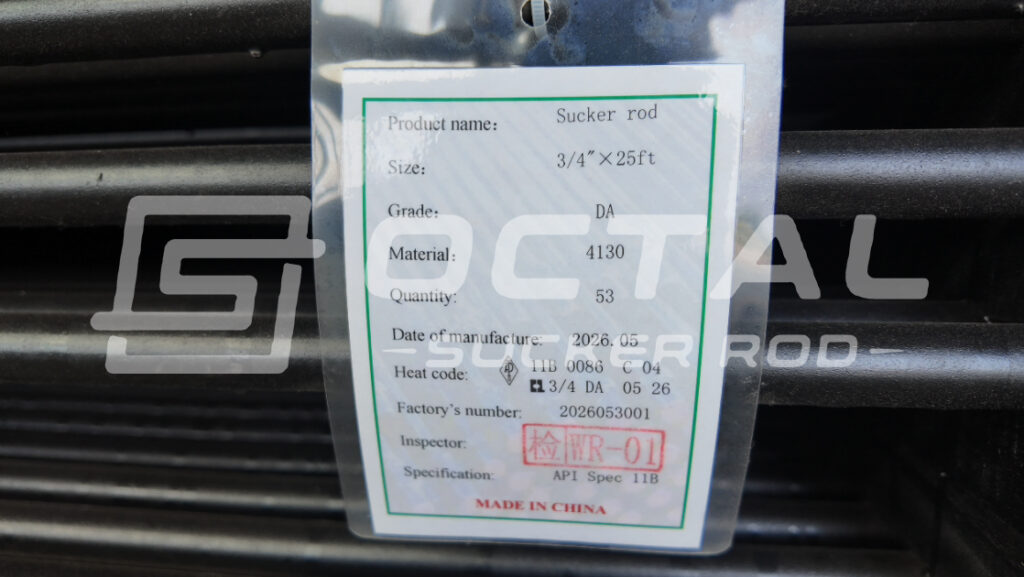
Octal approaches 4130 steel supply in the same way: the material grade is only the starting point. Product form, diameter or wall thickness, heat-treatment condition, required mechanical properties, dimensional tolerance and inspection documents must be defined before material is released for an engineering application. For AISI 4130 sucker rod applications, these controls are especially important because the finished rod condition, section size and heat treatment directly affect the mechanical properties delivered in service. For project procurement, matching the heat number, chemical analysis, mechanical test results and delivery condition is more useful than simply stating that the material is 4130 alloy steel.
What the 4130 Grade Designation Tells You
4130 belongs to the chromium-molybdenum family of low-alloy steels commonly described within the SAE 41xx series. In practical engineering use, AISI 4130 remains the familiar commercial name, although SAE now maintains the grade chemistry and notes that AISI no longer independently issues these steel designations. The corresponding UNS designation is G41300.
The grade name primarily identifies chemistry. It does not by itself define tensile strength, hardness, impact toughness, dimensional tolerance or final heat-treatment condition. For a finished API 11B sucker rod, the base-steel designation therefore has to be considered together with the applicable dimensional, mechanical and inspection requirements.
| Item | 4130 Reference |
|---|---|
| Common designation | AISI 4130 / SAE 4130 |
| UNS designation | G41300 |
| Steel family | Chromium-molybdenum low-alloy steel |
| Nominal carbon level | About 0.30% |
| Density | 7.85 g/cm³ |
| Typical product forms | Bar, forging stock, mechanical tubing and machined components |
| Property control | Chemistry + product form + section size + heat treatment |
That distinction matters when comparing suppliers. Two pieces of material may both be certified as 4130 but produce different mechanical results if one is normalized and the other is quenched and tempered.
Chemical Composition
The composition below represents the commonly published SAE/AISI 4130 chemistry. Chromium improves hardenability and contributes to strength and wear resistance, while molybdenum improves hardenability and helps maintain strength after tempering. Carbon remains moderate enough to retain a more workable balance between strength, ductility and fabrication than higher-carbon Cr-Mo grades.
| Element | Composition, wt.% | Main Metallurgical Role |
|---|---|---|
| Carbon, C | 0.28–0.33 | Strength, hardness and heat-treatment response |
| Manganese, Mn | 0.40–0.60 | Strength and hardenability |
| Silicon, Si | 0.15–0.35 | Deoxidation and strength contribution |
| Chromium, Cr | 0.80–1.10 | Hardenability, strength and wear resistance |
| Molybdenum, Mo | 0.15–0.25 | Hardenability and tempered strength |
| Phosphorus, P | ≤0.035 | Controlled residual element |
| Sulfur, S | ≤0.040 | Controlled residual element |
| Iron, Fe | Balance | Base metal |
For incoming material inspection, chemistry should be checked against the specified purchase standard and heat analysis, rather than against an approximate website value alone. SAE J404 also distinguishes ladle analysis from permitted product/check-analysis variation.
Physical Properties
The physical properties of 4130 alloy steel are much less sensitive to heat treatment than strength and hardness. They are useful for weight estimation, stiffness calculations, thermal analysis and component design.
| Property | Reference Value |
|---|---|
| Density | 7.85 g/cm³ |
| Density | 0.284 lb/in³ |
| Elastic modulus | 205 GPa |
| Bulk modulus | 140 GPa |
| Shear modulus | 80 GPa |
| Poisson’s ratio | 0.29 |
ASM/MatWeb reports an elastic modulus of approximately 205 GPa, which is typical of steel. Heat treatment can substantially alter yield strength and hardness, but it does not turn 4130 into a materially stiffer steel in elastic loading.
That distinction is important in design. Increasing heat-treated strength raises the stress level the component can tolerate before permanent deformation, but the elastic modulus—and therefore elastic deflection under the same geometry and load—remains approximately in the normal steel range.
Mechanical Properties Depend on Material Condition
The most important point in any set of 4130 steel properties is that mechanical values must be tied to condition and section size. Controlled quenching and tempering can raise the strength level required for high strength sucker rod applications, while final acceptance still depends on the specified rod grade and product requirements.
Published ASM reference data demonstrate the difference clearly. A normalized 25 mm round and a normalized 50 mm round do not produce exactly the same tensile and yield properties even when both are identified as 4130. Heat-treated sections show an even larger change.
| Material Condition | Reference Section | Tensile Strength | Yield Strength | Elongation in 50 mm | Hardness |
|---|---|---|---|---|---|
| Annealed reference condition | Published reference specimen | 560 MPa | 360 MPa | 28.2% | Approx. 163 HB equivalent reference |
| Normalized at 870°C, air cooled | 25 mm round | 670 MPa | 435 MPa | 25.5% | 197 HB |
| Normalized at 870°C, air cooled | 50 mm round | 615 MPa | 415 MPa | 28.2% | 167 HB |
| Water quenched from 855°C, tempered at 540°C | 50 mm round | 841 MPa | 685 MPa | 21.2% | 241 HB |
| Water quenched from 855°C, tempered at 480°C | 100 mm round | 841 MPa | 655 MPa | 20.5% | 241 HB |
These values are reference material data, not universal acceptance minima. A purchase specification may require a different strength level, hardness range, impact requirement or heat-treatment condition.
Why 4130 Steel Yield Strength Is Not One Number
The phrase 4130 steel yield strength often produces apparently conflicting answers because the material can be supplied in very different metallurgical states.
Published reference data span from approximately 360 MPa in an annealed condition to 685 MPa in one quenched-and-tempered 50 mm round condition shown above. The difference does not mean one source is necessarily wrong. It reflects changes in microstructure caused by heat treatment and cooling response.
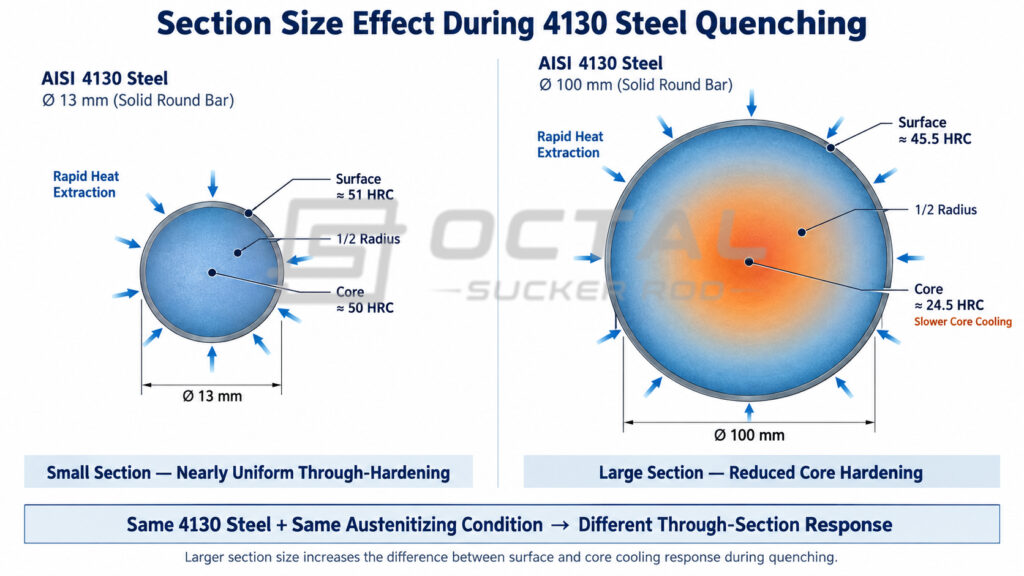
Section size also matters. During quenching, the surface and core do not cool at identical rates. MatWeb data for a 100 mm round quenched from 855°C show an as-quenched hardness of approximately 45.5 HRC at the surface but only about 24.5 HRC at the center before the reported tempered condition. This illustrates why a hardness reading taken only at the surface cannot automatically prove through-section properties in a heavy component.
Heat Treatment Controls the Final Property Balance
4130 responds well to several heat-treatment routes. The selected cycle depends on whether the objective is machinability, dimensional stability, strength, ductility or a specified finished-component property.
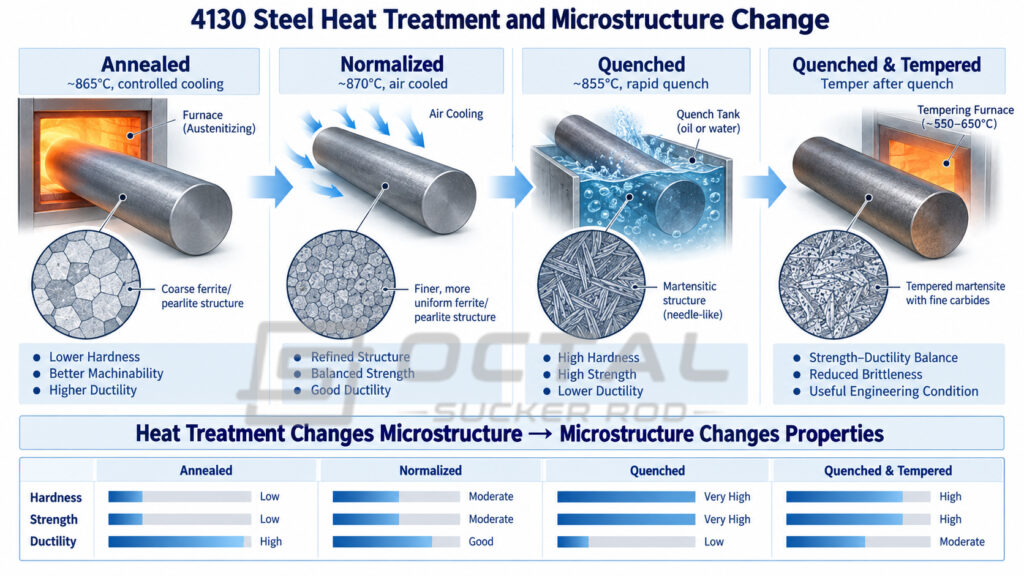
Published reference cycles include the following; they should be treated as engineering reference conditions rather than universal production instructions. Actual furnace parameters must account for product form, section size, equipment, quench severity and required specification.
| Treatment | Published Reference Temperature | Cooling Route | Main Purpose |
|---|---|---|---|
| Annealing | About 865°C | Controlled furnace cooling followed by air cooling | Reduce hardness and improve machinability |
| Normalizing | About 870°C | Air cooling | Refine structure and provide a relatively uniform normalized condition |
| Austenitizing for hardening | About 855°C in published reference data | Water quench in cited property datasets | Produce hardened structure before tempering |
| Tempering example | 480°C | After quenching | Retain higher strength with recovered ductility |
| Tempering example | 540°C | After quenching | Adjust strength–ductility balance |
Higher strength should not automatically be treated as better material. A lower tempering temperature can retain greater hardness, but the component may sacrifice some ductility and toughness. Selection therefore starts with the required load case rather than with the maximum achievable tensile number.
Hardness Must Be Read Together with Heat Treatment
Hardness provides a fast indication of material condition, but it should not be used as a substitute for complete mechanical testing when tensile or yield properties are contractual requirements.
| Reference Condition | Hardness |
|---|---|
| Normalized, 25 mm round | 197 HB |
| Normalized, 50 mm round | 167 HB |
| Quenched and tempered reference, 50 mm round | 241 HB |
| Quenched and tempered reference, 100 mm round | 241 HB |
| As-quenched 13 mm round, surface | Approx. 51 HRC |
| As-quenched 13 mm round, center | Approx. 50 HRC |
| As-quenched 100 mm round, surface | Approx. 45.5 HRC |
| As-quenched 100 mm round, center | Approx. 24.5 HRC |
The strong surface-to-core difference in the heavier as-quenched specimen is a practical example of section-size effect and hardenability.
For critical components, hardness location should therefore be defined in the inspection plan when through-section consistency matters.
Product Standard Matters as Much as the Grade Name
Ordering simply “4130 steel” leaves several engineering questions unanswered.
SAE J404 addresses chemical compositions for SAE alloy steels, while product-specific requirements can be controlled by other specifications. SAE explicitly points mechanical tubing users toward ASTM A513 and ASTM A519 rather than treating J404 as the complete tubing specification. ASTM A519 covers seamless carbon and alloy steel mechanical tubing and requires heat analysis for specified chemical elements.
| Requirement | What Should Be Defined |
|---|---|
| Material grade | SAE/AISI 4130 or specified equivalent |
| Product specification | Applicable bar, forging, tubing or component specification |
| Product form | Bar, tube, forging or machined part |
| Dimensions | OD, ID, wall thickness, diameter, length or finished drawing dimensions |
| Delivery condition | Annealed, normalized, normalized and tempered, or quenched and tempered |
| Strength requirement | Required tensile and yield values where applicable |
| Hardness | Required range and test location if specified |
| Toughness | Impact test requirement, temperature and acceptance value if project-specific |
| NDT | Method, coverage and acceptance standard where required |
| Certification | Heat number and material test certificate |
| Traceability | Heat/lot marking maintained through processing and packing |
This is also the second point where Octal’s supply workflow adds practical value. Instead of treating AISI 4130 as a commodity description alone, material can be reviewed against the requested product standard, heat-treatment state, dimensional requirements and documentation package before shipment. For engineered oilfield and mechanical components, this reduces the risk of receiving the correct chemistry in the wrong mechanical condition.
How to Judge Whether a 4130 Material Certificate Is Acceptable
A reliable acceptance decision should connect the physical material to its reported test results.
The inspection trail should normally preserve:
- Heat number → chemical analysis → product marking → heat-treatment record → mechanical test results → dimensional inspection → final packing identification
- Chemistry within the limits required by the applicable material specification
- Mechanical results corresponding to the specified delivery condition rather than an unrelated generic datasheet
- Test specimens identified by heat, lot and applicable section or product requirement
- Hardness results recorded at the specified location when hardness is an acceptance criterion
- NDT and additional project testing reported separately when required by the purchase specification
A certificate showing 0.30% carbon, 0.95% chromium and 0.20% molybdenum, for example, would sit comfortably inside the common 4130 chemistry ranges, but chemistry alone does not prove that the part meets a specified 650 MPa yield-strength requirement. The mechanical test report and actual heat-treatment condition would still have to demonstrate that requirement.
That distinction is one of the most important procurement points in a 4130 steel data sheet.
Machining, Forming and Welding Considerations
4130 in an annealed or normalized condition is generally easier to machine and form than the same steel after high-strength heat treatment. ASM reference data list machinability at approximately 70% relative to AISI 1212 taken as 100% for annealed/cold-drawn reference material.
| Fabrication Item | Engineering Consideration |
|---|---|
| Machining | Lower-hardness annealed or normalized conditions generally reduce cutting load and tool wear |
| Cold forming | Easier before high-strength final heat treatment |
| Heat treatment after machining | Allowance may be required for distortion and final dimensional finishing |
| Welding | Procedure must account for material condition, carbon/alloy content, section thickness and restraint |
| Post-weld condition | Required strength and toughness should be verified against the finished-component specification |
Welding should not be controlled by one universal preheat number taken from a generic datasheet. Section thickness, joint restraint, hydrogen control, filler metal, existing heat-treated condition and required final properties all influence the welding procedure.
Where 4130 Is Selected
The useful combination of moderate carbon, chromium-molybdenum hardenability and adjustable heat-treated strength allows 4130 to serve components that need more strength than basic low-carbon steel while retaining reasonable fabrication options.
Typical engineered uses include oilfield components, mechanical tubing, shafts, pins, structural tubular parts, forged components and other load-carrying parts where section size and heat treatment can be controlled.
Selection should still be based on the actual load spectrum. A component exposed mainly to static tensile loading has different requirements from one subjected to cyclic bending, torsion, impact or a corrosive service environment. For fatigue-sensitive parts, surface finish, stress concentration, thread geometry, decarburization, residual stress and inspection quality can matter as much as the nominal bulk tensile strength.
FAQ
Q: What is 4130 steel?
A: 4130 steel is a chromium-molybdenum low-alloy steel containing approximately 0.28–0.33% carbon, 0.80–1.10% chromium and 0.15–0.25% molybdenum. Its final mechanical properties depend strongly on section size and heat treatment.
Q: What is the yield strength of 4130 steel?
A: There is no single universal value. Published reference data show about 435 MPa for a normalized 25 mm round and about 685 MPa for a 50 mm round quenched from 855°C and tempered at 540°C. The purchase specification should define the required minimum value.
Q: Is AISI 4130 the same as 4130 alloy steel?
A: In normal commercial usage, both terms refer to the same chromium-molybdenum grade family commonly identified as SAE/AISI 4130 and UNS G41300. The actual product must still be ordered to the applicable bar, tubing, forging or component specification.
Q: What should be specified when ordering 4130 steel?
A: Define the product form, applicable material standard, dimensions, delivery condition, heat treatment, required tensile and yield properties, hardness if applicable, NDT requirements and certification. Grade chemistry alone does not establish finished-component performance.