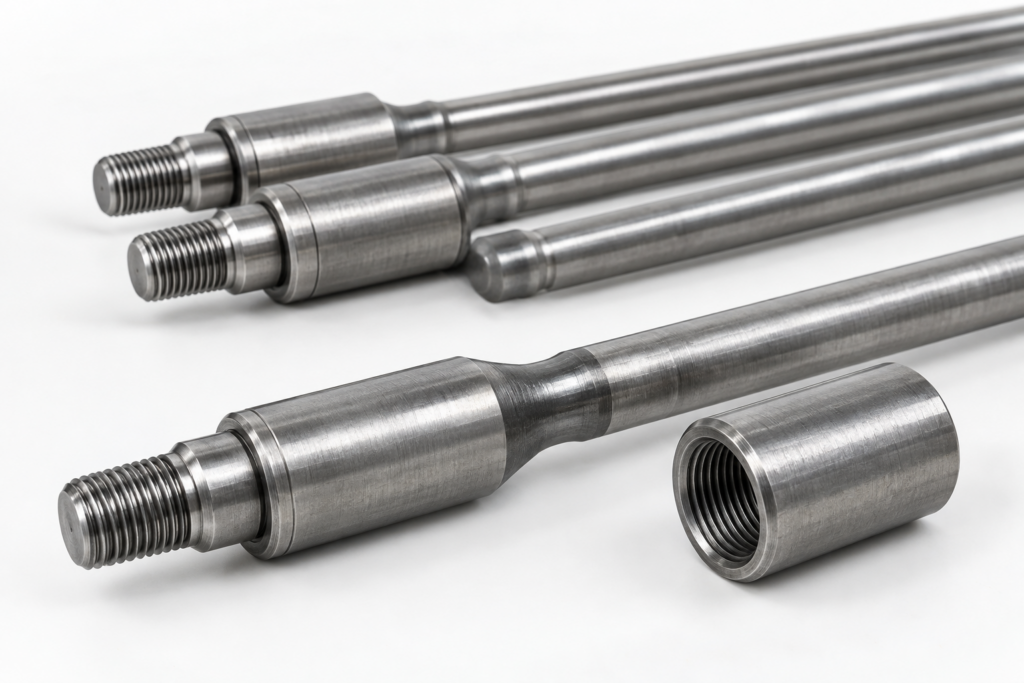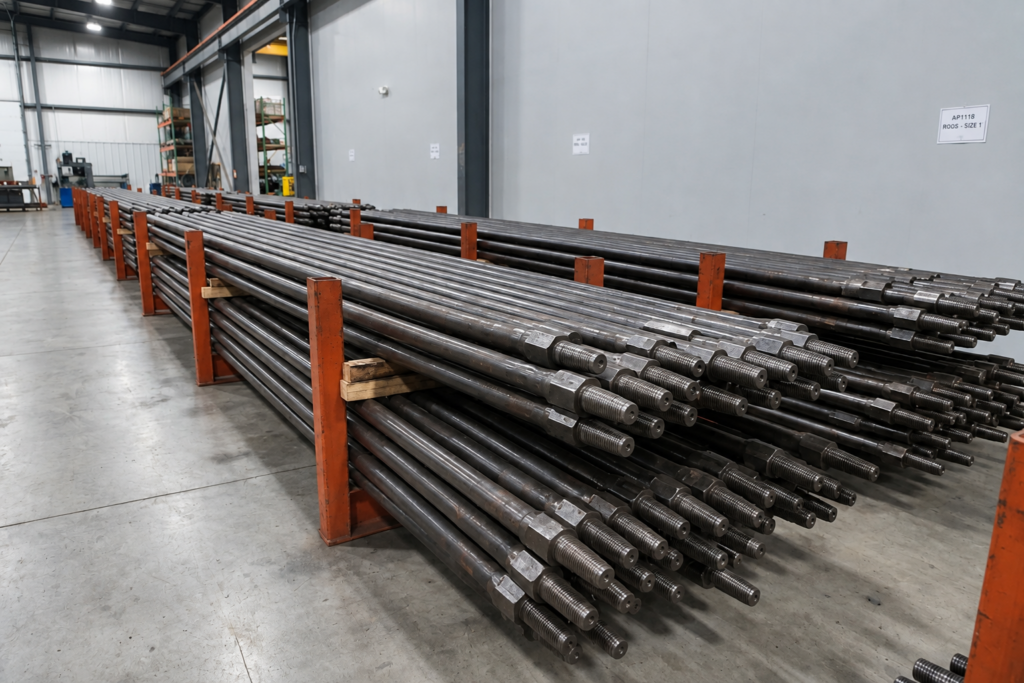
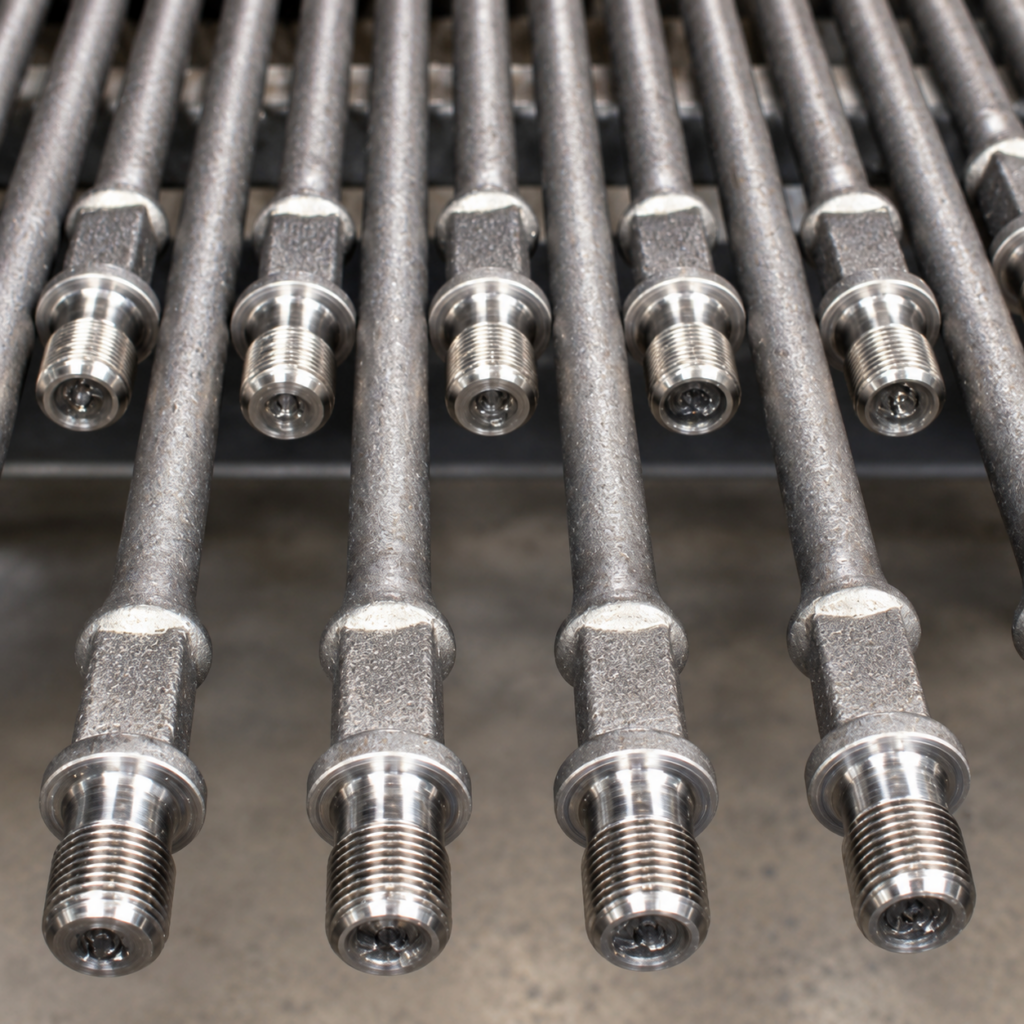
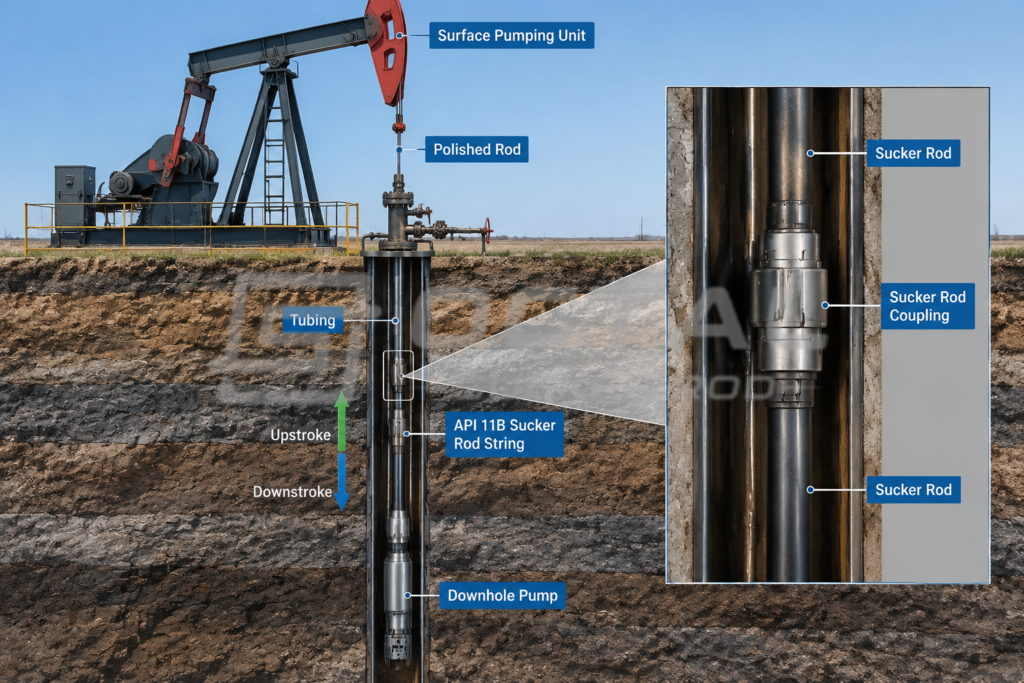
API 11B sucker rods are the core load-carrying members of a rod pumping system, used to transmit reciprocating motion and surface power from the pumping unit to the downhole pump. Installed as a rod string inside the tubing, they work under continuous upstroke and downstroke cycles, where tensile load, compressive load, vibration and bending stress are repeatedly applied throughout the production life of the well. In practical operation, a sucker rod is not only a motion-transmitting component, but also a fatigue-loaded mechanical product whose service life directly affects pumping stability, workover frequency and lifting cost.
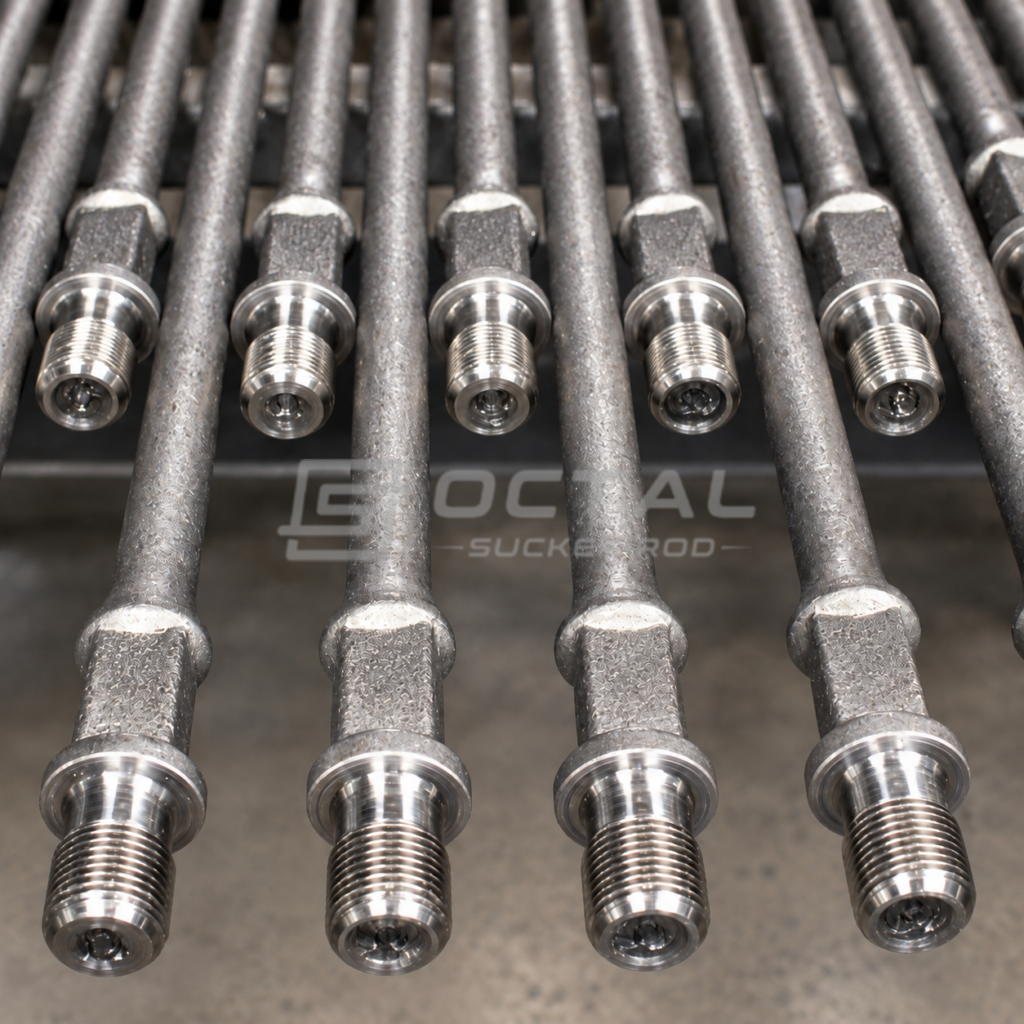
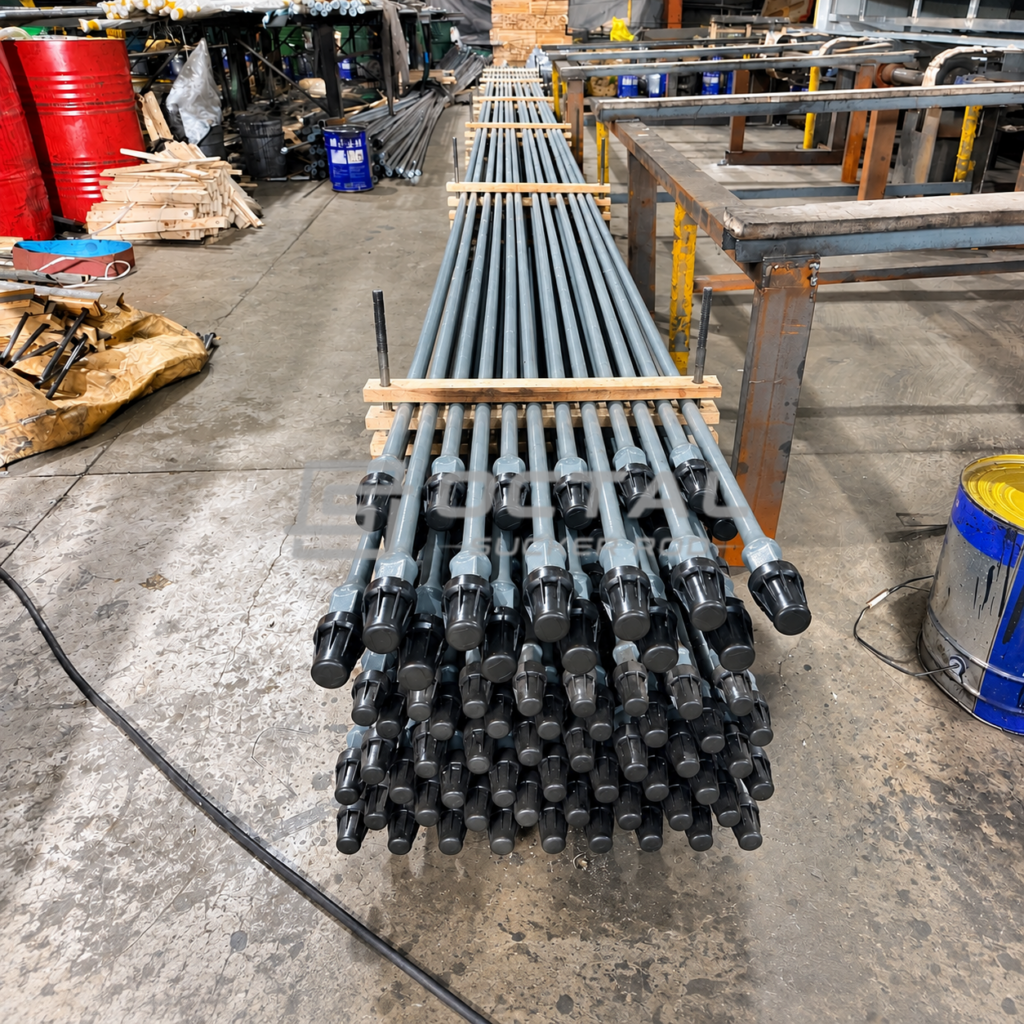
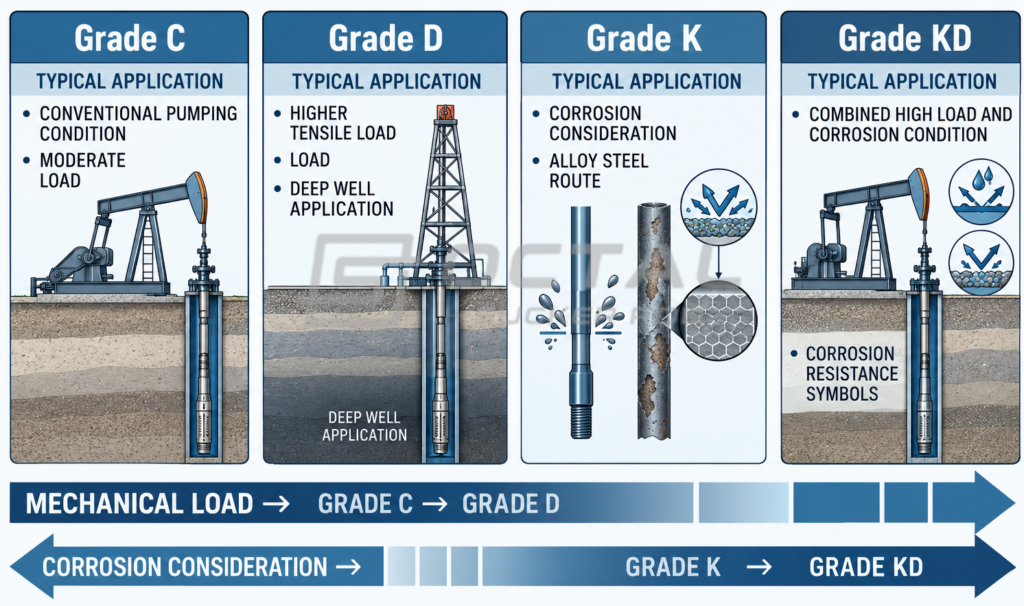
API 11B sucker rods are mainly classified by rod type and grade. Rod types include full-length sucker rods and pony rods, which are used together to complete the required rod string length. For field selection, the more important classification is by grade, including Grade C, Grade K, Grade D and Grade KD.Each grade is designed for different service requirements. Grade C is commonly used for conventional pumping conditions with moderate loads, Grade D provides higher mechanical strength for heavier loading conditions, while Grade K and Grade KD are considered when corrosion conditions require additional material performance evaluation. The final selection depends on the combined effects of rod load, well depth, fluid chemistry, fatigue exposure and operating environment.
Although sucker rods are standardized under API 11B, selecting the correct rod grade is not simply a matter of choosing the highest strength material. Different oil well conditions create different failure risks. A deep well increases axial load on the rod string, corrosive fluids accelerate corrosion fatigue, deviated wells introduce additional side contact and wear, while extreme temperature environments create additional requirements for material toughness and operational reliability.
Therefore, API 11B sucker rod selection should be based on the relationship between well conditions, loading conditions, corrosion environment and expected service life. The correct selection helps reduce premature rod failure, unplanned workover operations and production interruptions.
What Factors Affect API 11B Sucker Rod Selection?
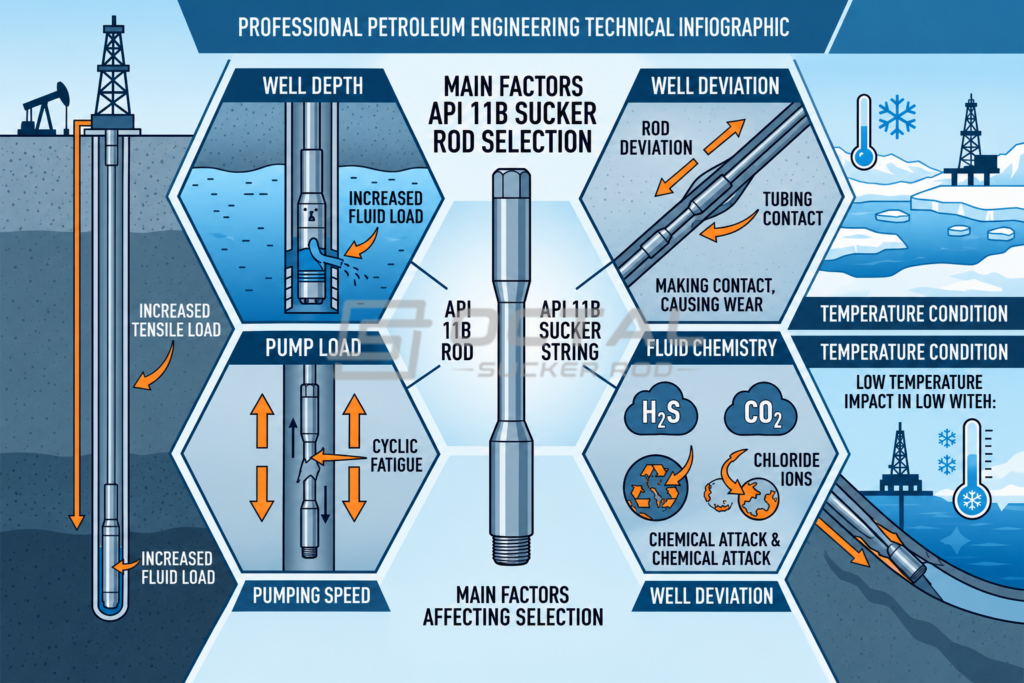
A sucker rod string works as a complete mechanical system rather than an individual component. During pumping operations, each rod section experiences thousands of loading cycles, and the actual service performance depends on multiple operating factors.
| Selection Factor | Engineering Influence | Main Failure Risk |
| Well depth | Increases rod string weight and axial load | Tensile overload |
| Pump size | Increases fluid load transferred through rod string | Higher working stress |
| Pumping speed | Increases cyclic loading frequency | Fatigue failure |
| Fluid composition | Determines corrosion severity | Corrosion fatigue |
| Well deviation | Creates tubing contact and bending force | Wear and mechanical damage |
| Temperature condition | Influences material performance and operation | Toughness and reliability issues |
Well Depth and Rod String Load
Well depth directly affects the mechanical loading condition of a sucker rod string. As the rod string length increases, the suspended weight and axial tensile load gradually increase, especially during the upward stroke when the surface pumping unit lifts the rod string and downhole pump load. In deep wells, sucker rods are exposed to higher working stress and repeated cyclic loading, making tensile strength, fatigue resistance and connection integrity critical selection factors. A suitable API 11B sucker rod grade should be selected according to the calculated operating load, expected fatigue exposure and complete rod string design rather than well depth alone. Although higher-strength grades may be considered for heavy-load applications, pump size, stroke frequency, fluid density and previous failure history should also be evaluated to ensure the selected rod can withstand long-term production conditions.
How Do API 11B Sucker Rod Grades Differ?
API 11B sucker rods are manufactured in different grades to accommodate variations in mechanical loading, fatigue exposure and service environments encountered during oil production. Although all grades perform the same basic function of transmitting reciprocating loads from the surface pumping unit to the downhole pump, their material properties and intended service conditions are different. Therefore, sucker rod grade selection should be based on the dominant operating risk, including rod-string load, corrosion exposure, pumping cycles and expected service life, rather than simply choosing the highest-strength option.
Grade C Sucker Rod
Grade C sucker rods are commonly selected for conventional rod pumping applications where the operating load remains within moderate ranges and the production environment does not introduce severe corrosion challenges. This grade provides a balanced combination of strength, ductility and fatigue performance for general oil well service.
Typical mechanical properties:
| Property | Grade C |
| Minimum Yield Strength | 60,000 psi (414 MPa) |
| Tensile Strength Range | 90,000–115,000 psi (621–793 MPa) |
| Minimum Elongation | ≥13% |
| Reduction of Area | ≥50% |
In practical applications, Grade C is suitable when the main requirement is reliable load transmission under standard pumping conditions. However, when rod-string loads increase due to greater well depth, larger pump size or higher production resistance, higher-strength grades may need to be considered.
Grade D Sucker Rod
Grade D sucker rods are designed for applications where higher mechanical loading capacity is required. Compared with Grade C, Grade D provides higher yield and tensile strength, making it suitable for wells where the rod string experiences increased axial loading and greater stress during repeated pumping cycles.
Typical mechanical properties:
| Property | Grade D |
| Minimum Yield Strength | 85,000 psi (586 MPa) |
| Tensile Strength Range | 115,000–140,000 psi (793–965 MPa) |
| Minimum Elongation | ≥13% |
| Reduction of Area | ≥50% |
Grade D is commonly considered for deeper wells, higher pump loads and applications where the calculated working stress approaches the limit of conventional grades. However, increased mechanical strength alone does not eliminate all failure risks. In corrosive wells or highly deviated wells, factors such as corrosion fatigue, tubing contact and connection wear must also be evaluated during sucker rod selection.
Grade K Sucker Rod
Grade K sucker rods are generally selected for service conditions where corrosion exposure requires additional consideration. The alloy steel material route provides different performance characteristics compared with conventional carbon steel grades, making Grade K a consideration for wells containing corrosive fluids.
Selection factors typically include:
- H₂S concentration;
- CO₂ corrosion potential;
- chloride content;
- water cut;
- corrosion inhibition practices.
In corrosive environments, sucker rod failures are often related to the combined effect of corrosion damage and cyclic loading rather than corrosion alone. Therefore, Grade K selection should be evaluated together with operating stress, fatigue exposure and production chemistry.
Grade KD Sucker Rod
Grade KD sucker rods are considered for demanding applications where both mechanical loading and corrosion conditions must be addressed simultaneously. They combine the requirements of higher load capacity with additional consideration for corrosion-related service challenges.
Typical applications include wells with:
- high rod-string loading;
- corrosive production fluids;
- long operating cycles;
- limited intervention opportunities.
For Grade KD selection, operators should evaluate the complete operating condition, including mechanical load calculation, fluid composition, well deviation and historical failure data.
Sucker Rod Grade Selection Is Based on Operating Conditions
The selection difference between API 11B grades can be summarized as:
| Grade | Main Selection Consideration | Typical Application Condition |
| Grade C | Balanced mechanical performance | Conventional pumping conditions |
| Grade D | Higher tensile and yield strength | Deep wells and higher loading conditions |
| Grade K | Corrosion-related service consideration | Wells with challenging fluid chemistry |
| Grade KD | Combined load and corrosion requirements | High-demand production environments |
How to Select Sucker Rod for Different Oil Well Conditions?
Deep Oil Wells: High Tensile Load Conditions
Deep wells create higher mechanical demands on a sucker rod string because the total suspended weight increases with the length of the rod string. During each pumping cycle, sucker rods repeatedly transfer the load between the surface pumping unit and the downhole pump, creating continuous axial stress and fatigue exposure. The lower sections of a long rod string are especially affected because they experience higher working loads during repeated upstroke and downstroke operations.
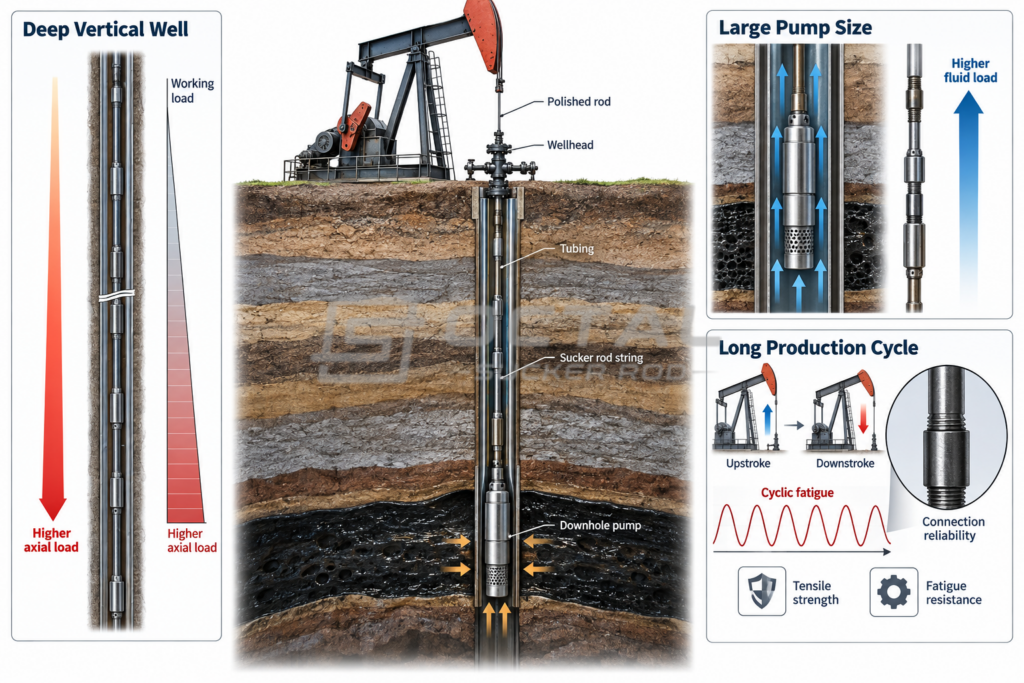
For deep well applications, sucker rod selection should focus on the relationship between calculated working load, tensile strength, fatigue resistance and connection integrity. Higher-strength grades such as Grade D may be considered when operating stress approaches the limit of conventional grades. However, well depth alone should not determine the final selection. Pump diameter, fluid density, stroke frequency, pumping speed and previous failure history should also be evaluated to ensure long-term production reliability.
| Well Condition | Main Engineering Concern | Selection Focus |
| Deep vertical well | Increased axial load from longer rod string | Tensile strength and fatigue resistance |
| Large pump size | Higher fluid load transferred to rod string | Working load calculation |
| Long production cycle | Continuous cyclic stress | Fatigue performance and connection reliability |
Corrosive Oil Wells: H₂S, CO₂ and High Chloride Conditions
Corrosive oil wells represent one of the most challenging environments for sucker rod service because the rod string is exposed to both chemical degradation and repeated mechanical loading. Common corrosive factors include hydrogen sulfide (H₂S), carbon dioxide (CO₂), chloride-containing produced water and high water-cut conditions.
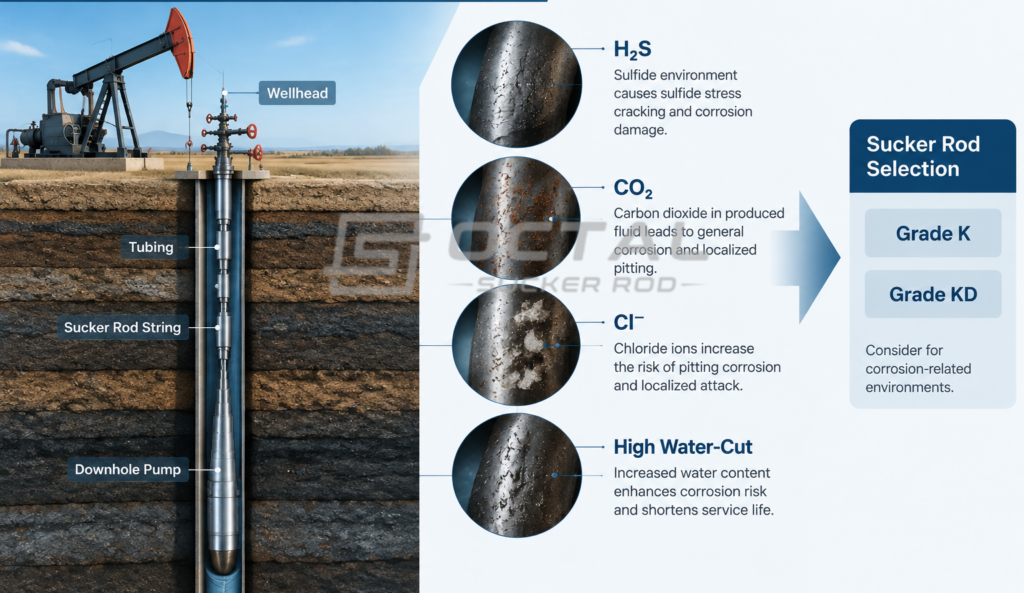
The primary concern in these wells is not only general corrosion but corrosion fatigue. During long-term pumping operations, sucker rods experience millions of stress cycles, and corrosion pits or surface damage can become stress concentration points that accelerate crack initiation. Therefore, sucker rod selection for corrosive environments should consider fluid chemistry, operating stress, corrosion control practices and expected service conditions together.
Grade K or Grade KD may be considered when corrosion-related risks become a major factor, but corrosion performance cannot be determined by grade name alone. Material properties, well conditions, production chemistry and historical failure data should be evaluated as a complete system.
| Corrosion Condition | Potential Risk | Selection Consideration |
| H₂S-containing fluid | Sulfide-related damage and accelerated cracking risk | Material evaluation and service condition review |
| CO₂ corrosion | Localized corrosion damage | Corrosion control strategy |
| High chloride produced water | Pitting and surface degradation | Alloy selection consideration |
| High water cut | Increased corrosion exposure | Production chemistry evaluation |
Deviated Oil Wells: Tubing Contact and Wear Conditions
Deviated and directional wells introduce additional mechanical challenges because the sucker rod string does not only experience axial loading but also side contact with the tubing. As the deviation angle increases, the rod may repeatedly contact the tubing wall during reciprocating movement, generating friction, wear and localized bending stress.
In these conditions, selecting a sucker rod only according to tensile strength may not address the main failure risk. The evaluation should include tubing contact conditions, wear tendency, rod string design and connection performance. Proper grade selection combined with suitable coupling and wear-control measures can help improve service reliability in deviated well applications.
| Well Condition | Main Engineering Concern | Selection Focus |
| Moderate deviation | Increased tubing contact | Wear control and rod string design |
| High deviation | Side loading and bending stress | Connection integrity and fatigue resistance |
| Long directional section | Continuous friction exposure | Complete artificial lift system evaluation |
Heavy Oil Wells: High Pumping Resistance Conditions
Heavy oil wells create additional mechanical loading because high-viscosity fluids require greater pumping force to move production fluids through the wellbore. The increased resistance can raise surface pumping loads and increase the cyclic stress experienced by the sucker rod string.
For these applications, sucker rod selection should be based on actual operating loads rather than fluid type alone. Pump size, production rate, stroke frequency and expected operating cycles should be considered together. Depending on the calculated mechanical demand and corrosion environment, higher-strength grades or grades with additional service considerations may be selected.
| Heavy Oil Condition | Potential Risk | Selection Consideration |
| High fluid viscosity | Increased pumping load | Load calculation |
| Larger pump requirement | Higher rod stress | Mechanical performance evaluation |
| Continuous operation | Increased fatigue cycles | Fatigue resistance |
Arctic and Permafrost Oil Wells: Low Temperature and Remote Operation Conditions
Oil wells located in Arctic and permafrost regions introduce unique challenges for sucker rod applications due to extremely low temperatures, seasonal temperature variations and limited access for maintenance operations. Unlike conventional oilfields, equipment failures in remote cold regions may require longer intervention periods, making long-term reliability and failure prevention especially important.
Low-temperature environments increase the importance of material performance, heat treatment consistency and manufacturing traceability. In addition, frozen ground conditions and remote field locations may complicate workover activities, requiring sucker rods with reliable mechanical properties and complete quality documentation throughout the supply chain.
For permafrost oil wells, API 11B sucker rod selection should consider not only rod-string loading and fatigue exposure but also operating temperature, maintenance conditions and expected service interval. The final selection should combine mechanical requirements, environmental conditions and inspection documentation to support reliable long-term operation.
| Permafrost Condition | Potential Risk | Selection Consideration |
| Low ambient temperature | Reduced material toughness requirement | Material properties and heat treatment control |
| Remote oilfield location | Difficult maintenance and longer intervention cycles | Traceability and reliability documentation |
| Temperature fluctuation | Changing operating conditions | Complete service condition evaluation |
| Extended production intervals | Higher cumulative fatigue exposure | Fatigue performance and inspection records |
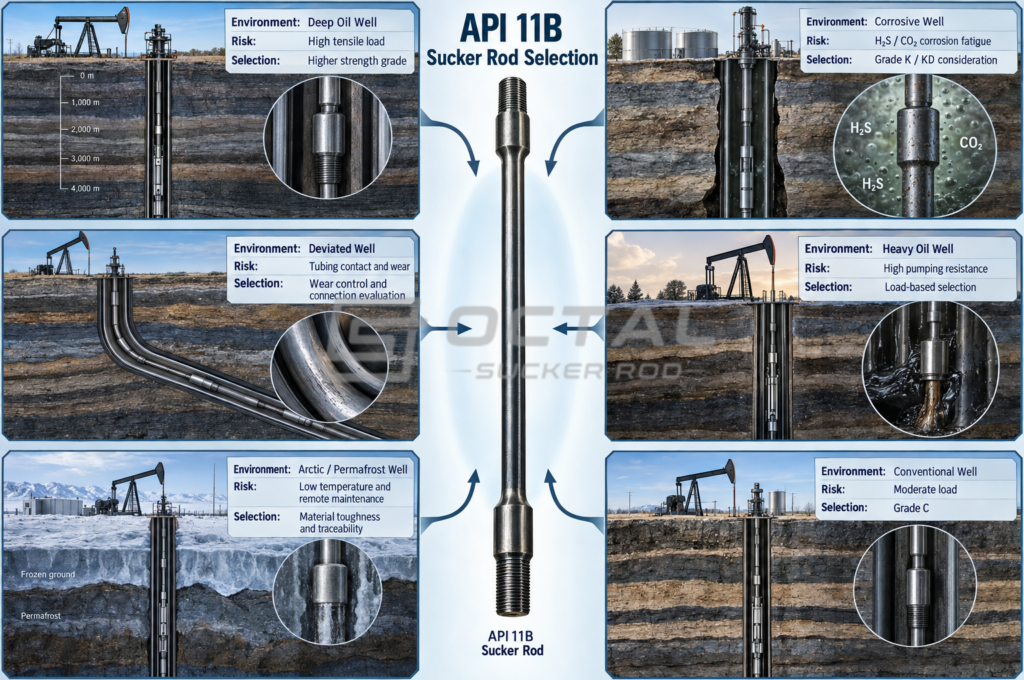
Sucker Rod Selection Based on Oil Well Conditions
The following table summarizes the relationship between operating environment and selection priorities.
| Oil Well Condition | Main Challenge | Selection Consideration |
| Conventional well | Moderate mechanical load | Grade C |
| Deep well | High tensile stress | Grade D or higher-strength option |
| Corrosive well | Corrosion fatigue | Grade K/KD depending on load |
| Deviated well | Wear and bending | Grade + connection design |
| Heavy oil well | High pumping resistance | Load-based selection |
| Arctic/permafrost field | Low temperature and maintenance difficulty | Material toughness + traceability |
How Octal Supports Different Sucker Rod Applications
Selecting the correct API 11B sucker rod is only the first step in ensuring reliable pumping performance. Different oil well conditions require different approaches in material selection, grade evaluation, manufacturing control and quality verification. Octal supports customers by evaluating the complete operating environment, including rod-string load, corrosion conditions, well deviation, temperature requirements and expected service life, to help identify a suitable sucker rod solution.
For conventional wells, Octal can provide API 11B sucker rods with balanced mechanical performance for standard pumping applications. For deep wells with higher loading requirements, the selection process focuses on mechanical properties, fatigue resistance and connection reliability. For corrosive environments involving H₂S, CO₂ or high water-cut conditions, additional attention is given to material selection, production requirements and traceability control. For deviated, heavy oil or extreme-temperature applications, Octal considers the combined effects of wear, cyclic loading, operating conditions and field maintenance requirements.
Beyond product supply, Octal provides support throughout the procurement process, including grade selection assistance, dimensional confirmation, manufacturing control, inspection documentation and shipment preparation. With controlled production processes and complete quality records, Octal helps customers reduce selection risks and improve the reliability of sucker rod performance in different oilfield environments.
FAQ
What is the difference between Grade C and Grade D sucker rods?
Grade D provides higher yield and tensile strength than Grade C and is generally considered when higher mechanical loading conditions exist. Final selection depends on calculated rod loads and operating conditions.
Is Grade K sucker rod suitable for all corrosive oil wells?
No. Corrosion performance depends on the complete production environment, including fluid chemistry, stress level, corrosion control measures and service history.
Does a deeper oil well always require a higher-grade sucker rod?
Not necessarily. Depth increases loading demand, but pump size, production conditions, deviation and corrosion environment must also be evaluated.
What documents should be provided with API 11B sucker rods?
Typical documentation may include material certificates, mechanical test records, dimensional inspection records and traceability information according to project requirements.