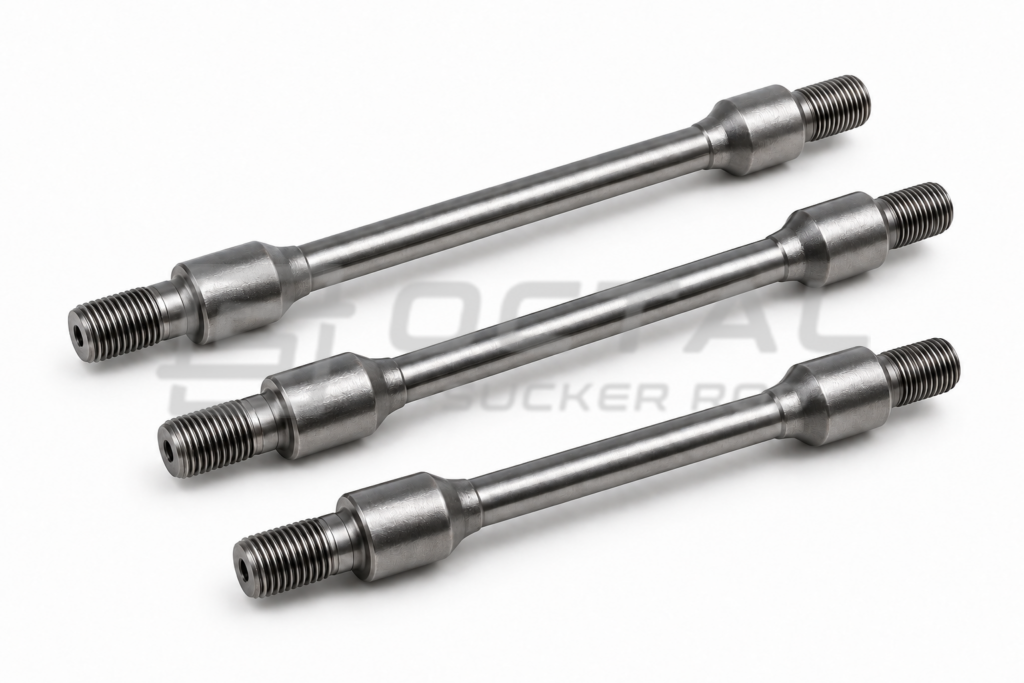
Pony Rod functions as the short-length load-transmitting member within a sucker rod string, providing the final length adjustment required between standard full-length rods while continuing to carry reciprocating tensile and dynamic loads during every pumping stroke. Depending on the specified grade and well condition, the rod body is produced from carbon steel or alloy steel, with forged or upset end sections, wrench flats, shouldered pin connections and matched sucker rod couplings. Heat treatment is selected to achieve the required strength and ductility for the grade, while the forged transition, pin shoulder and thread root remain critical fatigue-sensitive areas under repeated rod-lift loading.
Compared with a full-length sucker rod, the main difference lies in its shorter installed length rather than its basic mechanical function. Common pony rod lengths include 2, 4, 6, 8 and 10 ft, while frequently specified Octal configurations include 3/4 in., 7/8 in. and 1 in. rod-body diameters. Grade, body size, connection geometry and coupling compatibility must be matched to the surrounding sucker rod section, especially in tapered rod strings, higher-load wells, corrosive production conditions and workover replacement. A pony rod should therefore be selected as part of the complete rod-string design rather than as a simple spacer.
Pony Rod Specifications
API 11B pony rod dimensions and connection details are defined in relation to the sucker rod string in which the rod operates. Key parameters include finished length, rod-body diameter, grade or material class, end connection, coupling compatibility and string position. Together, these variables determine whether the pony rod matches the mechanical load path and connection geometry of the surrounding sucker rods.
| Specification Item | Pony Rod Data |
|---|---|
| Product Type | Steel pony rod for sucker rod lift systems |
| Applicable Standard | API Spec 11B where specified by the purchase order |
| Main Function | Rod-string length adjustment and reciprocating load transfer |
| Common Lengths | 2, 4, 6, 8 and 10 ft |
| Metric Length Reference | 0.61, 1.22, 1.83, 2.44 and 3.05 m |
| Common Octal Body Sizes | 3/4 in., 7/8 in. and 1 in. |
| Material | Carbon steel or alloy steel according to grade and service requirement |
| Main Grades | Grade C, Grade K and D-family |
| End Construction | Forged end with shouldered sucker-rod pin |
| Connection | Pin connection with matched sucker rod coupling |
| Main Selection Inputs | Length, diameter, grade, thread, coupling, string position and well condition |
| Typical Documentation | Material identification, mechanical test, dimensional/thread inspection and lot traceability |
Pony rods are produced in short lengths to complete the required sucker rod string length while maintaining the same load-transfer path as the adjoining rods. Their nominal length, rod-body diameter, grade and end connection are defined as a combined specification: the body diameter corresponds to the forged-end and pin geometry, while the grade determines the applicable mechanical-property range. As a result, pony rods with similar external dimensions can differ in strength level and connection configuration.
Pony Rod Structure and Working Principle
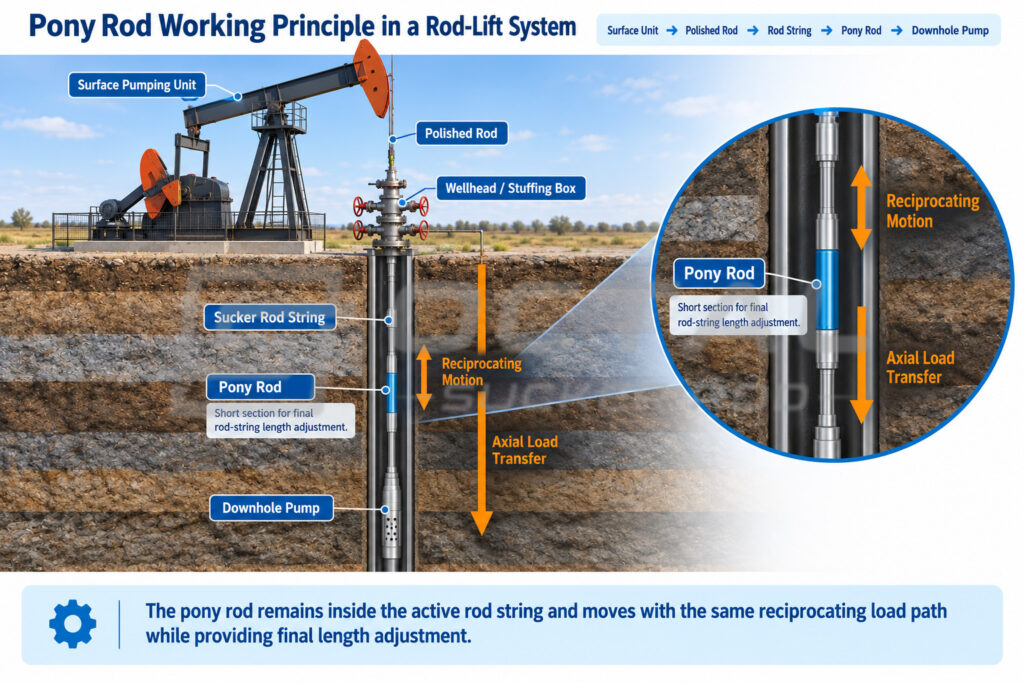
Within a rod-lift system, the pony rod works as part of the same continuous mechanical load path as the surrounding sucker rods. Reciprocating motion generated by the surface pumping unit passes through the polished rod and sucker rod string to the downhole pump. The pony rod moves through the same stroke and transfers axial load through its rod body and threaded end connections, while its shorter length provides the required adjustment in the completed rod string. Because the component remains inside the active load path, its structural details are governed by the same cyclic-loading and connection requirements applied to the adjoining sucker rods.
| Structural Section | Function | Engineering Significance |
|---|---|---|
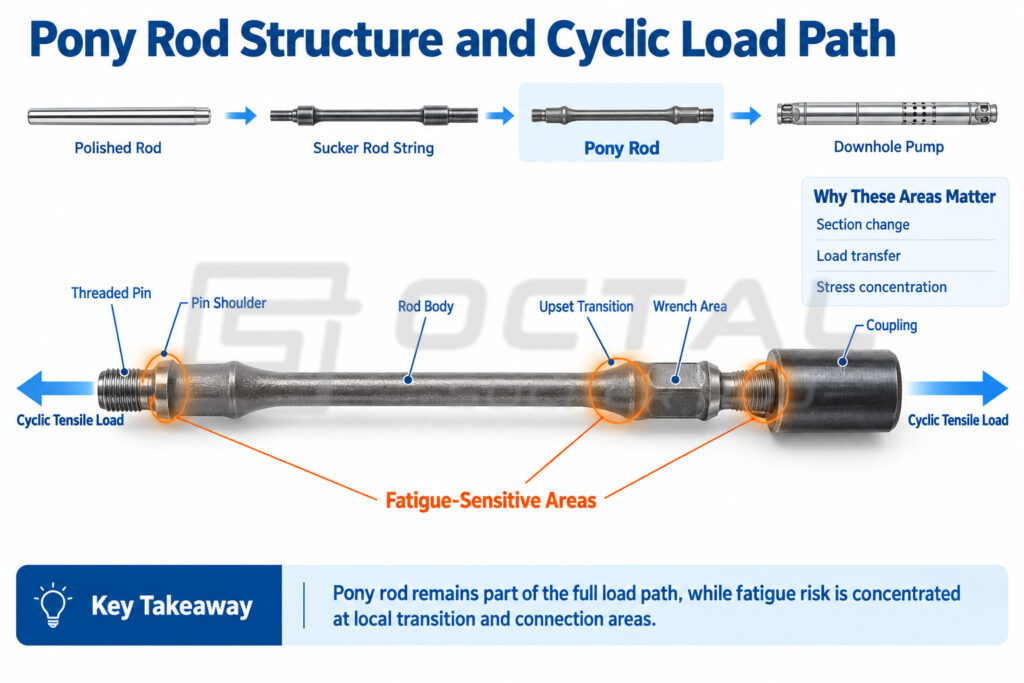
| Rod Body | Transfers axial tensile load along the main length of the pony rod | Body diameter and material grade determine the basic load-carrying section |
| Upset / Forged Transition | Changes the cross-section from the rod body to the larger end section | The geometric transition influences local stress concentration under cyclic loading |
| Forged End | Provides sufficient cross-section for the wrench area, shoulder and threaded pin | Forging quality and alignment affect the integrity of the connection end |
| Wrench Area | Provides the surface used during connection makeup and handling | Correct geometry supports controlled assembly without damaging the connection |
| Pin Shoulder | Forms the axial contact surface in the shouldered connection | Shoulder condition and geometry influence load transfer through the joint |
| Threaded Pin | Engages with the sucker rod coupling | Thread profile and dimensional accuracy control connection fit and load transfer |
| Coupling | Connects the pony rod to the adjoining sucker rod or rod-string component | Coupling size and thread geometry must correspond to the matching pin connection |
During operation, the load carried by the pony rod is not determined by its short length alone. Rod weight, fluid load, downhole pump load and rod-string acceleration all contribute to the tensile and dynamic stress acting through the component during each pumping cycle. The rod-body-to-upset transition, pin shoulder and thread root therefore remain critical areas for fatigue control, particularly where higher rod-string loads, repeated stroke reversal or corrosive produced fluids are present. This structural relationship explains why pony rod diameter, grade and connection geometry are treated as one mechanical system rather than as separate dimensional features.
Pony Rod Grades and Mechanical Properties
Pony rods operate under repeated tensile loading rather than a single static load, so grade evaluation should consider more than nominal strength. Yield strength indicates the load level at which permanent deformation begins, tensile strength defines the upper strength range of the material, while ductility and hardness influence how the rod responds to cyclic stress, local stress concentration and connection loading. These properties are especially relevant at the upset transition, pin shoulder and thread root, where geometric changes can amplify local stress during repeated pumping cycles. Material behavior under corrosion exposure must also be considered separately from mechanical strength, because a higher-strength grade does not automatically provide better resistance to corrosion fatigue.
| Grade / Material Class | Minimum Yield Strength | Tensile Strength | Main Selection Direction |
|---|---|---|---|
| Grade C | 60 ksi / 414 MPa | 90–115 ksi / 621–793 MPa | Moderate mechanical load under controlled corrosion conditions |
| Grade K | 60 ksi / 414 MPa | 90–115 ksi / 621–793 MPa | Material route selected with greater attention to corrosive production conditions |
| D-Family | 85 ksi / 586 MPa | 115–140 ksi / 793–965 MPa | Higher mechanical loading where additional strength margin is required |
Grade C vs Grade D Strength Comparison
The difference between Grade C and Grade D pony rods is mainly reflected in their mechanical-property range rather than external dimensions. Both grades can be manufactured with similar nominal rod-body sizes and connection configurations, but their strength levels determine the load range they are designed to support under repeated rod-lift operation.
The main mechanical-property differences between Grade C and Grade D pony rods are summarized below.
| Grade | Minimum Yield Strength | Tensile Strength Range | Elongation | Reduction of Area |
|---|---|---|---|---|
| Grade C | 60 ksi / 414 MPa | 90–115 ksi / 621–793 MPa | ≥13% | ≥50% |
| Grade D | 85 ksi / 586 MPa | 115–140 ksi / 793–965 MPa | ≥13% | ≥50% |
Compared with Grade C, Grade D increases the minimum yield strength from 60 ksi (414 MPa) to 85 ksi (586 MPa), providing a higher resistance margin against permanent deformation under higher tensile loading.
However, pony rod grade selection depends on more than strength level. The actual requirement is determined by the combined effect of rod-string loading, cyclic stress, connection geometry, corrosion exposure and installation position within the sucker rod string. Therefore, Grade C and Grade D with the same nominal size may have similar external dimensions but different service capabilities.
Grade C Pony Rod
Grade C pony rods are used in rod-string sections where calculated mechanical loading remains moderate and the produced-fluid environment is reasonably controlled. Their lower strength range compared with D-family rods suits applications that do not require additional high-strength capacity, while actual service suitability still depends on cyclic stress, well geometry, corrosion exposure and connection condition rather than well depth or grade designation alone.
Grade D Pony Rod
Grade D pony rods provide a higher mechanical strength range, with a minimum yield strength of about 85 ksi and tensile strength of 115–140 ksi, making them suitable for rod-string sections exposed to higher loading from rod weight, fluid load, pump load or dynamic stress. These conditions are more common in deeper installations, larger pump configurations and highly loaded sections of tapered strings, although higher strength does not remove fatigue sensitivity at the forged end, thread, shoulder or corrosion-damaged surface.
Grade K Pony Rod
Grade K pony rods use an alloy-steel material route intended for service where corrosion behavior requires greater consideration than strength alone. Although their mechanical strength range can overlap Grade C, their application is more closely related to the interaction between material condition, cyclic stress and the produced-fluid environment. Corrosion performance is influenced by factors such as produced-water chemistry, chloride content, CO₂ or H₂S exposure, operating temperature, inhibitor effectiveness and material hardness, so Grade K should be evaluated from the actual corrosion mechanism of the well rather than treated as a universally corrosion-resistant grade.
Pony Rod Connection and Coupling Compatibility
The connection system of a pony rod is defined by the relationship between the rod-body diameter, forged end, threaded pin, shoulder and coupling, rather than by rod-body size alone. Axial load carried by the rod body passes through the forged transition into the pin and is then transferred across the threaded connection to the coupling and adjoining sucker rod. Each nominal rod size therefore corresponds to a specific connection geometry and coupling envelope. The larger diameter at the forged end and coupling is required to accommodate the threaded connection and provide the cross-sectional area needed for repeated cyclic load transfer. This dimensional relationship also affects clearance within the tubing, especially where full-size couplings are used in larger rod sections.
| Nominal Rod Size | Rod Body OD | Typical Full-Size Coupling OD |
|---|---|---|
| 5/8 in. | 15.88 mm | 1.500 in. / 38.10 mm |
| 3/4 in. | 19.05 mm | 1.625 in. / 41.28 mm |
| 7/8 in. | 22.23 mm | 1.812 in. / 46.00 mm |
| 1 in. | 25.40 mm | 2.187 in. / 55.60 mm |
| 1-1/8 in. | 28.58 mm | 2.375 in. / 60.33 mm |
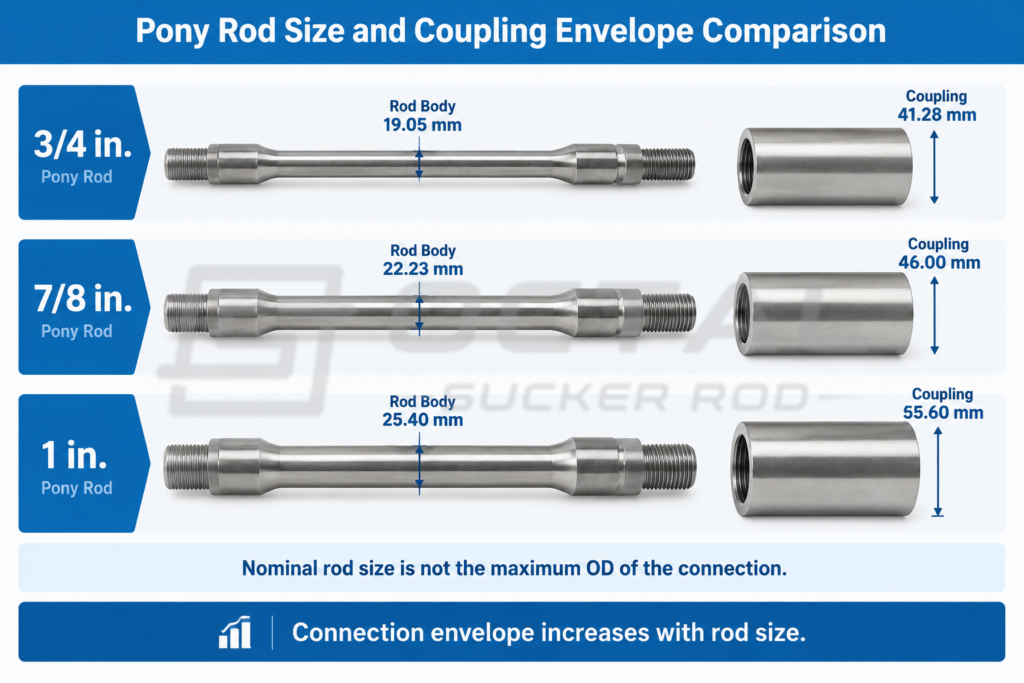
The coupling diameter increases with rod size because the connection has to contain the matching internal thread while maintaining sufficient wall section around the joint. For this reason, connection compatibility involves the complete geometry from the rod body through the forged end and pin to the coupling, not only the nominal outside diameter of the rod. Differences in pin dimensions, shoulder geometry or coupling type can change how load is transferred across the joint even when two pony rods have the same body size and length. In service, the connection is repeatedly loaded during each pumping cycle, making thread condition, shoulder contact, coupling fit and alignment important to the fatigue behavior of the assembled rod string.
Pony Rod Forging and Manufacturing Process
Pony rod manufacturing centers on three operations that directly affect service performance: end forging, heat treatment, and connection machining. After the steel bar is identified and cut to length, the rod ends are forged to form the upset section, wrench area and pin body. The finished rod is then heat treated according to the specified grade, straightened as required, and machined to the final pin and thread geometry before inspection and marking. These operations control the strength of the rod body, the fatigue behavior of the forged transition and the dimensional accuracy of the connection.
End Forging and Upset Formation
The rod end is locally forged to increase the cross-section required for the wrench area, shoulder and threaded pin. The transition between the rod body and forged end is particularly important because repeated tensile loading passes through this change in section during every pumping cycle. Controlled forging geometry, alignment and surface condition help limit local stress concentration in this fatigue-sensitive area.
Heat Treatment
Heat treatment establishes the mechanical-property range required for the specified pony rod grade. The process controls yield strength, tensile strength, ductility and hardness, with the final properties verified against the applicable Grade C, Grade K or D-family requirements. Mechanical results must remain associated with the corresponding heat or production lot.
Pin and Thread Machining
The forged end is machined to form the pin, shoulder and sucker rod thread that connect the pony rod to the coupling. Dimensional accuracy at these surfaces directly affects connection fit and cyclic load transfer. Thread form, shoulder geometry, alignment and gauge conformity are therefore the main controls during final connection machining.
Pony Rod Selection for Different Well Conditions
Pony rod application depends on the operating environment of the sucker rod string, including mechanical loading, corrosion exposure, string position and connection requirements. The same pony rod length may be applied in different wells, but the required grade, diameter and connection configuration are determined by the actual rod-string condition.
| Well Condition | Main Factors Affecting Pony Rod Selection | Typical Considerations |
|---|---|---|
| Conventional Rod-Lift Wells | Moderate rod load, controlled corrosion, standard rod-string configuration | Pony rod is mainly used to complete rod-string length adjustment while maintaining the same diameter, grade and connection system as the surrounding rods |
| Higher Rod-String Loads | Increased rod weight, fluid load, pump load, stroke length and dynamic stress | Higher-strength grades and suitable rod-string positions may be required where tensile loading increases, especially in deeper wells or highly loaded sections |
| Corrosive Produced-Fluid Conditions | Produced-water chemistry, chloride content, CO₂/H₂S exposure, temperature and corrosion control program | Material selection should consider corrosion mechanism together with cyclic loading, because corrosion damage can accelerate fatigue failure |
| Workover and Replacement Applications | Existing rod size, grade, thread type, coupling and installed string configuration | Replacement pony rods need to correspond with the existing rod-string components to maintain connection and load-transfer conditions |
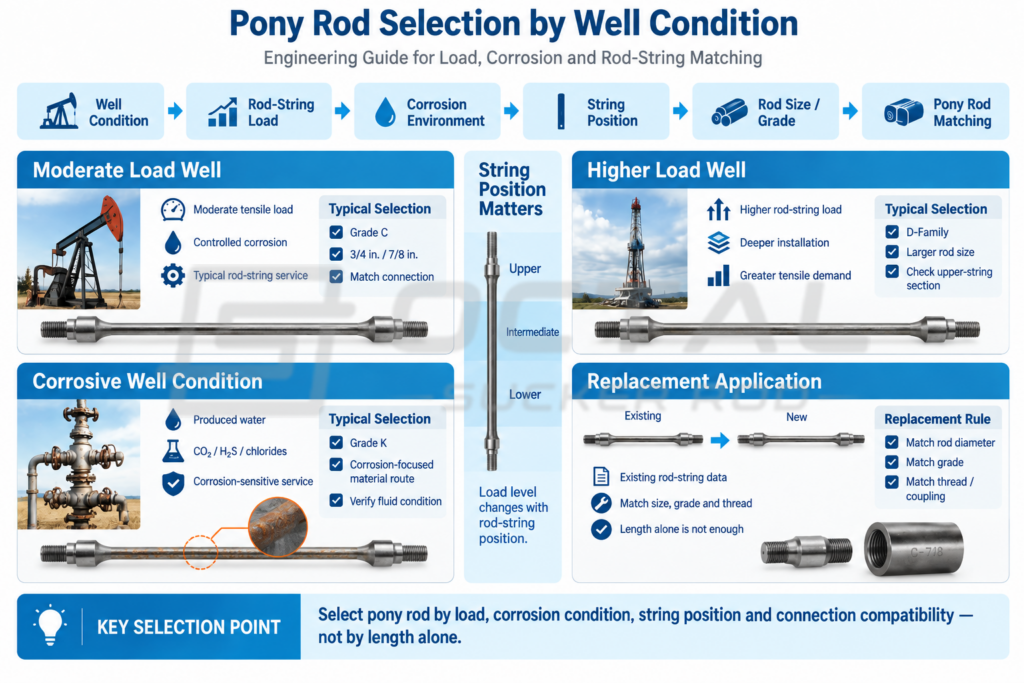
In all applications, pony rod performance depends on the combined effect of mechanical loading, material behavior and connection integrity. Length alone does not define the service condition of the component, as the pony rod remains part of the complete sucker rod load path during operation.
Pony Rod Inspection and Quality Verification
Pony rod inspection focuses on verifying the consistency between the finished component and its specified material, grade, dimensions, connection geometry and production traceability. The inspection process covers both the rod body and connection areas because the component is subjected to repeated tensile loading during operation. Typical verification items include:
| Inspection Item | Verification Focus | Typical Record |
|---|---|---|
| Material Identification | Steel heat/lot identification and material traceability | Material certificate / heat record |
| Mechanical Properties | Yield strength, tensile strength and specified mechanical requirements | Mechanical test report |
| Dimensions | Length, rod-body diameter, straightness and forged-end geometry | Dimensional inspection record |
| Connection | Pin, thread and shoulder geometry | Thread and connection inspection record |
| Surface Condition | Forged-end surface, machining quality and visible defects | Visual inspection record |
| Product Identification | Grade, size and production lot marking | Traceability record |
Inspection records provide a complete link between the finished pony rod and its manufacturing history, allowing the material, mechanical properties and connection condition of each production lot to be verified throughout the supply process.
Pony Rod Supply and Technical Coordination
Octal Steel provides pony rods for sucker rod pumping systems, supporting applications where short-length rod sections are required within a complete rod-string configuration. Supply can be coordinated with related components such as sucker rods, couplings, polished rods and sinker bars, allowing rod diameter, grade, connection type and matching components to be considered within the same system.
Technical coordination covers key pony rod parameters including length, body diameter, material grade, pin and thread configuration, coupling compatibility and service conditions. Manufacturing and inspection records can include material identification, mechanical-property documentation, dimensional and thread inspection records, marking and heat/lot traceability according to applicable project requirements, ensuring each pony rod is supplied with verified specifications and traceable production information.
FAQ
Why is a pony rod used in a sucker rod string?
A pony rod is used to provide short-length adjustment within a sucker rod string while maintaining continuous load transfer between the surface pumping unit and the downhole pump. Unlike a spacer component, a pony rod remains part of the reciprocating load path and experiences the same cyclic tensile loading as the surrounding sucker rods.
Can a pony rod be selected only by length and diameter?
No. Pony rod selection also depends on grade, material class, forged-end design, pin and thread configuration, coupling compatibility and the position of the rod string where it is installed. Two pony rods with the same nominal length and body diameter may have different mechanical properties and connection requirements.
What is the difference between Grade C, Grade K and Grade D pony rods?
Grade C, Grade K and Grade D pony rods mainly differ in their mechanical properties and service considerations. Grade C is commonly associated with moderate loading conditions, Grade D provides a higher mechanical strength range for higher tensile loading, while Grade K focuses more on material behavior under corrosive service conditions rather than increased strength alone.
Which parts of a pony rod are most critical for fatigue resistance?
The fatigue-sensitive areas of a pony rod are typically associated with geometric transitions and connection regions, including the forged transition, pin shoulder and thread root. These areas experience concentrated stress during repeated pumping cycles, so forging quality, thread machining accuracy, surface condition and corrosion control directly influence service performance.