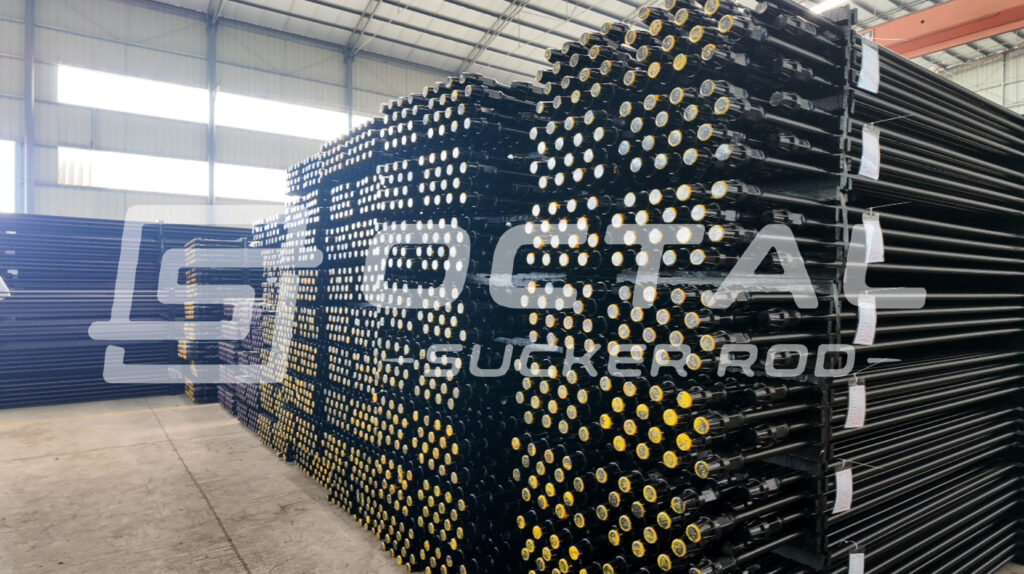
Delivered 3,200 pieces of Grade D sucker rod together with matching couplings for an onshore oilfield artificial-lift project in Oman. The shipment was based on a 7/8 inch sucker rod configuration with a standard 25 ft rod length, selected for a conventional rod-pumping system where the customer required API dimensional control, Grade D mechanical performance, and complete shipment traceability.
The rods were supplied as API 11B sucker rod products with matching connection components and protective packing for ocean transport to Sohar, Oman. Grade D was selected because its API mechanical-property range provides a higher strength level than Grades C and K for applications where the rod string is subjected to repeated tensile loading during pumping service. API 11B specifies a minimum yield strength of 586 MPa and a tensile-strength range of 793–965 MPa for Grade D steel sucker rods. Octalsteel
Octal Sucker Rod coordinated the rods, couplings, inspection records, thread protection, and export packing as one shipment so the customer could receive the rod-string components under a consistent delivery and documentation package.
Project Supply Details
| Item | Project Requirement |
|---|---|
| Destination | Sohar, Oman |
| Application | Onshore oilfield rod-pumping system |
| Product | Grade D sucker rod |
| Standard | API 11B |
| Rod Diameter | 7/8 in (22.23 mm nominal) |
| Rod Length | 25 ft (7.62 m) |
| Rod Quantity | 3,200 pcs |
| Matching Couplings | 3,250 pcs |
| Mechanical Grade | Grade D |
| Minimum Yield Strength | 586 MPa |
| Tensile Strength Range | 793–965 MPa |
| Packing | Bundled rods with thread protection and export packing |
The 7/8 inch sucker rod size was used as the main rod diameter for the project. This diameter corresponds to a nominal rod body diameter of approximately 22.23 mm, while the actual pin, shoulder, and connection dimensions are controlled separately by the applicable API requirements. Api Drill Pipe
Inspection Before Shipment
The inspection scope focused on the features that directly affect rod-string assembly and field installation rather than relying only on a material certificate.
The shipment inspection included:
- rod body diameter and overall dimensional checks;
- straightness and visible surface-condition inspection;
- pin thread profile and connection dimensions;
- matching of each sucker rod coupling to the specified rod size;
- verification of mechanical-property records for the Grade D production batch;
- heat and batch traceability through the inspection and packing records;
- confirmation that thread protectors remained secure before loading.
API 11B requires dimensional inspection of sucker rods and provides specific inspection procedures for circular features and connection dimensions. It also requires chemical analysis for each steel heat used in sucker rod manufacture. American Petroleum Institute
For this shipment, rods were released only after the production and inspection records were matched to the relevant packing identification.
Packing for Ocean Shipment
Long sucker rods require different packing attention from short machined oilfield components. Damage at the rod ends or threaded pins can create connection problems even when the rod body remains undamaged.
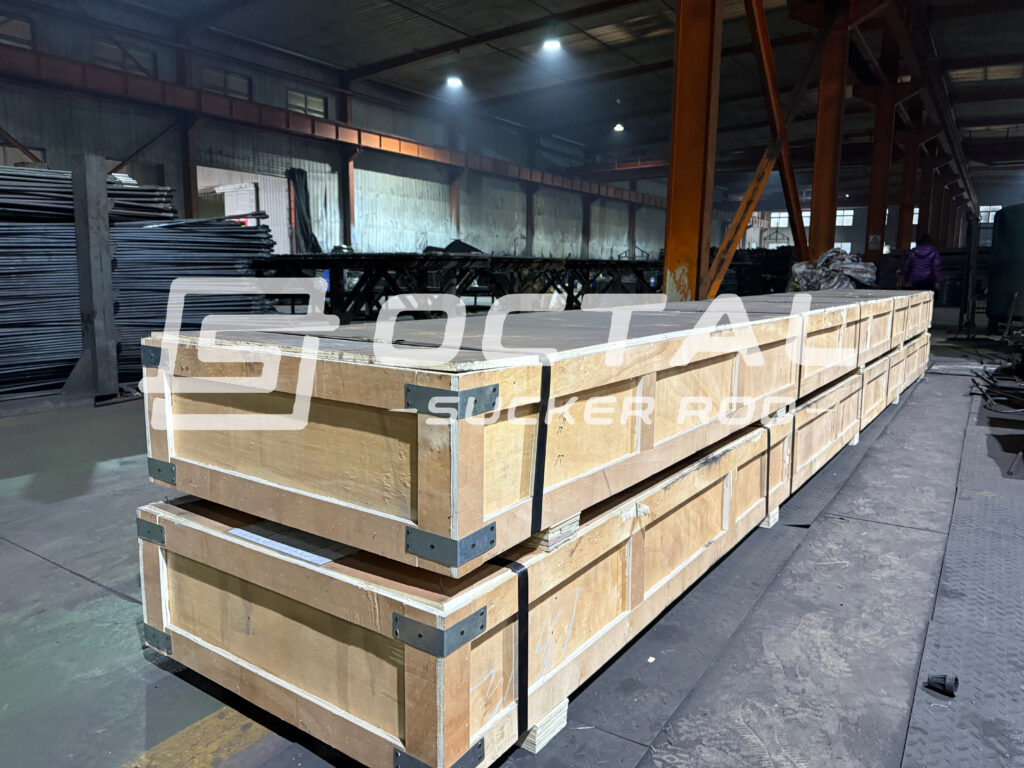
The rods were therefore packed in aligned bundles with protected connection ends and lifting positions arranged to limit uncontrolled bending during handling. Matching couplings were packed separately and identified by size and shipment batch.
Before container or cargo loading, the packing team checked that:
- thread protectors were fully installed;
- rod bundles remained aligned and securely restrained;
- lifting points did not load exposed threaded sections;
- bundle identification remained visible;
- coupling packages could be traced to the same shipment documents.
This packing method was intended to protect both rod straightness and the machined connection surfaces during inland handling and sea transportation.
Why Grade D Was Used
Grade D is commonly selected where a rod string requires a higher mechanical-strength level than lower-strength conventional sucker rod grades.
Under API 11B, Grade D has the following specified mechanical limits:
| Mechanical Property | API Grade D Requirement |
|---|---|
| Minimum Yield Strength | 586 MPa |
| Minimum Tensile Strength | 793 MPa |
| Maximum Tensile Strength | 965 MPa |
These values make Grade D sucker rod suitable for many conventional rod-pumping systems, but grade selection should still consider well depth, calculated rod load, pumping geometry, corrosion environment, and fatigue demand. A higher-strength grade does not replace a proper rod-string design. Octalsteel
Shipment Result
The complete rod and coupling package was released for shipment after dimensional, connection, documentation, and packing checks were completed. The goods were then prepared for delivery to Sohar for onward transportation to the customer’s oilfield site.
For an international sucker rod supplier, the important part of this type of shipment is not only supplying the specified diameter and grade. The rod, connection components, inspection records, and packing identification must remain traceable as one delivery package so the customer can verify the material before field assembly.
FAQ
Q: What Grade D sucker rod specification was supplied for this Oman project?
A: The shipment used API 11B Grade D sucker rods in a 7/8 in diameter and 25 ft length configuration, together with matching couplings for an onshore rod-pumping application.
Q: Why was a 7/8 inch sucker rod selected for this shipment?
A: The 7/8 inch sucker rod was selected to match the customer’s rod-string design and pumping requirements. Rod diameter should be confirmed from the calculated load, well depth, pumping geometry, and required rod-string configuration rather than selected from size alone.
Q: Were sucker rod couplings supplied with the rods?
A: Yes. Matching sucker rod couplings were included in the shipment, with size identification, thread protection, and packing arranged separately from the rod bundles to protect the connection surfaces during transport.
Q: What should a sucker rod supplier check before international shipment?
A: A sucker rod supplier should verify rod dimensions, thread condition, mechanical-property records, batch traceability, coupling matching, thread protection, bundle identification, and export packing before the goods are released for shipment.