Supplied Grade K sucker rods for an onshore rod-pumping project in Port Harcourt, Nigeria, where the customer needed the rod string to operate under repeated cyclic loading while exposed to produced fluids containing water and dissolved CO₂. The selection therefore considered both mechanical loading and the effect of the downhole environment on long-term rod performance.
The project did not select the rod grade from tensile strength alone. Produced water and dissolved CO₂ can increase corrosion activity on exposed steel surfaces, while the continuous reciprocating motion of the pumping system subjects each rod to repeated stress cycles. Under these conditions, corrosion damage and cyclic stress can interact and shorten fatigue life even when the nominal rod load remains below the material tensile limit.
A Grade K sucker rod was selected as the standard-strength alloy-steel option for this application. The supplied API 11B sucker rod configuration used 3/4 in rod bodies with matching connection components, dimensional inspection, surface-condition checks and export packing before delivery to Port Harcourt.
Project Requirement and Supply Scope
The well conditions required a balance between mechanical properties and corrosion tolerance rather than simply specifying the highest-strength rod available.
| Project Item | Supply Requirement |
|---|---|
| Destination | Port Harcourt, Nigeria |
| Application | Onshore rod-pumping artificial lift system |
| Product | Grade K sucker rod |
| Standard | API 11B |
| Rod Diameter | 3/4 in (19.05 mm) |
| Rod Length | 25 ft (7.62 m) |
| Quantity | 3,600 pcs |
| Service Environment | Produced water with dissolved CO₂ |
| Main Operating Concern | Corrosion-fatigue under repeated cyclic loading |
| Packing | Reinforced wooden export cases |
| Delivery Scope | Rods, matching connection components and inspection documentation |
The 3/4 inch sucker rod size was used to match the customer’s rod-string design and expected pumping load. Rod diameter was considered together with well loading and rod-string configuration rather than treated as an independent size selection.
Why Grade K Was Selected for the Well Condition
Grade K occupies a different position from a higher-strength Grade D rod. Public API-aligned product data commonly place Grade K at a minimum yield strength of about 414 MPa and a tensile-strength range of approximately 621–793 MPa. Its alloy-steel route is used where the application requires standard rod strength together with greater attention to corrosion exposure. Octalsteel
| Mechanical Property | Grade K Reference |
|---|---|
| Minimum Yield Strength | 414 MPa / 60 ksi |
| Tensile Strength | 621–793 MPa / 90–115 ksi |
| Nominal Rod Diameter for This Project | 19.05 mm / 3/4 in |
| Rod Length for This Project | 7.62 m / 25 ft |
For this project, the important issue was not simply whether a corrosion resistant sucker rod could withstand CO₂-containing fluid. The engineering concern was the combination of corrosive produced fluid and alternating mechanical stress. Corrosion pits or surface damage can become stress-concentration locations from which fatigue cracking develops during repeated pumping cycles.
Grade K therefore provided an appropriate material route for the specified service, but it was not treated as a universal solution for every corrosive well. Actual service life still depends on fluid chemistry, CO₂ partial pressure, water composition, operating stress, pumping frequency and the effectiveness of the field corrosion-control program. Research on sucker-rod service likewise identifies operating load and environmental conditions as important contributors to fatigue and corrosion performance.
Pre-Shipment Inspection
Inspection concentrated on the locations that can influence rod-string assembly and corrosion-fatigue performance after installation. Particular attention was given to the rod body and connection area because surface discontinuities, damaged threads or poor handling can create local stress concentrations.
The pre-shipment inspection included:
- rod body diameter and dimensional verification;
- straightness inspection along the rod body;
- visual inspection for abnormal surface defects and handling damage;
- upset, wrench-square and shoulder condition checks;
- pin-thread profile and connection inspection;
- matching of connection components to the specified rod size;
- verification of heat and production-batch traceability;
- confirmation of thread protection before packing.
The inspection records were matched with the corresponding production and packing identification so that the delivered oilfield sucker rod batches remained traceable through shipment.
Surface Protection and Export Packing
Packing was arranged to protect both the long rod bodies and the machined connection ends during inland transport and ocean shipment.
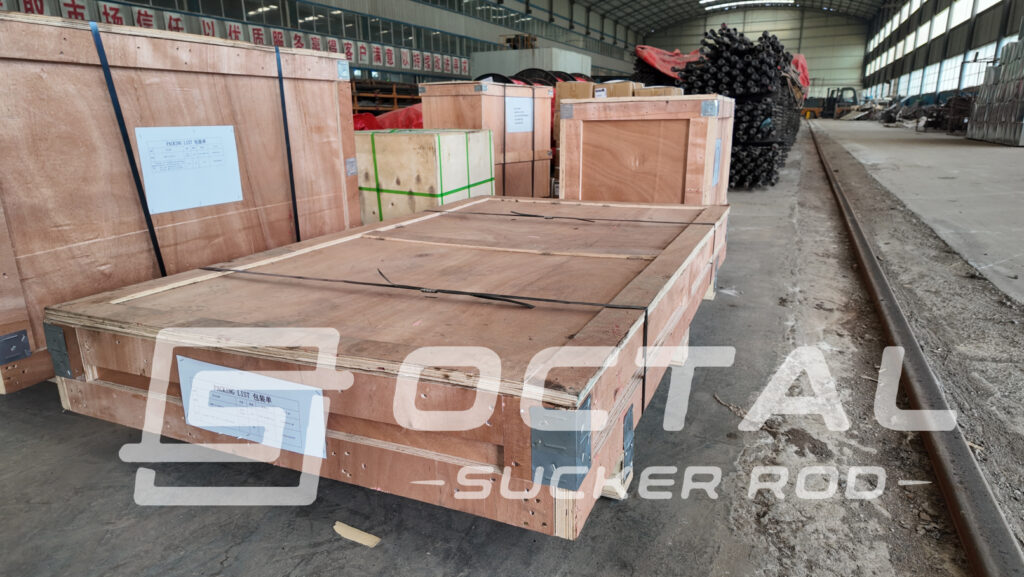
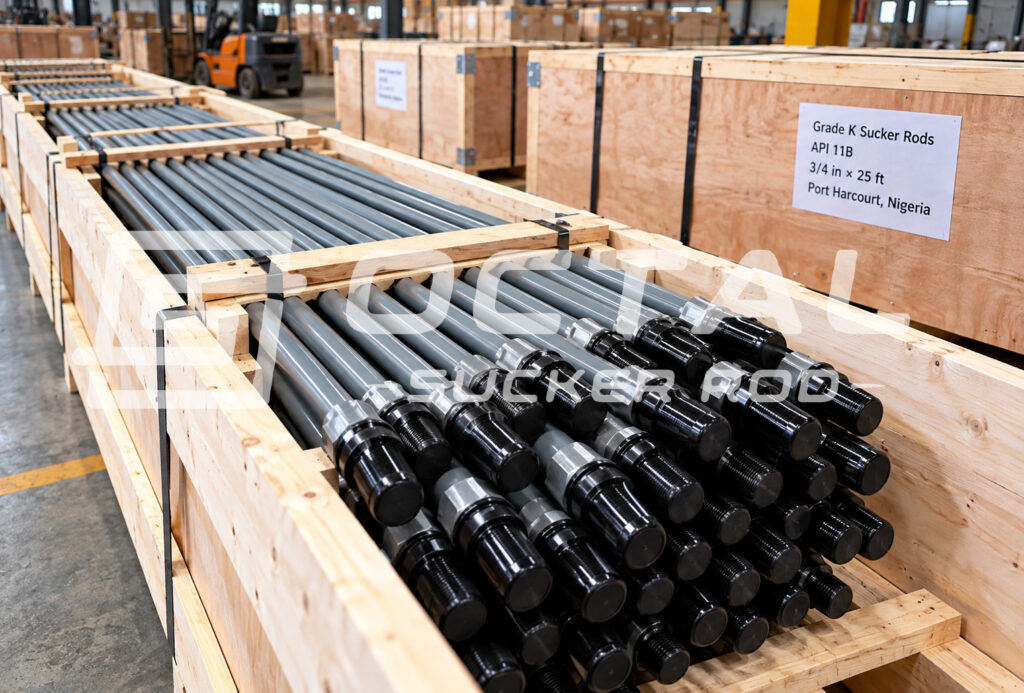
The rods were aligned inside reinforced wooden export cases with internal timber supports positioned to restrict movement. Threaded ends were protected before the cases were closed, while the long rod bodies were supported to reduce uncontrolled deflection during lifting and handling.
| Packing Control | Purpose |
|---|---|
| Thread-end protection | Prevent impact and contamination of machined pin threads |
| Internal timber support | Keep long rods aligned during transport |
| Movement restraint | Reduce rod-to-rod impact inside the case |
| External case reinforcement | Maintain packing integrity during lifting and transfer |
| Batch identification | Preserve traceability between rods and shipment documents |
For a corrosion-sensitive application, preventing storage and transport damage is particularly important. Surface damage introduced before installation can undermine the benefit of selecting a material suited to the intended well environment.
Delivery to Port Harcourt
After dimensional, surface, connection and documentation checks were completed, the wooden cases were released for export shipment to Port Harcourt. Packing identification was kept consistent with the inspection documentation so that the customer could verify the delivered batches before the rods were transferred to the field.
This project illustrates why sucker-rod selection should consider more than a strength grade on a material certificate. For wells containing produced water and dissolved CO₂, rod-string reliability depends on the interaction between material grade, cyclic stress, surface condition and corrosion control. The role of the sucker rod supplier is therefore to supply the specified product while maintaining dimensional compliance, traceability and connection protection through final delivery.
FAQ
Q: Why was Grade K selected instead of Grade D for this project?
A: The primary concern was the combination of produced-fluid corrosion exposure and repeated cyclic loading rather than maximum tensile capacity alone. Grade K provides a standard-strength alloy-steel route that can be considered where corrosion tolerance is an important part of the rod-selection process. Grade D provides a higher strength level and is normally evaluated when mechanical load becomes the dominant requirement.
Q: Can Grade K sucker rods be used in every CO₂-corrosive well?
A: No. Grade K should not be treated as universally suitable for every corrosive environment. Fluid composition, CO₂ conditions, produced-water chemistry, operating stress and the corrosion-inhibition program should be evaluated for the specific well.
Q: Why was a 3/4 inch sucker rod used for this shipment?
A: The 3/4 in size was selected to match the specified rod-string design and pumping load for this project. Rod diameter should be determined from the complete rod-string loading and operating conditions rather than from well depth alone.
Q: What was checked before the rods were shipped to Nigeria?
A: The release inspection covered rod dimensions, straightness, surface condition, upset and shoulder areas, pin threads, connection matching, production-batch traceability and thread protection before the rods were packed for export.