
Sucker rod materials mainly include carbon steel and alloy steel grades such as AISI 4130, 4138, 4140, 4142, and 4330, used to manufacture rod strings that transmit reciprocating motion and axial loads from surface pumping equipment to downhole pumps. These steels differ in carbon content and alloying elements, particularly chromium, molybdenum, and nickel, which influence hardenability, heat-treatment response, strength, and toughness. The finished rods operate under repeated tensile loading, making fatigue performance, surface integrity, and rod-end connection strength important considerations alongside basic mechanical properties.
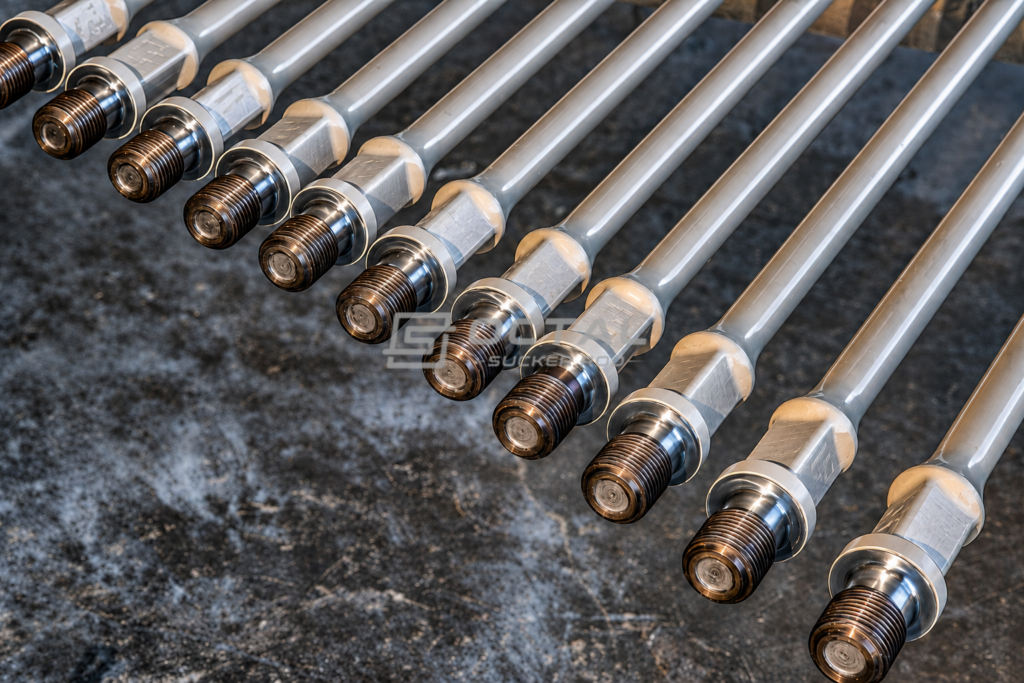
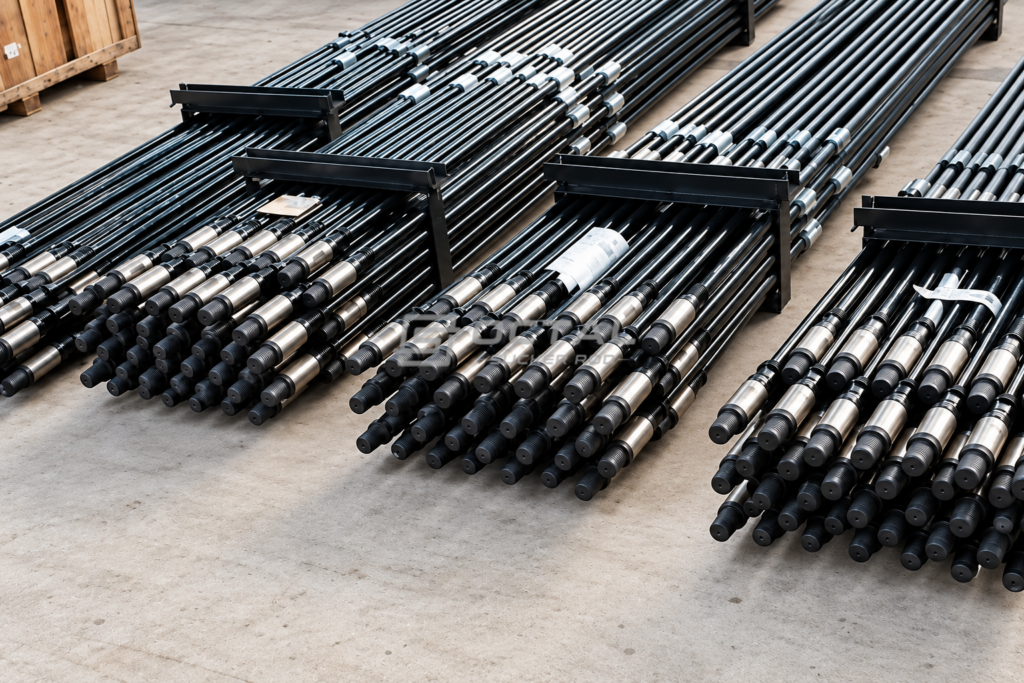
Material selection depends on the required API 11B finished-product grade, rod diameter, operating loads, well deviation, and exposure to CO₂, H₂S, or chloride-containing fluids. Carbon and alloy steels offer different combinations of mechanical properties and heat-treatment characteristics, but a higher-strength material does not necessarily provide better corrosion resistance or longer fatigue life. The selected steel must be evaluated against the intended service conditions, while the finished sucker rod must meet the specified tensile properties, dimensional tolerances, connection requirements, and inspection criteria.
Types of Sucker Rod Materials
Sucker rods are manufactured from different material systems according to their required strength, weight, stiffness, and operating environment. Carbon steel and alloy steel are the main materials for conventional steel sucker rods, while fiberglass-reinforced composites provide an alternative where lower rod-string weight or specific fluid compatibility requirements are important.
Carbon Steel Sucker Rods
Carbon steel relies mainly on controlled carbon and manganese content to develop its mechanical properties. It can be used for conventional sucker rod grades when the finished product meets the specified strength, ductility, and dimensional requirements. Material cleanliness, surface quality, and heat-treatment condition influence its performance under repeated loading.
Alloy Steel Sucker Rods
Alloy steel uses elements such as chromium, molybdenum, and nickel to modify hardenability and the strength–toughness balance. Common material families include Cr-Mo steels such as AISI 4130, 4140, and 4142, as well as Ni-Cr-Mo steels such as AISI 4330. These alloys allow different mechanical properties to be developed through controlled heat treatment, although corrosion suitability must be assessed separately.
Fiberglass Sucker Rods
Fiberglass sucker rods consist of continuous reinforcing fibers embedded in a polymer resin system, typically with specially designed end fittings. Their lower density reduces rod-string weight compared with steel, but their lower axial stiffness, temperature limits, load capacity, and connection performance require separate design verification.
Comparison of Sucker Rod Material Types
| Material Type | Composition / Structure | Main Characteristics | Selection Considerations |
| Carbon Steel | Fe-C-Mn system | Conventional strength and ductility; simpler alloy chemistry | Required API grade, fatigue, corrosion exposure |
| Cr-Mo Alloy Steel | Fe-C-Cr-Mo system | Improved hardenability; adjustable strength and toughness through heat treatment | Mechanical loads, heat-treatment condition, fatigue |
| Ni-Cr-Mo Alloy Steel | Fe-C-Ni-Cr-Mo system | Additional control of hardenability and toughness | Strength requirements, toughness, service environment |
| Fiberglass Composite | Reinforcing fibers and polymer resin | Low density, lower axial stiffness, material-dependent chemical compatibility | Temperature, tensile loading, connection design |
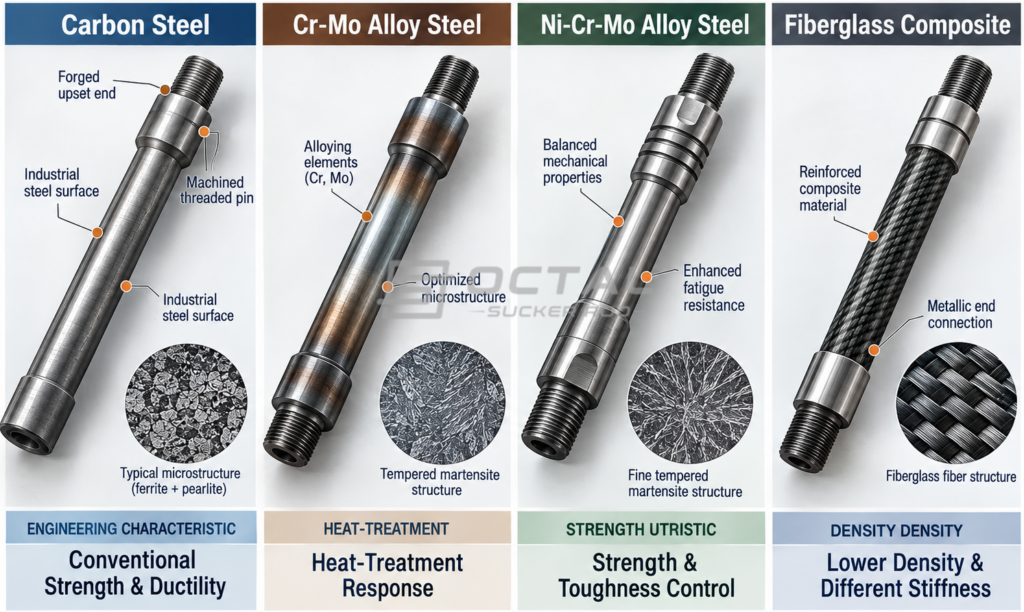
The principal difference between these material systems is not simply their achievable tensile strength. Material chemistry, manufacturing condition, elastic behavior, fatigue response, and downhole environment must be considered together when specifying a finished sucker rod.
Common Steel Materials Used for Sucker Rods
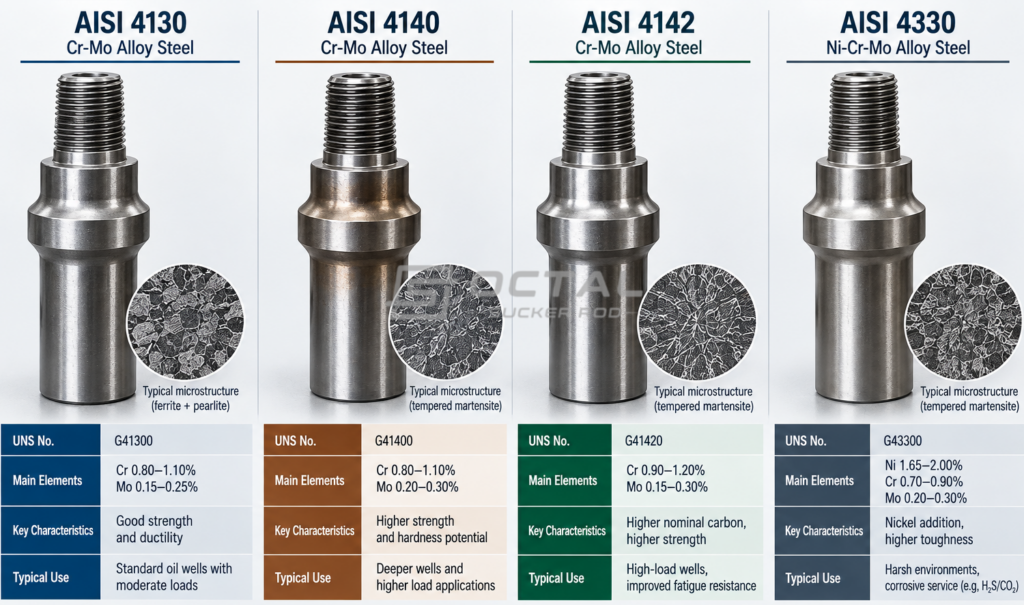
Sucker rod steel is commonly identified by AISI or SAE designations that specify the nominal chemical composition and alloy family. Common materials include carbon-manganese steels and chromium-molybdenum alloys such as AISI 4130, 4138, 4140, and 4142, along with nickel-chromium-molybdenum steels such as AISI 4330. These materials differ in carbon content, alloying elements, hardenability, and heat-treatment response, which influence the achievable strength, toughness, and hardness of finished sucker rods.
The 41xx series primarily consists of chromium-molybdenum steels, while the 43xx series contains nickel as an additional principal alloying element. However, an AISI steel designation identifies the material rather than its finished API 11B grade. Mechanical properties and product compliance must be verified separately.
Common AISI Steel Materials
The following table compares common steel grades referenced in sucker rod manufacturing and material specifications.
| Steel Material | Alloy Family | Material Characteristics | Main Verification Focus |
| AISI 1541 | Carbon-Manganese | Medium-carbon steel with relatively high manganese content | Chemistry, ductility, finished strength |
| AISI 4120 | Cr-Mo | Lower-carbon chromium-molybdenum alloy steel | Material chemistry, heat-treatment condition |
| AISI 4130 | Cr-Mo | Approximately 0.30% carbon with chromium and molybdenum | Strength, toughness, heat-treatment response |
| AISI 4138 | Cr-Mo | Higher nominal carbon content than AISI 4130 | Hardness, strength, fatigue-sensitive properties |
| AISI 4140 | Cr-Mo | Approximately 0.40% carbon with good hardening response | Strength, hardness, toughness |
| AISI 4142 | Cr-Mo | Slightly higher nominal carbon content than AISI 4140 | Heat-treatment consistency, finished properties |
| AISI 4330 | Ni-Cr-Mo | Nickel-containing chromium-molybdenum alloy steel | Strength–toughness balance, heat-treatment verification |
These are representative steel materials, not a confirmed Octal production or inventory list. Actual availability, modified compositions, and finished-product grades must be verified against the applicable manufacturing specification.
Key Differences Between Sucker Rod Alloy Steels
Although these steel grades share certain alloying elements, differences in carbon content and alloy composition affect their response to heat treatment and the mechanical properties achievable in the finished rod.
AISI 4130 vs 4140 — Carbon Content and Strength
AISI 4130 typically contains 0.28–0.33% carbon, compared with 0.38–0.43% in AISI 4140. The higher carbon content of 4140 allows greater hardness and strength to be developed under suitable heat-treatment conditions. However, the final balance of strength, ductility, and toughness depends on processing conditions, and higher hardness does not necessarily result in improved fatigue resistance.
AISI 4142 and 4142M — Standard vs Modified Alloy Chemistry
AISI 4142 has a slightly higher nominal carbon range than AISI 4140, while modified grades such as 4142M may contain adjusted manganese, chromium, vanadium, or other alloying-element limits. These modifications are defined by the relevant manufacturer’s material specification rather than a universal 4142M chemistry. The specified composition, heat-treatment condition, and finished mechanical properties must therefore be verified independently.
AISI 4330 — Nickel-Chromium-Molybdenum Alloy Steel
AISI 4330 differs from the 41xx series through the addition of nickel to its chromium-molybdenum alloy system. Nickel contributes to hardenability and toughness development, while chromium and molybdenum support the steel’s heat-treatment response. This alloy system provides a different approach to achieving the required strength–toughness balance, but nickel content alone does not establish resistance to CO₂ corrosion, H₂S-related cracking, or chloride-containing produced fluids.
Material Comparison and Selection Considerations
The differences between these steels should not be interpreted as a ranking from lower to higher overall performance. AISI 4140 or 4142 may develop higher hardness than 4130 under comparable heat-treatment conditions, while nickel-containing 4330 offers a different alloy system for controlling strength and toughness. The actual performance depends on the specified chemistry, manufacturing process, and final heat-treated condition.
For finished sucker rods, material selection must also account for API 11B grade requirements, cyclic loading, rod-end geometry, connection compatibility, and corrosion exposure. A steel grade can only be considered suitable when its finished mechanical properties and product requirements are verified for the intended application.
Sucker Rod Chemical Composition
Sucker rod chemical composition influences steel hardenability, heat-treatment response, strength, and toughness. Carbon, manganese, chromium, molybdenum, and nickel are the principal elements that distinguish common sucker rod steels. Material chemistry must be verified against the specified steel designation or approved manufacturer specification.
Chemical Composition of Common Sucker Rod Steels
The following table provides representative AISI/SAE chemical composition ranges in weight percent (wt.%).
| AISI Steel | C (%) | Mn (%) | Cr (%) | Mo (%) | Ni (%) |
| 4130 | 0.28–0.33 | 0.40–0.60 | 0.80–1.10 | 0.15–0.25 | — |
| 4140 | 0.38–0.43 | 0.75–1.00 | 0.80–1.10 | 0.15–0.25 | — |
| 4142 | 0.40–0.45 | 0.75–1.00 | 0.80–1.10 | 0.15–0.25 | — |
Note: Values are representative standard steel chemistry ranges, not universal API 11B requirements. Modified materials such as 4142M and 4330M require verification against their specific material specifications. A dash indicates no principal nickel addition, not necessarily zero nickel.
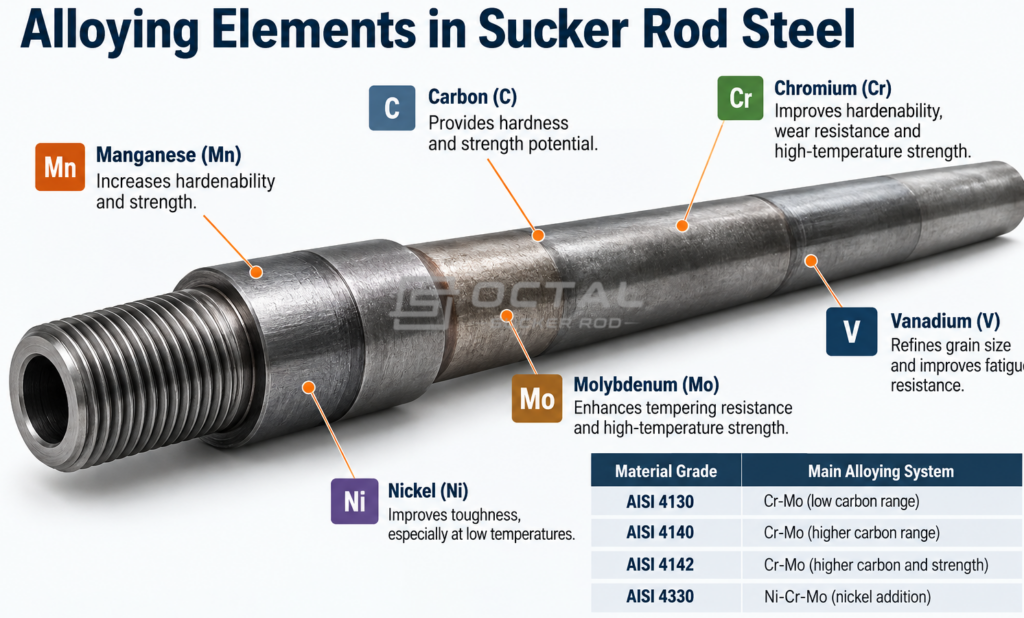
Function of Alloying Elements in Sucker Rod Steel
| Element | Metallurgical Function | Effect on Sucker Rod Material |
| Carbon (C) | Increases potential hardness and strength | Influences strength and toughness balance |
| Manganese (Mn) | Improves hardenability and supports deoxidation | Supports strength development |
| Chromium (Cr) | Improves hardenability | Supports heat-treatment response |
| Molybdenum (Mo) | Improves hardenability and tempering resistance | Helps maintain mechanical properties after tempering |
| Nickel (Ni) | Improves hardenability and can support toughness | Influences strength–toughness balance |
| Silicon (Si) | Supports deoxidation and strengthening | Contributes to steelmaking and mechanical properties |
| Vanadium (V) | Supports grain refinement and precipitation strengthening | Can improve strength with controlled processing |
| Phosphorus (P) | Residual element associated with embrittlement | Requires control for toughness |
| Sulfur (S) | Influences sulfide inclusion formation | Steel cleanliness affects fatigue-sensitive components |
How Chemical Composition Affects Finished Rod Quality
Steels with similar carbon content may develop different mechanical properties because alloying elements influence hardenability and microstructure during heat treatment. Steel cleanliness and surface condition also affect fatigue crack initiation under repeated loading.
Chemical composition alone does not determine finished sucker rod performance. The specified material must also meet the required mechanical properties, heat-treatment condition, and applicable API 11B product requirements.
Mechanical Properties of Sucker Rod Materials
The mechanical properties of sucker rod materials depend on steel chemistry, heat treatment, section size, and final manufacturing condition. In service, the rod body must carry axial loads while repeatedly cycling between maximum and minimum stress during pumping operations.
Yield strength, tensile strength, ductility, toughness, and fatigue resistance should be assessed together. A material capable of achieving high tensile strength may still perform poorly if its surface condition, connection geometry, corrosion resistance, or fatigue behavior is unsuitable.
Key Material Properties and Their Engineering Significance
| Property | Engineering Meaning | Relevance to Sucker Rod Performance |
| Yield Strength | Stress associated with the onset of plastic deformation | Helps assess resistance to permanent deformation under axial loading |
| Tensile Strength | Maximum engineering tensile stress during a tensile test | Indicates ultimate static tensile capacity |
| Elongation | Plastic deformation before fracture | Provides information about ductility |
| Reduction of Area | Reduction in cross-sectional area at fracture | Further indication of material ductility |
| Hardness | Resistance to localized indentation | Supports heat-treatment verification and selected damage assessments |
| Toughness | Resistance to fracture, including under conditions involving crack initiation or propagation | Relevant to material integrity and fracture susceptibility |
| Fatigue Resistance | Response to repeated or fluctuating stress | Important for long-term reciprocating loading |
| Corrosion-Fatigue Resistance | Fatigue behavior in a corrosive environment | Important where corrosion and cyclic stress occur together |
Conventional API 11B Sucker Rod Mechanical Properties
API 11B establishes finished-product requirements for applicable sucker rod classifications. The following ranges provide a conventional reference for commonly discussed steel grades.
| Finished Sucker Rod Grade | Minimum Yield Strength | Tensile Strength |
| Grade C | 60 ksi (414 MPa) | 90–115 ksi (621–793 MPa) |
| Grade K | 60 ksi (414 MPa) | 90–115 ksi (621–793 MPa) |
| Grade D Carbon | 85 ksi (586 MPa) | 115–140 ksi (793–965 MPa) |
| Grade D Alloy | 85 ksi (586 MPa) | 115–140 ksi (793–965 MPa) |
| Grade D Special | 85 ksi (586 MPa) | 115–140 ksi (793–965 MPa) |
These conventional sucker rod grades define finished-product strength ranges rather than the chemistry of a particular AISI steel.These are conventional grade reference values, not material-specific test results. Requirements must be checked against the applicable API 11B edition and purchase specification. Proprietary KD and High Strength products require their own verified property specifications.
AISI 4140, for example, should not be assigned the Grade D strength range solely because of its material designation. Finished rod mechanical testing must establish whether the supplied product satisfies the specified grade.
Material Strength and Fatigue Performance
Sucker rods experience repeated tensile loading as the pumping unit moves up and down. Material strength determines how much stress a rod can withstand before permanent deformation or fracture, while fatigue resistance describes its ability to withstand repeated loading without developing cracks. A steel with higher tensile strength does not always have better fatigue performance.
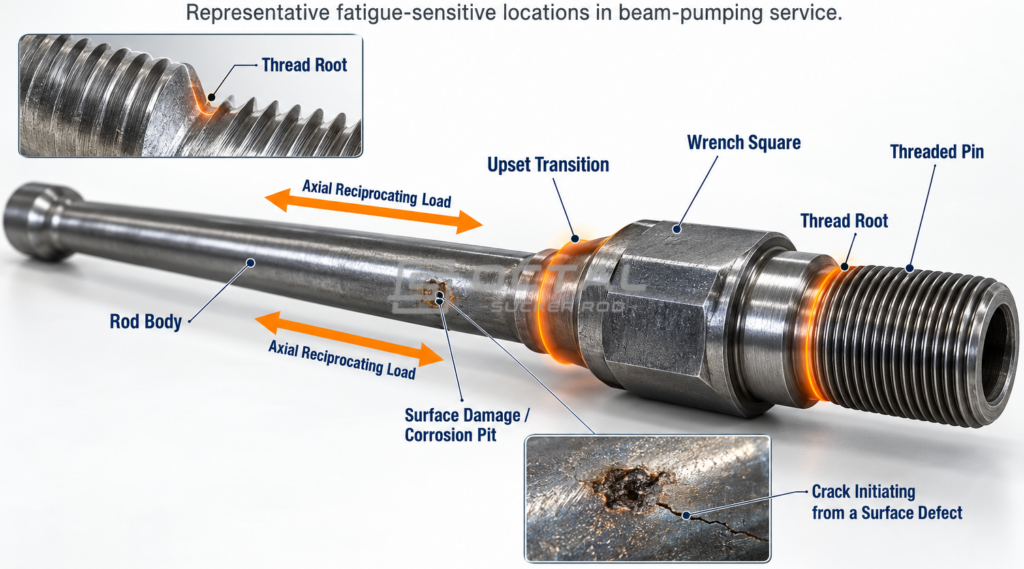
The following factors influence fatigue performance in sucker rod materials:
| Factor | Effect on Sucker Rod Performance |
| Material Strength | Determines resistance to excessive tensile loading, but higher strength alone does not guarantee longer fatigue life. |
| Cyclic Loading | Larger differences between maximum and minimum loads increase fatigue demand. |
| Heat Treatment | Controls the strength, hardness, and toughness of the finished steel. |
| Surface Condition | Scratches, corrosion pits, and manufacturing defects can initiate fatigue cracks. |
| Rod-End Geometry | Thread roots, upset transitions, and shoulder regions can concentrate stress. |
| Corrosion Exposure | Corrosive fluids can accelerate crack initiation and fatigue damage. |
Where Do Sucker Rod Fatigue Failures Commonly Occur?
Fatigue cracks may develop at thread roots, upset transitions, or damaged rod-body surfaces where local stresses are concentrated. For example, a corrosion pit or machining defect can become a crack initiation point under repeated pumping loads, even when the rod’s nominal tensile stress is below its yield strength.
For material selection, strength, toughness, surface quality, and corrosion conditions must be evaluated together. The selected steel and its heat-treatment condition should meet the required API 11B finished-product grade, while rod-end dimensions and connection compatibility must also be verified.
Sucker Rod Materials vs API 11B Grades
A common source of confusion in sucker rod specifications is the distinction between the steel designation and the finished-product grade.
AISI/SAE steel designations primarily identify a material’s chemical composition family. API 11B grades establish requirements for finished sucker rod products, including applicable mechanical and dimensional characteristics.An API 11B sucker rod must satisfy the applicable finished-product mechanical, dimensional, connection, and inspection requirements.
A particular alloy steel may be used in manufacturing a specified finished grade, but this relationship must be supported by the relevant production and inspection records.
Steel Material vs Finished Product Grade
| Item | Steel Material Designation | Finished Sucker Rod Grade |
| Example | AISI 4142 / 4142M | API 11B Grade D Alloy |
| Classification Basis | Steel chemistry and material specification | Finished rod product requirements |
| Principal Verification | Chemical analysis, steel identity | Mechanical properties and applicable product inspection |
| Processing Requirement | Specified material condition and manufacturing route | Finished product must satisfy required acceptance criteria |
| Documentation | Material certificate, heat number | Product tests, inspection, marking, traceability |
For example, an AISI 4142M Grade D Alloy sucker rod involves two separate specifications. The 4142M designation identifies the alloy material route, while Grade D Alloy identifies the required finished product classification. Both must be verified rather than treated as interchangeable terms.
Relationship Between Material and Finished Grade
| API Grade Family | Material Consideration | Main Acceptance Concern |
| Grade C | Suitable steel chemistry and processing route | Finished strength, ductility, dimensions |
| Grade K | Material qualified for the specified grade and application | Product properties and corrosion-service suitability |
| Grade D Carbon | Carbon-steel-based manufacturing route | Higher conventional Grade D strength requirements |
| Grade D Alloy | Alloy-steel-based manufacturing route | Finished strength and controlled mechanical properties |
| Grade D Special | Grade-specific material and manufacturing requirements | Compliance with the applicable product specification |
| KD / High Strength | Manufacturer- or product-specific material systems | Verified specification, qualification, and test requirements |
Corrosion-related product grades still require an assessment of the actual fluid composition and well conditions. A designation such as Grade K or KD should not be interpreted as unconditional suitability for sour service.
Sucker Rod Material Selection for Different Well Conditions
Sucker rod material selection should be based on the combination of axial loading, cyclic stress, corrosion exposure, well deviation, operating temperature, and connection design.
A higher-strength alloy can reduce the risk of static overload when properly specified, but it may not solve failures caused by corrosion pits, thread damage, bending, or poor rod-string configuration.
Material Selection by Well Condition
| Well Condition | Primary Material Concern | Selection Consideration | Data Required |
| Low-corrosion conventional well | Strength, fatigue, cost | Carbon steel or alloy steel meeting the required finished grade | Rod loads, diameter, operating cycles |
| Higher axial loading | Static strength and cyclic stress | Verify finished strength and fatigue demand rather than selecting by steel name alone | Maximum/minimum loads, rod-string design |
| CO₂-containing produced fluids | General/localized corrosion and fatigue interaction | Assess environment, corrosion control, and qualified material options | CO₂ partial pressure, pH, water chemistry, temperature |
| H₂S-containing fluids | Cracking susceptibility and corrosion fatigue | Review environmental qualification, hardness, strength and stress conditions | H₂S conditions, pH, temperature, stress, applicable requirements |
| Chloride-bearing produced water | Pitting susceptibility and corrosion-fatigue risk | Assess water chemistry, oxygen ingress, corrosion inhibition | Chloride concentration, dissolved oxygen, pH, temperature |
| Deviated wellbore | Rod bending, tubing contact, wear | Consider material properties together with guides, clearances, and rod-string layout | Deviation profile, side loads, tubing dimensions |
| High-frequency reciprocating operation | Cyclic fatigue | Review stress amplitude, surface quality and rod-end geometry | Pumping speed, load history, cycle range |
| PCP drive-string service | Combined axial loading and torque | Verify material, connection strength, torsional demand, and fatigue | Torque, axial loads, speed, coupling configuration |
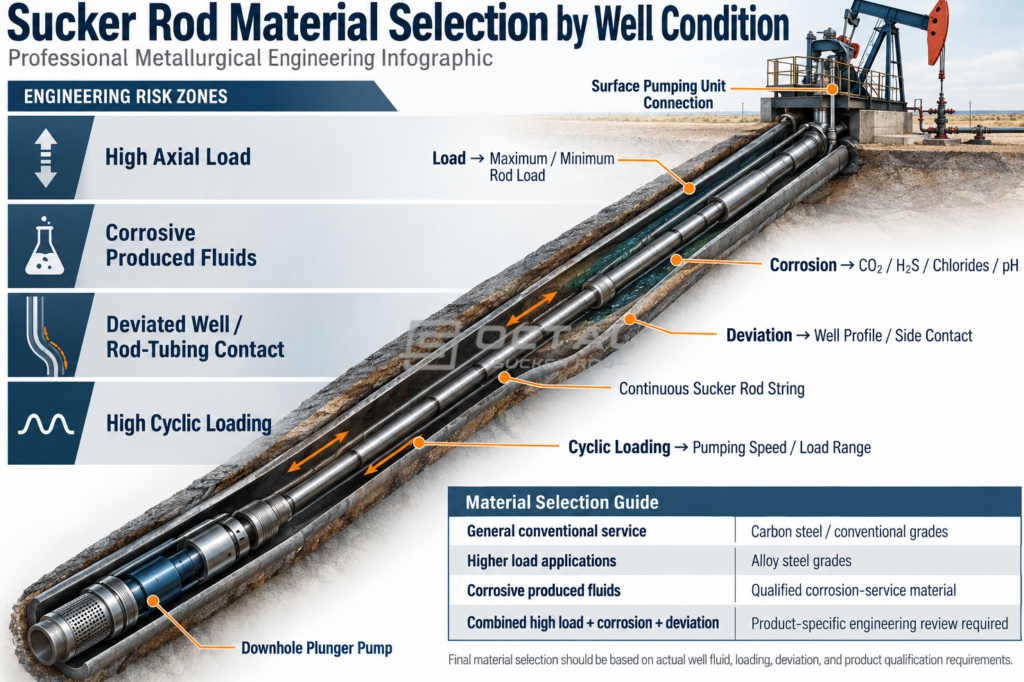
Corrosion and Material Selection
CO₂, H₂S, chlorides, dissolved oxygen, and produced-water chemistry can all affect carbon and low-alloy steel sucker rods.
CO₂ may cause general or localized corrosion in wet service, while H₂S can increase the risk of environmentally assisted cracking in susceptible steels. Chlorides and dissolved oxygen may further accelerate corrosion, depending on temperature, water chemistry, and operating conditions.
Material selection should therefore consider the actual fluid composition, hardness, stress level, temperature, and corrosion-control method. No conventional AISI steel grade should be treated as universally resistant to CO₂, H₂S, or chloride-containing service.
Rod Diameter and Material Loading
Rod diameter directly affects the cross-sectional area of the sucker rod and therefore the nominal stress generated by a given axial load.
| Nominal Rod Diameter | Diameter (mm) | Solid Body Area (mm²) |
| 5/8 in. | 15.875 | 197.9 |
| 3/4 in. | 19.050 | 285.0 |
| 7/8 in. | 22.225 | 388.0 |
| 1 in. | 25.400 | 506.7 |
| 1-1/8 in. | 28.575 | 641.3 |
Areas are theoretical values based on nominal solid rod-body diameter and do not include thread-root geometry or manufacturing tolerances.
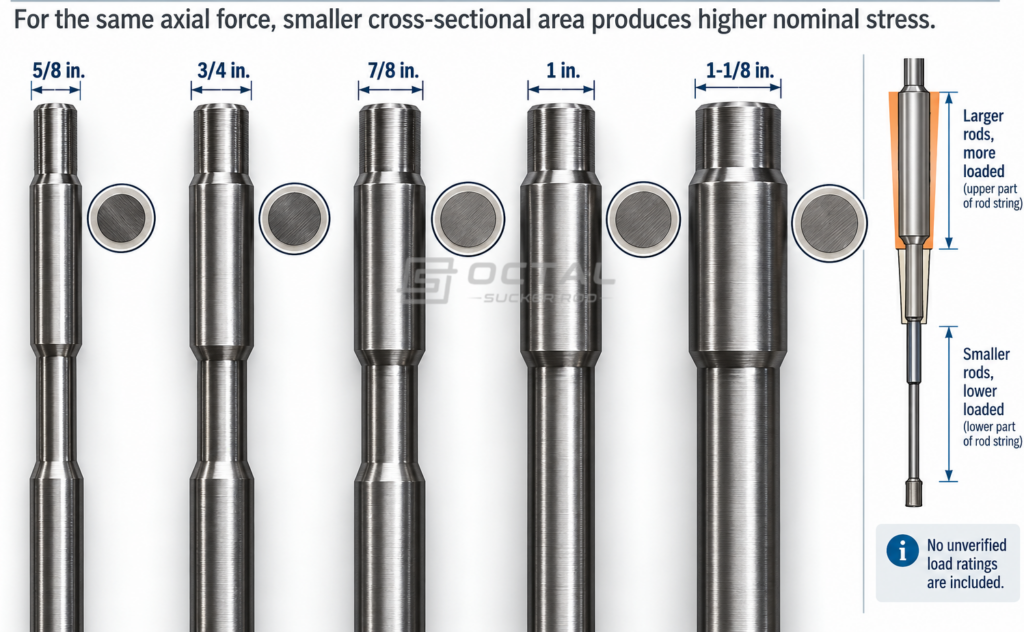
Under the same axial load, a smaller rod diameter produces higher nominal stress. Actual rod-string design must also consider dynamic loading, suspended rod weight, connection capacity, and well deviation.
Tapered rod strings use different diameters along the string to distribute load more efficiently. Final diameter selection should therefore be based on rod-string loading analysis rather than material strength alone.
Heat Treatment and Material Verification
Heat treatment is used to develop the required strength, hardness, toughness, and microstructure of sucker rod steel. Its effect depends on alloy composition, rod diameter, heating temperature, cooling rate, and the selected manufacturing route. Cr-Mo steels such as AISI 4130, 4140, and 4142 respond differently because of variations in carbon content and alloy chemistry.
The important point is not only how the steel is heat treated, but also how the finished condition is verified.
Heat-Treatment Processes and Verification
| Process / Item | Main Purpose | Verification Focus |
| Normalizing | Refines and controls the steel microstructure through air cooling after austenitizing | Heating temperature, soaking time, cooling condition |
| Quenching | Develops a hardened microstructure through controlled rapid cooling | Cooling rate, hardenability, distortion, cracking |
| Tempering | Adjusts hardness, strength, and toughness after quenching | Tempering temperature, holding time, final properties |
| Stress Relieving | Reduces residual stresses introduced during manufacturing | Temperature and previous processing condition |
| Mechanical Testing | Confirms the strength of the finished sucker rod | Yield strength, tensile strength, ductility |
| Hardness Testing | Checks the final heat-treated condition | Applicable product or project limits |
| Dimensional & Thread Inspection | Confirms rod size and connection geometry | Diameter, length, thread, shoulder, pin dimensions |
| Material Traceability | Links the finished rod back to the original steel heat or production lot | Heat number, MTC, lot identification, marking |
The heat-treatment route must match the specified steel material and finished-product requirements. Insufficient hardenability may cause differences between surface and core properties, while excessive hardness or inadequate tempering can reduce toughness and increase cracking susceptibility.
For finished sucker rods, the heat-treatment result should therefore be confirmed through mechanical tests, hardness measurements, dimensional inspection, and traceable production records rather than assumed from the steel designation alone.
Material Traceability
Steel Heat → MTC → Heat Treatment → Mechanical Testing → Final Inspection → Rod Marking & Packing
This traceability chain helps confirm that the specified material, processing condition, and finished-product test results belong to the same production heat or lot.
Sucker Rod Materials Ordering and Supply Review
Sucker rod orders should specify both the steel material and the finished-product requirements. AISI or SAE designation alone does not fully define the product, so buyers should also provide the required API 11B grade, rod diameter and length, connection type, inspection requirements, quantity, and delivery destination. For high-load, deviated, or corrosion-sensitive wells, operating loads, temperature, fluid composition, and corrosion conditions should also be included.
Octal can review these requirements before production to confirm the material and grade combination, connection compatibility, inspection documents, marking, packing, and delivery conditions.
FAQ
Can a sucker rod be ordered by AISI steel grade alone?
An AISI designation specifies the steel material but does not fully define the finished sucker rod. The purchase order should also identify the API 11B grade, diameter, length, connection, mechanical properties, inspection requirements, and applicable standard edition.
Can the same sucker rod steel material meet different API grades?
Potentially, depending on the material specification, heat-treatment route, manufacturing process, and finished-product qualification. The intended API grade must be demonstrated by the applicable mechanical tests and product inspections. A material certificate alone does not establish compliance with a particular finished grade.
What material information is needed when replacing existing sucker rods?
The purchaser should identify the existing rod grade, steel material if known, diameter, length, connection type, and operating conditions. Failure history, corrosion conditions, and rod loads are particularly useful when the replacement is intended to address recurring rod failures.
Does alloy steel automatically provide better corrosion resistance than carbon steel?
No. Chromium-molybdenum and nickel-chromium-molybdenum alloying can improve selected mechanical and heat-treatment properties, but conventional low-alloy steels are not universally resistant to CO₂, H₂S, chlorides, or corrosion fatigue. The actual fluid environment and material qualification must be reviewed separately.
What material certificates and inspection records should accompany sucker rods?
Documentation should include the applicable material certificate, heat or lot identification, finished mechanical test records, and product inspection records required by the purchase specification. Heat-treatment information, thread inspection, additional NDT, and third-party verification should be included when specified by the standard or purchase order.