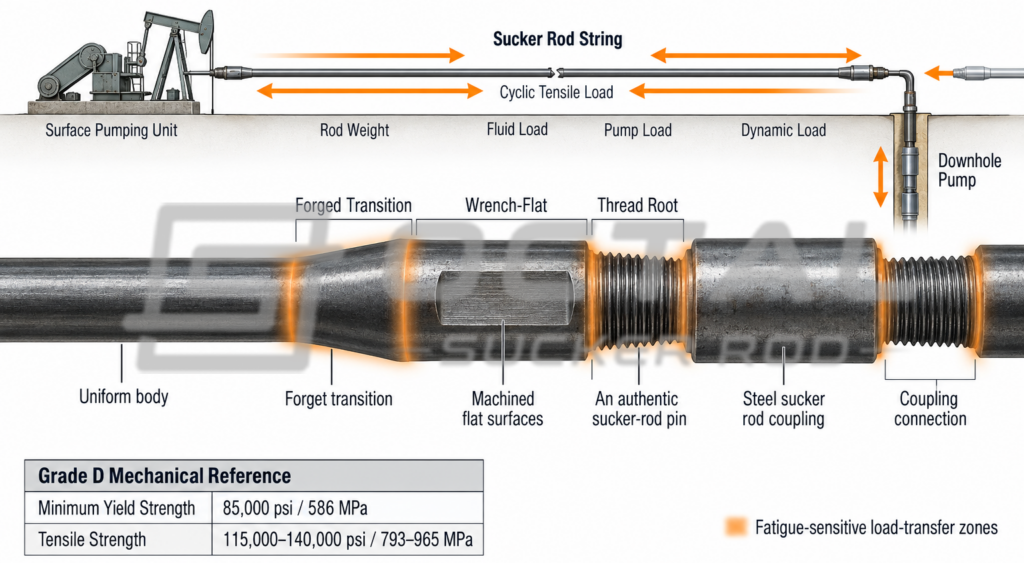
Grade D sucker rod (API 11B Grade D sucker rod) is a heat-treated steel rod-string component used in reciprocating rod-lift systems to transmit cyclic tensile load and reciprocating motion from the surface pumping unit to the downhole pump. Each rod consists of a steel rod body, forged or upset end sections, wrench flats, precision-machined threaded pins, and compatible sucker rod couplings that connect individual rods into a continuous string. During operation, the rod string carries its own weight together with fluid load, pump load, and dynamic stress generated during stroke reversal. Grade D is intended for higher mechanical loading than standard-strength Grade C, making it suitable for rod strings where calculated tensile and dynamic stresses require additional strength margin. Its selection still needs to consider corrosion condition, well deviation, tubing contact, and connection compatibility, because higher strength alone does not address corrosion or wear-related service risks.
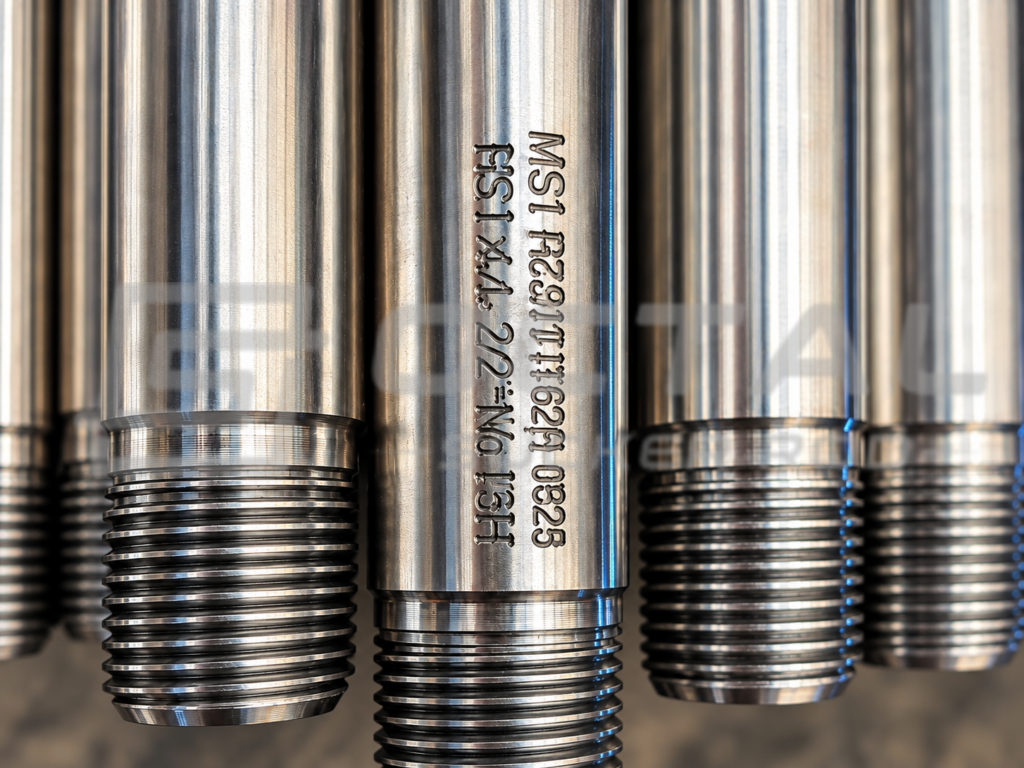
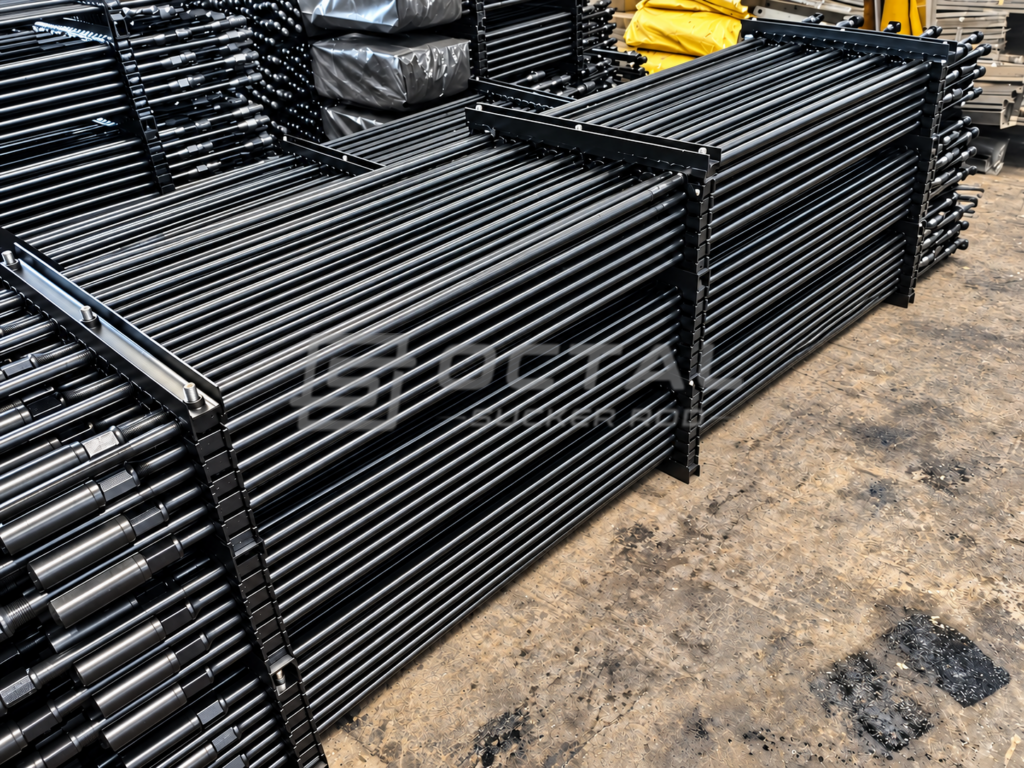
For Grade D, Octal’s current manufacturing reference specifies a minimum yield strength of 85,000 psi (586 MPa) and a tensile strength range of 115,000–140,000 psi (793–965 MPa). These values provide greater resistance to permanent deformation and tensile loading than Grade C while retaining the ductility required for repeated cyclic service. In practical selection, Grade D is therefore used where rod-string loading is the main design concern, while corrosion-resistant grades or coated rod options should be evaluated separately when produced-fluid corrosion or rod-to-tubing wear becomes the dominant service risk.
Grade D Sucker Rod Specifications
Grade D identifies the mechanical-performance level of the rod; it does not define one particular rod diameter or one universal steel chemistry. The same Grade D strength range can be applied to different nominal rod sizes, while diameter determines the rod-body cross-section and therefore affects the load carried by each section of the rod string.
| Specification | Grade D Reference |
| Product | Grade D Sucker Rod |
| Standard Basis | API Spec 11B |
| Strength Position | Higher-strength sucker rod |
| Minimum Yield Strength | 85,000 psi / 586 MPa |
| Tensile Strength | 115,000–140,000 psi / 793–965 MPa |
| Elongation, 200 mm | ≥13% |
| Reduction of Area | ≥50% — Octal manufacturing reference |
| Hardness | Material and heat-treatment specific |
| Common Nominal Rod Sizes | 5/8″, 3/4″, 7/8″, 1″, 1-1/8″ |
| Common Nominal Lengths | 25 ft / 7.62 m and 30 ft / 9.14 m |
| End Configuration | Forged end, wrench section and threaded pin |
| Coupling Options | Full-size or slim-hole, according to connection and service requirements |
The current API publication is API Specification 11B, 28th Edition, covering sucker rods and rod-related products. Purchase documents should identify the required edition, grade, rod size, length and connection configuration rather than referring only to “API sucker rod.”
Grade D Sucker Rod Mechanical Properties
The Grade D sucker rod mechanical properties are important because a rod string does not carry one constant static pull. During each pumping cycle, rod weight, fluid load, pump load and acceleration change the tensile stress in the string. Yield strength therefore determines the point at which permanent deformation becomes a concern, while tensile strength defines the higher end of material resistance before tensile failure.
| Mechanical Property | Octal Grade D Reference | Engineering Significance |
| Minimum Yield Strength | 85,000 psi / 586 MPa | Controls resistance to permanent deformation under high rod load |
| Minimum Tensile Strength | 115,000 psi / 793 MPa | Lower limit of Grade D tensile performance |
| Maximum Tensile Strength | 140,000 psi / 965 MPa | Upper limit of the specified tensile range |
| Elongation over 200 mm | ≥13% | Indicates retained ductility after heat treatment |
| Reduction of Area | ≥50% | Octal manufacturing reference for tensile ductility |
| Hardness | Material / heat-treatment specific | Used to verify heat-treatment and material consistency |
The Grade D table in the Octal manufacturing data does not assign one fixed HRC or HB hardness value. Hardness should therefore follow the approved raw-material and heat-treatment specification and remain traceable to the production heat and lot. Assigning a single universal hardness value to every Grade D sucker rod would ignore differences in steel route and heat-treatment practice.
The useful engineering difference between Grade C and Grade D is therefore not simply that Grade D is “harder.” Its defined advantage is the higher yield and tensile range. Hardness is primarily a manufacturing verification parameter unless a project specification sets a separate acceptance range.
Grade D Sucker Rod Sizes and Dimensional Control
For purchasing and replacement, Grade D sucker rod size refers to the nominal diameter of the straight rod body, not the outside diameter of the forged end, threaded shoulder or coupling. Octal’s current dimensional reference covers common rod-body sizes from 5/8 in. to 1-1/8 in., corresponding to nominal diameters from 15.88 mm to 28.58 mm. Each size has its own allowable rod-body tolerance, so dimensional acceptance should be based on the specified tolerance rather than the nominal size alone.
| Nominal Rod Size | Nominal Rod Body OD | Rod Body OD Tolerance |
| 5/8″ | 15.88 mm | +0.18 / −0.36 mm |
| 3/4″ | 19.05 mm | +0.20 / −0.41 mm |
| 7/8″ | 22.23 mm | +0.20 / −0.41 mm |
| 1″ | 25.40 mm | +0.23 / −0.46 mm |
| 1-1/8″ | 28.58 mm | +0.25 / −0.51 mm |
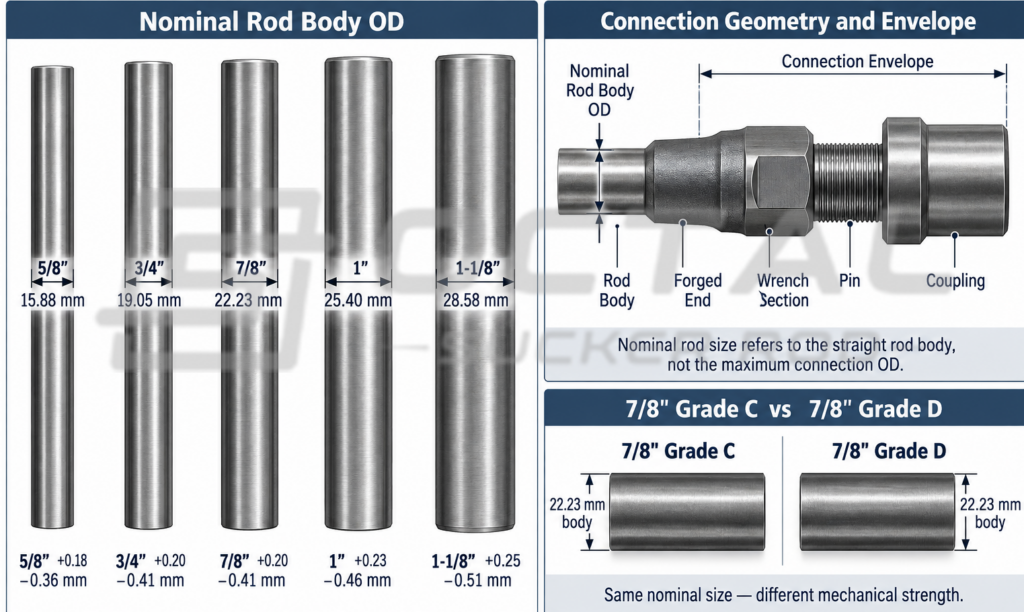
The rod diameter affects the steel cross-sectional area, rod-string weight and the load carried by each section of the string, while Grade D defines the mechanical-property range of the material. These are two separate selection factors. For example, a 7/8-in. Grade D rod has a nominal body diameter of 22.23 mm with a +0.20/−0.41 mm tolerance. A 1-in. Grade D rod increases the nominal body diameter to 25.40 mm, providing a larger cross-section, but it also adds rod weight and changes the dimensional envelope of the string. The correct size should therefore follow the rod-string design and calculated loading rather than simply selecting the largest available diameter.
This distinction is especially important in replacement work. A 7/8-in. Grade C rod and a 7/8-in. Grade D rod use the same nominal rod-body size, but their mechanical properties are different. Replacing Grade C with Grade D may retain the same body diameter while changing the strength level. Changing from 7/8 in. to 1 in., however, changes both the body diameter and the rod-string geometry, so the existing tubing clearance, coupling size and connection arrangement must also be checked.
Grade C vs Grade D and Grade K Sucker Rod
Grade C, D and K can use the same nominal sucker rod size system, but grade selection is determined by mechanical loading and service condition rather than rod diameter alone. In Octal’s current manufacturing reference, Grade D has a distinctly higher strength range, while Grade C and Grade K share a lower mechanical-property range but are selected for different service priorities.
| Grade | Minimum Yield Strength | Tensile Strength | Elongation | Reduction of Area | Main Selection Focus |
| Grade C | 60,000 psi / 414 MPa | 90,000–115,000 psi / 621–793 MPa | ≥13% | ≥50% | Moderate rod loading and controlled corrosion |
| Grade D | 85,000 psi / 586 MPa | 115,000–140,000 psi / 793–965 MPa | ≥13% | ≥50% | Higher calculated rod-string loading |
| Grade K | 60,000 psi / 414 MPa | 90,000–115,000 psi / 621–793 MPa | ≥13% | ≥50% | Greater emphasis on corrosion-related service conditions |
Values are based on the current Octal manufacturing mechanical-property reference. Final material route and service requirements should be confirmed for the project.
The numerical difference between Grade C and Grade D is substantial. Grade D increases minimum yield strength from 60,000 to 85,000 psi, a gain of 25,000 psi or about 42%. Its minimum tensile strength increases from 90,000 to 115,000 psi, while the upper tensile limit rises from 115,000 to 140,000 psi. This additional strength margin is the main reason Grade D is selected when calculated rod-string tensile and dynamic loads are higher.
The higher strength does not come from simply increasing rod diameter. For example, a 7/8-in. Grade C rod and a 7/8-in. Grade D rod both use a 22.23 mm nominal rod body, but Grade D provides the higher mechanical-property range. This allows the engineer to change the strength level without automatically changing the nominal rod size, provided the existing connection and load calculations remain suitable.
Grade K should be treated differently. In the current Octal reference, its yield and tensile values are similar to Grade C, so its main distinction is service selection related to corrosion behavior and produced-fluid conditions, not higher mechanical strength. Grade D therefore addresses higher mechanical loading, while Grade K places more emphasis on the corrosive environment.
For purchasing, the grade should match the dominant risk: use Grade D when calculated mechanical load requires more strength margin; use Grade C where loading remains moderate; and evaluate Grade K or other corrosion-resistant solutions when fluid corrosion becomes the controlling condition. A higher grade alone does not correct corrosion, rod-to-tubing wear or poor connection compatibility.
Grade D Sucker Rod Connection and Coupling Compatibility
The sucker rod connection carries the same cyclic tensile load that passes through the rod body, so pin and coupling compatibility is part of the Grade D load path rather than a separate accessory issue. Each coupling connects two threaded rod pins, and its nominal size corresponds to the nominal sucker rod size. Octal’s current reference includes full-size, slim-hole, reducing and slim-hole reducing coupling configurations, with Grade T and Grade SM coupling options available according to the required service condition.
| Rod Size | Full-Size Coupling OD | Slim-Hole Coupling OD | Nominal Coupling Length |
| 5/8″ | 38.10 mm | 31.80 mm | 101.6 mm |
| 3/4″ | 41.28 mm | 38.10 mm | 101.6 mm |
| 7/8″ | 46.00 mm | 41.30 mm | 101.6 mm |
| 1″ | 55.60 mm | 50.80 mm | 101.6 mm |
| 1-1/8″ | 60.33 mm | 57.15 mm | 114.3 mm |
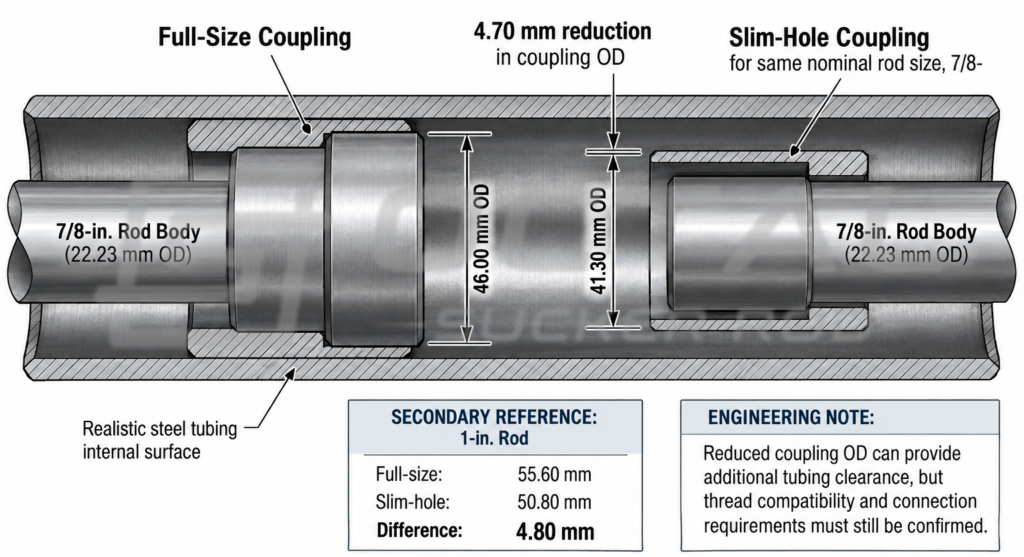
The difference between full-size and slim-hole couplings becomes important where tubing clearance or rod-to-tubing contact is limited. For example, a 7/8-in. full-size coupling has a 46.00 mm OD, while the slim-hole version reduces the OD to 41.30 mm. For a 1-in. rod, the corresponding coupling OD changes from 55.60 mm to 50.80 mm. The reduced outside diameter can provide additional clearance, but the final selection still has to match the rod thread and required connection arrangement.
For reducing couplings and slim-hole reducing couplings, Octal’s reference states that the outside diameter and length are determined by the larger thread size. This should be checked when different connection sizes are joined in the same rod string so that the selected coupling matches both the thread combination and the available tubing space.
Grade D Rod Load and Service Conditions
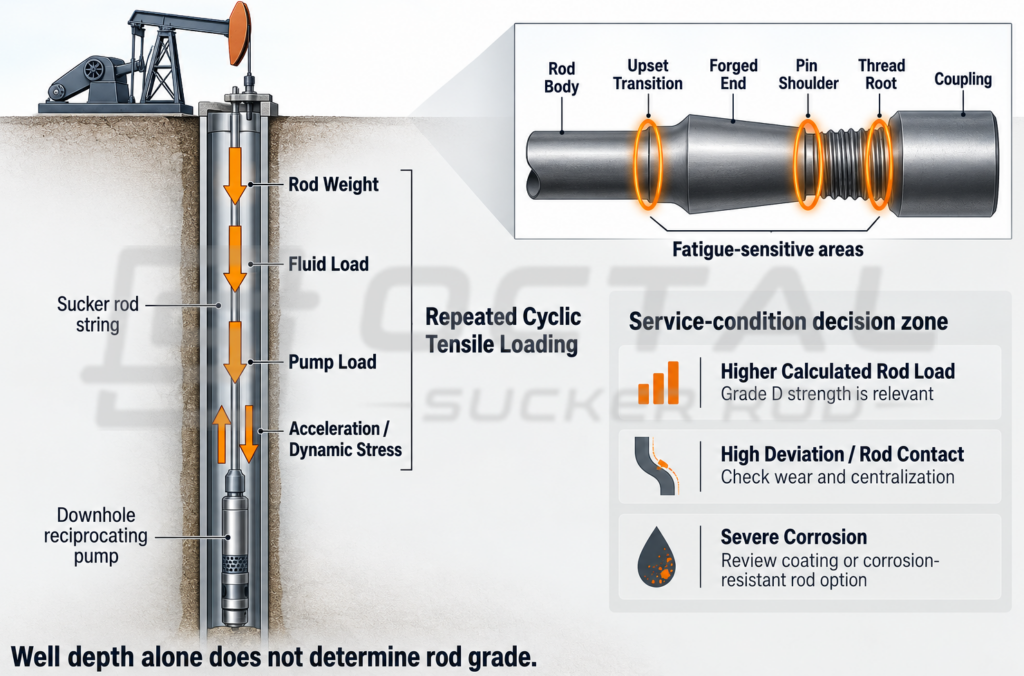
Grade D is selected mainly when the rod string needs more mechanical strength than Grade C can provide. In actual operation, the rod carries not only its own weight, but also fluid load, pump load and dynamic stress generated during every stroke.
- Higher rod-string load: Grade D is suitable when calculated tensile and dynamic loads approach the operating limit of a standard-strength rod. The higher yield and tensile range gives more strength margin under repeated cyclic loading.
- Fatigue-sensitive areas: The upset transition, forged end, pin shoulder, thread root and coupling deserve particular attention because these areas carry the load through changes in section and connection geometry. Damage or poor machining here can shorten fatigue life even when the rod body itself is strong enough.
- Conditions needing additional review: High deviation, severe corrosion and frequent rod-to-tubing contact should not be solved by selecting a stronger grade alone. These conditions may require centralizers, coating or another material route in addition to Grade D strength. Octal’s sucker rod range also includes coated and corrosion-resistant options for these service conditions.
Selection point: well depth alone does not determine whether Grade D is required. Rod weight, pump load, fluid condition, stroke behavior and rod-string configuration should be checked together.
Grade D Sucker Rod Material and Heat Treatment
Grade D does not refer to one fixed steel chemistry. The selected carbon or alloy steel must be suitable for heat treatment and capable of reaching the required Grade D yield strength, tensile strength, and ductility after manufacturing. Material grades such as 4130, 4138M, or 4320 may appear in different supplier specifications, but they should not be treated as the universal definition of Grade D.
Heat treatment is one of the main controls behind Grade D performance. Octal’s cooperative manufacturing base uses quenching and tempering lines with independently controlled heating zones and thermocouples to improve heating uniformity and help maintain stable mechanical properties across the rod body.
For procurement and inspection, the finished rod should be accepted by its actual test results rather than by the steel name alone. Yield strength, tensile strength, hardness, straightness, and heat-treatment records should remain traceable to the corresponding material heat and production lot.
Manufacturing and Inspection Control
Grade D sucker rod production requires consistent control of forging, heat treatment, straightening, machining and thread geometry. Octal’s cooperative manufacturing base uses an 800-ton horizontal forging machine, an 800-ton hydraulic upsetting unit and a 1,000-ton hydraulic straightening machine, together with dedicated heat-treatment and connection-processing equipment to maintain forged-end geometry, rod straightness and mechanical-property consistency.
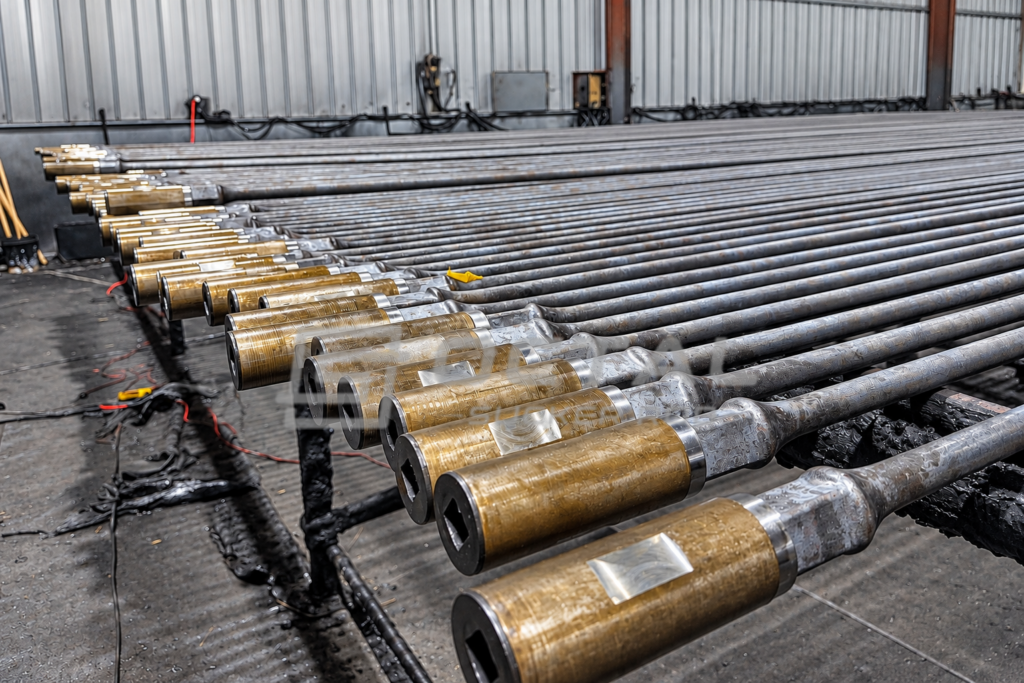
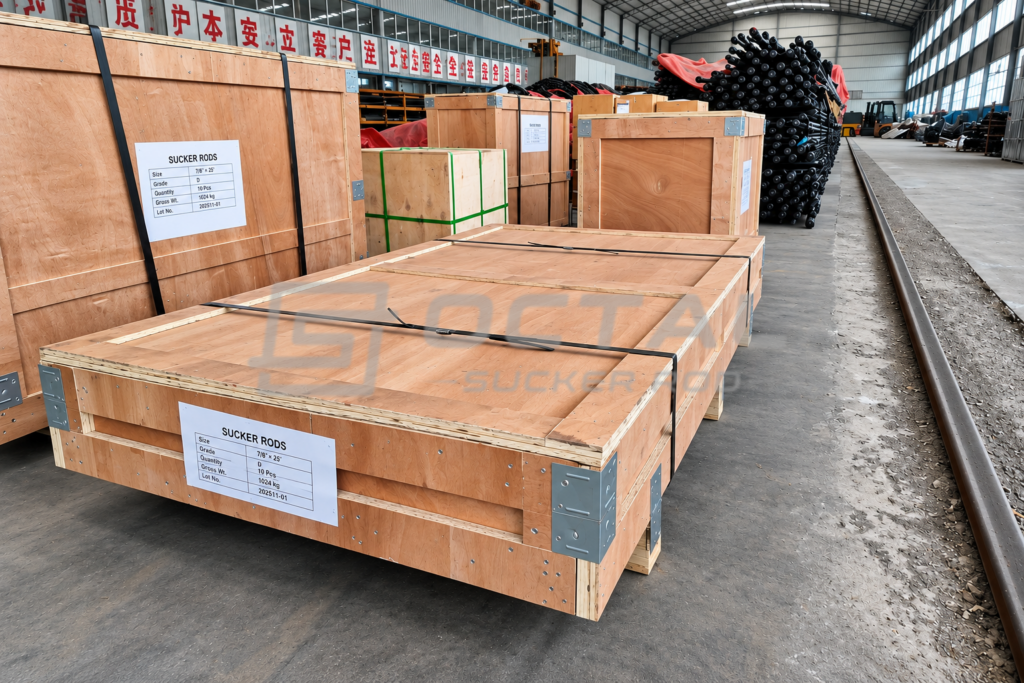
Finished rods are verified through tensile, impact, hardness and metallographic testing, together with dimensional and thread inspection. Mechanical test results, material heat numbers, heat-treatment records, dimensional checks, marking and packing information can be linked to the production lot, providing traceability from raw material to final shipment.
Grade D Sucker Rod Ordering, Supply and Inspection
For Grade D sucker rod orders, the purchase specification should confirm the grade, nominal rod diameter, length, pin/thread configuration, coupling type, service condition and inspection requirements rather than identifying the rod by size alone. Octal can supply Grade D sucker rods together with compatible couplings, pony rods, sinker bars and other rod-string components, with manufacturing covering forging, heat treatment, straightening, machining and inspection. Mechanical test results, dimensional checks, heat-treatment records and production-lot traceability can be provided according to project requirements, helping ensure that replacement rods match both the required strength level and the existing rod-string connection configuration.
FAQ
Can a Grade D sucker rod replace a Grade C rod of the same diameter?
The body diameter may be the same, but the grades have different mechanical properties. Replacement should also confirm calculated rod loading, length, pin/thread configuration, coupling type and service condition.
Is Grade D sucker rod made from one specific steel grade?
No single steel chemistry should be treated as the universal definition of Grade D. The approved material and heat-treatment route must produce the required Grade D mechanical properties and meet the applicable manufacturing specification.
Why is hardness not listed as one fixed value for Grade D?
The current Octal Grade D mechanical table specifies yield strength, tensile strength, elongation and reduction of area but does not assign one universal Grade D HRC or HB value. Hardness should follow the approved material and heat-treatment specification and be traceable to the relevant production lot.
What should be checked when ordering a Grade D sucker rod coupling?
Confirm the rod size, pin/thread configuration, coupling type, required connection strength and tubing clearance. Full-size and slim-hole couplings have different outside diameters, so dimensional fit should be checked before replacement or new-string assembly.